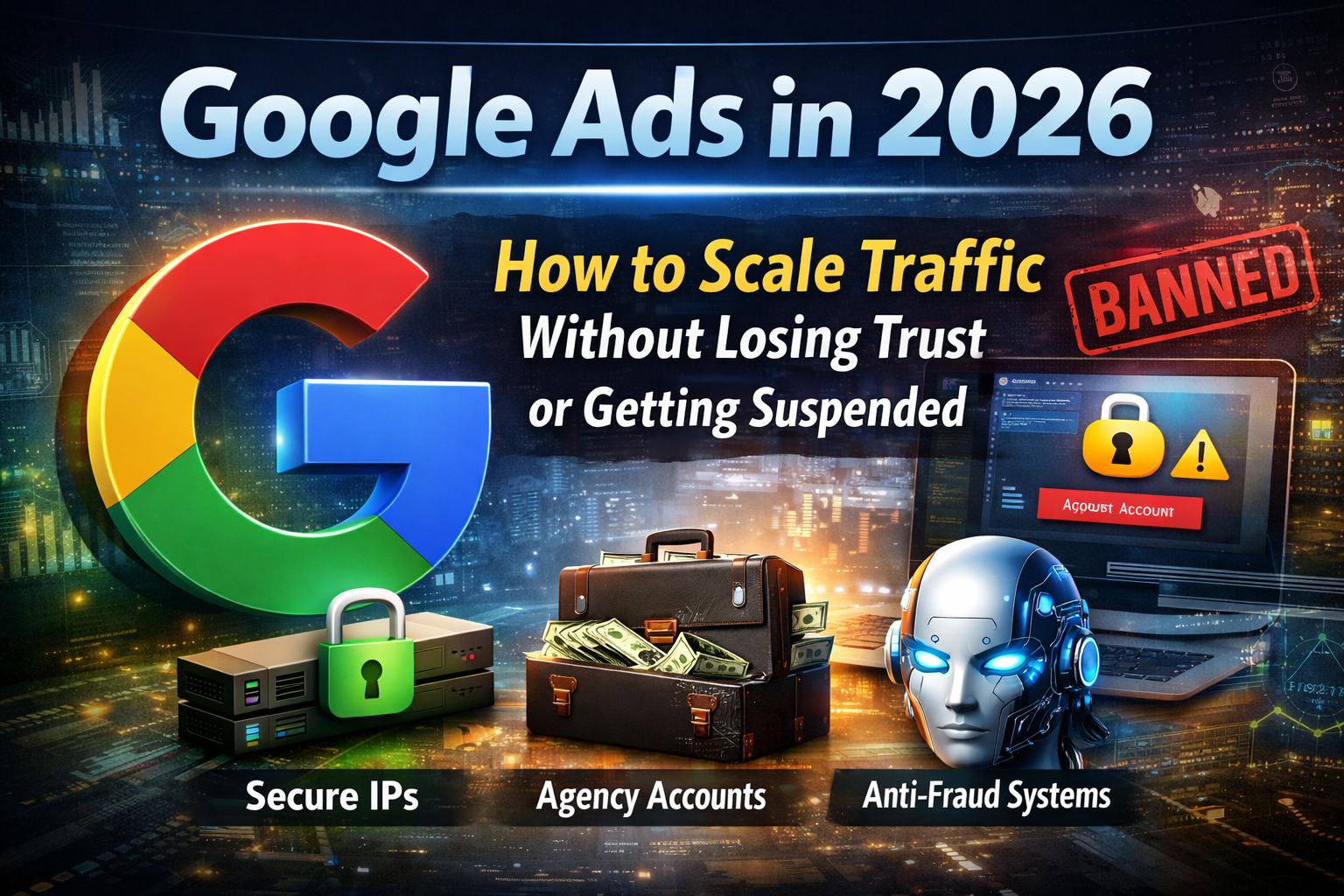
Google Ads in 2026: How to Scale Traffic Without Losing Trust or Getting Your Account Suspended
In 2026, working with Google Ads has truly become an engineering task. Moderation algorithms, anti-fraud systems, and Google’s machine learning models analyze not only creatives and landing pages, but the entire advertiser infrastructure: account history, payment discipline, IP environment, and behavioral patterns inside the interface.
If scaling once meant simply increasing budgets and duplicating funnels, today the key factor is maintaining account trust. Losing Google’s trust doesn’t just lead to ad disapprovals — it can result in a complete shutdown: suspension of the advertising account, payment profile, or even the MCC structure.
The core question of 2026 is no longer “How do we launch more campaigns?” but rather “How do we scale in a way that algorithms perceive as natural growth?”
What Google Ads Trust Really Means — and Why It Matters More Than Budget
Trust is a composite credibility score that Google assigns to an account. It isn’t visible in the interface, but it directly affects:
- Review speed
- Delivery stability
- Spending limits
- Frequency of manual checks
- Suspension probability
Trust is influenced by multiple categories of signals:
| Signal Group | What Google Evaluates |
| Account History | Age, budget consistency |
| Financial Behavior | Payment stability, absence of chargebacks |
| Behavioral Patterns | Editing logic, frequency of changes |
| Technical Environment | IP consistency, devices, login patterns |
| Ad History | Rejection ratio, vertical categories |
A sudden budget increase or vertical shift without infrastructure preparation is often interpreted as a risk signal.
This is why agency Google Ads accounts with history and credit lines are significantly more valuable in 2026 than fresh self-registered accounts — they already carry baseline trust.
Why Google Suspends Accounts During Scaling
Most suspensions are not caused by the offer itself, but by inconsistencies between the account’s historical behavior and its new activity.
Key risk triggers include:
- Sudden budget spikes
- Geo expansion without gradual growth
- Launching a new vertical too quickly
- Technical overlap between accounts
Google actively analyzes relationships between accounts. If multiple ad accounts are accessed from the same technical environment, devices, or IP addresses, a network pattern is formed. If one account is suspended, connected accounts may also face restrictions.
Financial infrastructure is also under stricter monitoring. Mismatch between account country, payment profile, and technical login environment often leads to additional verification.
Google’s anti-fraud systems evaluate not only the ad — but the context of its launch.
Scaling Infrastructure: Why Technical Consistency Is Critical
Stable scaling requires environmental consistency. Frequent IP changes, logins from multiple countries, or low-trust server IP usage reduce credibility.
In 2026, IP trustworthiness plays a significant role in ad account stability. If access occurs through datacenter IPs or low-quality proxies, it may be interpreted as masking behavior.
When managing multiple accounts, using stable mobile IP addresses with high trust levels significantly reduces technical triggers. Infrastructure built on dedicated 4G/5G devices with real SIM cards appears to Google as standard user behavior.
Solutions like Coronium.io provide dedicated mobile IP infrastructure without device sharing, helping reduce anti-fraud triggers when operating multiple Google Ads accounts.
This is not about bypassing the system — it’s about creating an environment that doesn’t look suspicious.
Agency Accounts as a Risk Management Tool
In 2026, renting agency Google Ads accounts is not merely convenient — it’s strategic risk management.
Their advantages include:
- Established performance history
- Verified payment discipline
- Credit lines
- Higher baseline trust
However, even agency accounts can be lost if mismanaged. Sudden vertical shifts or chaotic scaling will still reduce trust.
Agency accounts provide the opportunity to grow gradually instead of restarting from zero after every suspension.
How to Scale Budgets Without Triggering Reviews
Google monitors spending dynamics. If an account consistently spends $500 per day and suddenly jumps to $10,000, automated review systems are likely to activate.
A safer scaling model looks like this:
| Scenario | Algorithm Reaction |
| Gradual budget increase | Perceived as organic business growth |
| Sudden spike | Triggers review mechanisms |
| Expansion within same geo | Lower risk |
| Simultaneous multi-geo launch | Elevated scrutiny |
Creative testing should also be gradual. Uploading dozens of similar ads at once often results in automatic disapprovals.
9 Hidden Reasons for Google Ads Suspensions in 2026
Google’s anti-fraud systems operate deeper than most advertisers realize. Below are under-discussed but increasingly common risk factors.
1. Sudden Behavioral Shift
It’s not the vertical change itself that’s risky — it’s the absence of gradual transition.
2. Geo–Infrastructure Mismatch
Account country, payment profile, and login IP region must logically align.
3. Cross-Account Technical Overlap
Shared IPs, devices, and browser fingerprints create network associations.
4. Abnormal Budget Velocity
Especially dangerous for new accounts without spending history.
5. Frequent Billing Changes
Card replacements, failed payments, or inconsistent billing details reduce trust.
6. Repeated Launch Templates
Identical campaign structures across multiple accounts create detectable network patterns.
7. Unstable IP Environment
Constant IP rotation or datacenter usage lowers environmental consistency.
8. Chaotic Account Management
Dozens of rapid edits or constant campaign toggling signals instability.
9. MCC Cascade Effect
A severe violation in one account may affect the entire MCC hierarchy.
Why These Factors Matter More in 2026
Google increasingly relies on machine learning anomaly detection. The system evaluates probability of risk — not just direct policy violations.
Algorithms assess whether an account behaves like a sustainable business or a temporary scheme.
Infrastructure consistency, financial discipline, and technical stability now matter as much as creative compliance.
Conclusion: Scaling as a Controlled System
Google Ads in 2026 demands a systemic approach.
Without a stable technical environment, predictable behavioral patterns, and disciplined budget management, scaling becomes high-risk.
Operating through stable agency accounts, increasing budgets progressively, and maintaining independent infrastructure — including high-trust mobile IP solutions — allows for controlled and sustainable growth.
Final Takeaway
Google Ads in 2026 is a trust-based ecosystem.
Safe scaling requires:
- Stable agency accounts
- Financial discipline
- Gradual budget increases
- Independent technical environments
- High-trust IP infrastructure
Scaling is no longer about aggressive growth. It’s about system management — aligning risk, infrastructure, and behavioral consistency into a unified strategy.