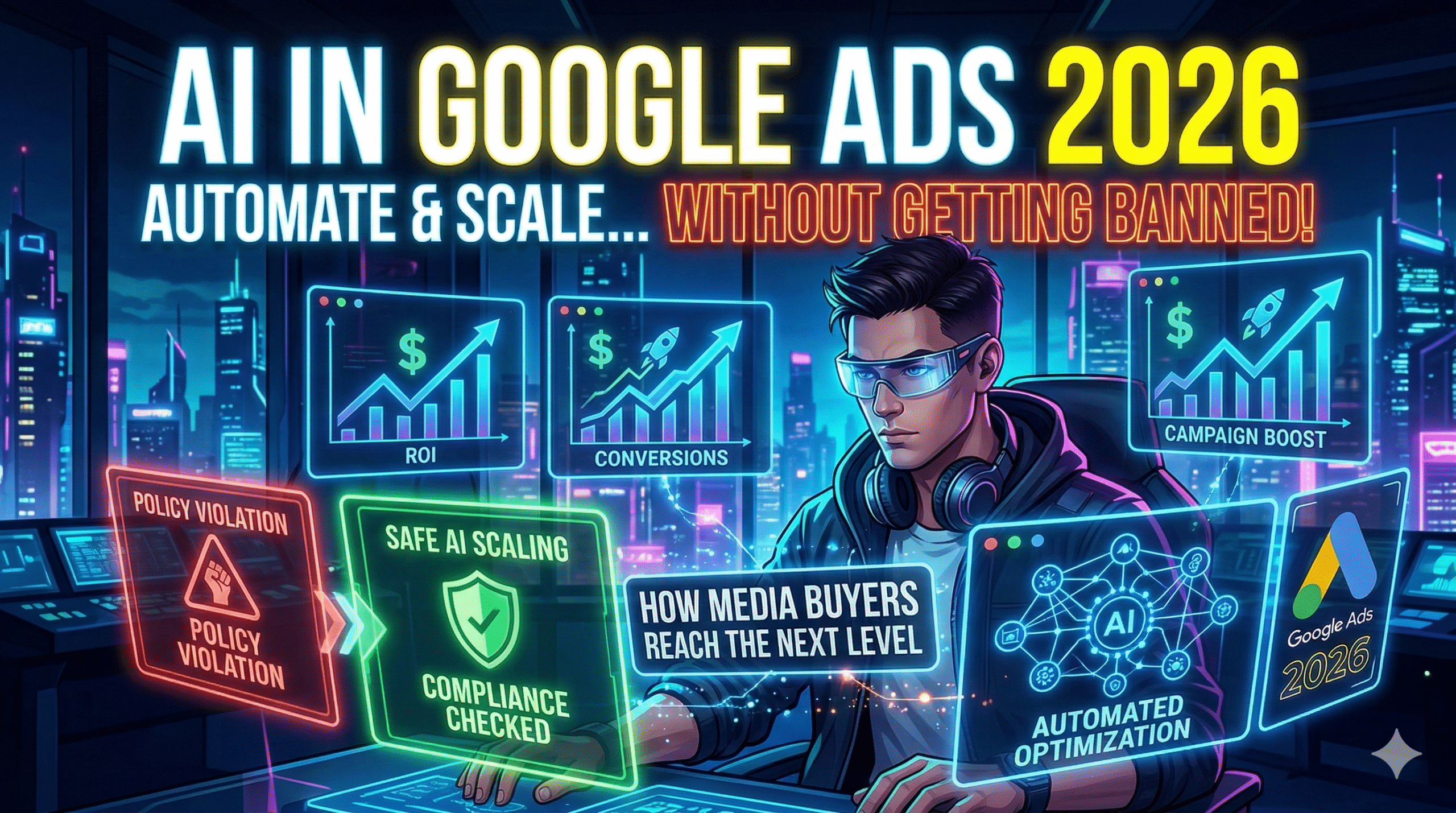
AI IN GOOGLE ADS 2026: HOW MEDIA BUYERS CAN AUTOMATE CAMPAIGNS AND REACH THE NEXT LEVEL (WITHOUT GETTING BANNED)
Introduction: Why AI Is No Longer the Future — It’s Your Reality Right Now
If you’re still setting bids manually, writing ad copy in a notepad, and optimizing campaigns “by feel” — welcome to 2019. In 2026, Google Ads is essentially an AI platform with an advertising interface layered on top. And if a media buyer hasn’t learned to work with Google’s AI tools to their advantage, they’re simply losing ground to those who have.
The good news: AI in Google Ads isn’t just a threat in the form of smart filters and aggressive moderation. It’s also a powerful set of tools for scaling, optimization — and, with the right approach, protecting your accounts from bans.
In this article we’ll cover:
- Which Google Ads AI tools actually work in arbitrage in 2026
- How to use Smart Bidding and automated strategies without losing control
- Why AI simultaneously bans accounts and helps protect them
- How agency accounts amplify the effect of AI automation
- Practical campaign structures and strategies that work right now
Part 1. What Has Changed: AI Has Completely Taken Over Google Ads
Google Is No Longer an Ad Network — It’s an AI Monetization Machine
In 2026, Google’s algorithms automatically process over 99% of all decisions within the platform. This includes:
- Real-time auction — AI determines your actual bid, position and cost-per-click based on hundreds of signals simultaneously
- Audience targeting — the algorithm independently expands and narrows reach based on behavioral data
- Creative generation — through Responsive Search Ads and Performance Max, Google automatically tests combinations of headlines, descriptions and images
- Bid optimization — Smart Bidding strategies analyze conversion patterns and adjust bids in real time
For a media buyer this means one thing: trying to operate in “manual mode” while ignoring AI tools isn’t control. It’s losing money.
The Dual Role of AI: Ally and Enemy at the Same Time
Here’s the paradox that only experienced media buyers understand: the same AI that bans your accounts for “Circumventing Systems” and “Suspicious Payments” can work for you — if you learn to feed it the right data.
Google’s AI learns from patterns. Good patterns (stable traffic, quality conversions, predictable behavior) = trust = fewer bans and better auction positions. This is exactly why account warm-up and proper campaign structure aren’t just “rules of the game” — they’re the way you speak to AI in its own language.
Part 2. Google Ads AI Tools for Media Buyers: What Actually Works
2.1. Smart Bidding: Stop Losing Money on Bids
Smart Bidding is a set of automated bid management strategies powered by machine learning. In 2026, four of them are most relevant for arbitrage:
Target CPA (Target Cost Per Acquisition) Ideal for offers with a clearly measurable action — a lead, registration, or app install. Google automatically adjusts bids to achieve a set conversion cost. Works well with at least 30–50 conversions in the campaign over the past 30 days.
Practical tip: don’t set an overly aggressive CPA at launch. Give the algorithm time to “learn” — for the first two weeks, work with a higher target CPA, then gradually reduce it by 10–15% every 5–7 days.
Target ROAS (Target Return on Ad Spend) Optimal for e-commerce offers and nutra with a clear margin. The system maximizes conversion value at a given ROAS. Requires more data — at least 50+ conversions with value over 30 days.
Maximize Conversions An excellent choice for launching new campaigns and warming up accounts. The algorithm spends the budget as efficiently as possible to get the maximum number of conversions. Doesn’t require historical data — suitable for fresh accounts.
Maximize Conversion Value An advanced version of the above — optimizes not for quantity but for total conversion value. Pairs perfectly with Performance Max.
Key insight for media buyers: Smart Bidding works better the higher the quality of conversion data you pass to Google. If you’re sending traffic to a white page while the actual conversion happens on the offer landing page — set up tracking via Google Tag Manager or server-side event sending. The more accurate the signal, the smarter the AI works in your favor.
2.2. Performance Max in 2026: How to Control the “Black Box”
Performance Max has become a mandatory tool — Google actively pushes it by limiting the capabilities of standard campaign types. But for a media buyer, PMax is simultaneously an opportunity and a minefield.
Why PMax is dangerous without proper setup:
- The algorithm decides on its own where and to whom to show ads — without proper control it can “drift” into non-target placements and audiences
- PMax actively uses conversion data for learning — bad signal = bad learning = wasted budget
- Moderation in PMax works differently: ads may pass review, then a week later the campaign is blocked
How media buyers work with PMax in 2026:
Step 1. Managing audience signals Upload your own audiences (lookalikes from converted users, email lists) as “signals” — this isn’t hard targeting, but a hint to the algorithm about who to focus on.
Step 2. Quality Asset Groups Create multiple Asset Groups with different angles. Don’t let Google fill in the gaps in your creatives — upload the maximum number of images, headlines and descriptions that you control.
Step 3. Exclusions via Placement Exclusions Through the Google Ads API or account manager, you can add placement exclusions — remove junk traffic from mobile apps that generate clicks without conversions.
Step 4. Separating PMax and Search Never mix “hot” Search and PMax on the same keywords in one account. PMax’s priority on overlaps can cannibalize your best search campaigns.
2.3. Responsive Search Ads and AI Text Generation: What You Need to Control
Google killed Expanded Text Ads (ETAs) long ago and switched everyone to RSA. In RSA you upload up to 15 headlines and 4 descriptions, and the algorithm tests combinations and determines “winners” on its own.
What this means for a media buyer:
On one hand, it saves time on A/B testing. On the other — you lose control over the specific wording the user sees.
A practical approach that works:
- Pin key elements — your call to action, the offer’s USP — to specific positions using the “Pinned” setting. This way the algorithm preserves your control over critical elements.
- Write headlines with different “temperatures” — from informational to transactional. The algorithm will automatically match the right “temperature” to the user’s search intent.
- Monitor your ad strength: “Poor” strength is a signal to revise. “Excellent” strength doesn’t guarantee passing moderation based on topic.
2.4. Demand Gen Campaigns: A New Scaling Tool
In 2024–2025, Google replaced Discovery campaigns with Demand Gen. In 2026 this is one of the most underrated tools for media buyers.
Demand Gen runs on YouTube (including Shorts), Gmail and the content network with a focus on interest and intent-based audiences. AI independently optimizes impressions for the “top of funnel” — demand generation.
For media buyers this opens up opportunities in niches where Search delivers expensive traffic: nutra, finance, iGaming (in permitted geos). Demand Gen on a “warmed up” account with a solid history allows you to scale volume at a lower CPM than pure YouTube.
Part 3. AI vs. the Media Buyer: Why Accounts Get Banned and How to Protect Yourself
3.1. How Google’s AI Detects Arbitrage Patterns
Google’s moderation system in 2026 is a multi-layered AI detector that analyzes:
Infrastructure signals:
- IP address and its usage history
- Payment card and transaction history
- Account registration pattern (form-filling speed, device type, browser fingerprint)
Behavioral signals:
- Budget growth rate after campaign creation
- Sudden changes in campaign structure
- Mismatch between the ad content, the white page and the actual landing page
Conversion signals:
- Abnormally high or abnormally low CTR
- Non-standard conversion patterns (all conversions at night, all in one region)
- Discrepancy between the stated topic and user behavior
Content signals:
- Ad text containing trigger words for specific verticals
- Mismatch between the display URL and the final URL
- Historical domain reputation
3.2. Protection Strategy: How to “Speak” to AI in Its Language
Understanding how the detector works allows you to build the right infrastructure:
Principle 1: Consistency and Predictability AI trusts predictable patterns. A sudden campaign launch from zero budget to $10,000/day is a red flag. Gradual scaling (budget increase of no more than 20–30% per day) is a sign of a “normal” advertiser.
Principle 2: Clean Infrastructure Each new account is a new “identity” with its own IP, browser profile, payment method and device. Mixing infrastructure across different accounts is the most common cause of linked bans.
Principle 3: Conversion Data Quality Pass real conversion signals to Google. Fake conversions “break” the algorithm’s training and create anomalies that are easy to detect.
Principle 4: Account Trust as an Asset An account with history isn’t just a “place to run ads.” It’s accumulated trust that reduces moderation aggressiveness. This is exactly why agency accounts with 2–5+ years of history unlock possibilities unavailable to self-registered accounts.
Part 4. Why Agency Accounts + AI Automation = The Perfect Combo for 2026
4.1. Trust as the Foundation of AI Learning
Here’s a fact that changes everything: Google’s AI learns from data within a specific account. An account with two years of campaign history, stable budget spend and “clean” conversions — this is fertile ground for AI algorithms.
When you launch Smart Bidding on a fresh self-registered account — the algorithm has nothing to analyze. The first 2–4 weeks the system is “learning” — during this time you’re spending money without getting optimized results.
On an agency account with history, the algorithm starts already “warmed up” — Smart Bidding kicks in significantly faster, auction quality is higher, and CPA is lower from day one.
4.2. Moderation Resilience — Critical When Working with AI
Performance Max and Demand Gen are highly automated campaign types. They work great, but require time to learn (a minimum of 6–8 weeks of stable operation without sudden changes).
If the account gets banned during the learning phase — all accumulated progress is lost. Starting over on a new account begins from scratch.
Agency accounts with high trust pass moderation more smoothly — the algorithm treats “verified” advertisers differently than new ones. This means your PMax campaigns can complete their learning cycle, and you reach the point where the algorithm actually starts delivering ROI.
4.3. Scaling Without a Ceiling
One of a media buyer’s biggest limitations is the daily spend limit. New accounts face strict restrictions: the system doesn’t allow sudden budget increases, and moderation becomes more aggressive when trying to scale.
On an agency account with a history of high spend — the ceiling is significantly higher. Combined with AI optimization, this opens up the ability to scale volume not linearly, but exponentially.
Part 5. Practical Strategies: AI + Agency Account Combos for Different Verticals
5.1. Nutra and Health Offers
Working combo for 2026:
- Agency account with history in permitted health verticals
- White page with a fully medical look (disclaimers, links to studies)
- Performance Max with audience signals (interest-based audiences: health, fitness)
- Target CPA with historical statistics (if conversions exist on the account) or Maximize Conversions at launch
Key insight: In nutra, Google’s AI learns well on micro-conversions — button click, scroll to a specific point, video view. Set up micro-conversions as secondary goals to speed up the learning process.
5.2. iGaming and Betting (Licensed Geos)
Working combo for 2026:
- Agency account with a gambling license in the target geo
- Demand Gen for top-of-funnel (YouTube Shorts with reviews)
- Search with Target CPA to capture “hot” demand (queries with a bookmaker’s brand)
- Performance Max to scale to lookalike audiences
Key insight: In betting, the AI algorithm works well with Custom Intent audiences — users who searched for competitors’ bonus terms. Passing these signals significantly improves traffic quality.
5.3. Financial Offers (Loans, Credits, Investments)
Working combo for 2026:
- Agency account with verified financial data
- Search with Target CPA + a limited set of high-frequency keywords
- RSA with pinned key messages about reliability and terms
- Lead Form Extensions for collecting applications directly from search — without visiting the landing page
Key insight: The financial vertical is one of the most strictly regulated. Here an agency account with a clean history isn’t just desirable — it’s critically necessary for stable operation.
Part 6. AI Tools Beyond Google Ads: What Amplifies Your Results
Automation doesn’t end inside the Google Ads interface. Media buyers in 2026 use external AI tools to amplify results:
For analysis and competitive intelligence: AI-based tools analyze competitors’ ad libraries, identify working combos and formats in your niche. This allows you to not reinvent the wheel, but improve what already works for others.
For content and landing page creation: AI-generated copy for white pages, ad headlines and geo-adapted versions significantly speeds up testing new funnels. Important: Google can identify fully auto-generated content — use AI as an accelerator, but always add human editing.
For managing multiple accounts: Automated scripts in Google Ads (JavaScript) allow you to manage rules, alerts and bid adjustments across an entire portfolio of accounts. Combined with agency accounts, this makes it possible to scale management without linearly growing your team.
Conclusion: Arbitrage in 2026 Is About Working With AI, Not Against It
The main takeaway from this article is simple: AI in Google Ads is not a temporary trend or another algorithm update. It’s a fundamental shift in how the platform operates. And the media buyer who learns to use AI tools consciously — Smart Bidding, Performance Max, Demand Gen — gains a competitive advantage that only grows over time.
But AI automation only works on a quality foundation. That foundation is account trust, clean infrastructure, and proper conversion signals. This is exactly where agency accounts with history become not just a convenience, but a strategic asset.
Want to discuss which account suits your vertical and how to build an AI automation stack? Contact the PPC Rebels team — we work with media buyers who think one step ahead.
Frequently Asked Questions (FAQ — for Google Featured Snippets)
What is Smart Bidding in Google Ads? Smart Bidding is a set of automated bid management strategies powered by machine learning. Google analyzes real-time signals (device, time of day, location, behavioral history) and automatically adjusts bids to achieve a goal: maximum conversions, a target CPA, or a target ROAS.
Why is an agency Google Ads account better than a self-registered one? An agency account has a real spending history, verified payment data and accumulated trust within Google’s system. This means softer moderation, faster Smart Bidding learning, higher spend limits and a lower risk of getting blocked when scaling.
How do you speed up Performance Max learning? To speed up PMax learning you need to: pass quality audience signals, set up micro-conversions (intermediate actions), avoid changing the campaign for the first 4–6 weeks, and ensure a sufficient budget to accumulate statistics (at least 10–20 conversions per week).
How long does Smart Bidding take to learn? The standard Smart Bidding learning period is 2–4 weeks. During this time the system collects enough data to optimize. On accounts with a conversion history, learning happens faster — sometimes within 7–10 days.
Article prepared by the PPC Rebels team — a trusted provider of agency Google Ads accounts for media buyers and traffic arbitrageurs. ppcrebels.com
To purchase Google Ads agency accounts, contact us at ppcrebels.com or on Telegram @ppc_rebels_alex