Cloaking in Google Ads 2026: The Complete Guide for Media Buyers — From Theory to a Working Setup
Disclaimer: This material is for educational purposes only. Using cloaking violates Google Ads policies and may result in account suspension.
March 2026. You’re staring at the screen reading “Your account has been suspended.” Sound familiar? Welcome — today we break down cloaking in Google Ads from A to Z: what it is, how it works, why most people do it wrong, and why in 2026 without the right infrastructure you’re simply burning money.
This isn’t a theoretical lecture. This is a real market picture — with mistakes, schemes, and lessons that cost media buyers tens of thousands of dollars.
What Is Cloaking in Google Ads and Why Does It Exist
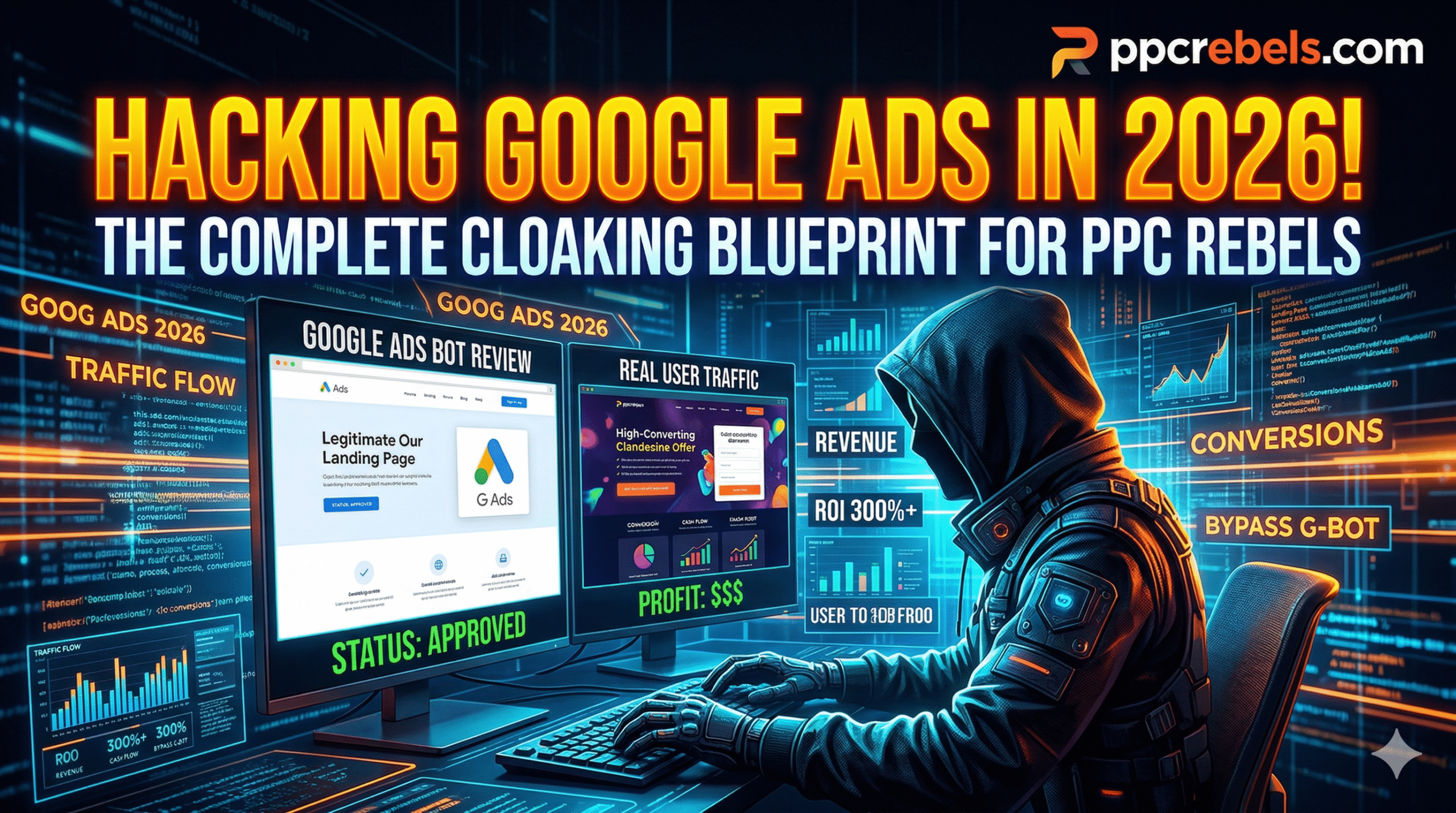
Cloaking is a technology that shows different content to different visitors based on their characteristics. In traffic arbitrage this means one thing: Google’s moderator sees a “white” page, while the real user lands on a gambling, nutra, or gray financial offer — anything that violates platform rules.
In practice the flow looks like this:
- Google bot / crawler → “white” landing page (a recipe blog, health article, sock shop)
- Real user from the target GEO → the actual offer
Simple concept. Complex execution. Enormous cost of failure.
Why Cloaking Got Harder in 2026
Google has fundamentally upgraded its moderation system over the past two years. Here’s what changed:
1. AI moderation runs in real time Previously moderation was asynchronous: create a campaign, launch it, get a verdict in 12–24 hours. Now algorithms monitor campaign behavior continuously — an abnormal CTR, strange traffic patterns, or a mismatch between landing page and ad copy trigger automatic reviews with no human moderator involved.
2. Visitor fingerprinting got more sophisticated Google has become significantly better at identifying its own bots. They now use real browser sessions (headless Chrome with normal headers), randomized user-agent strings, and IPs from residential ranges rather than data centers. Old cloakers that filtered only by IP and user-agent became transparent as glass.
3. Suspicious Payments 2.0 Even if your ad passes moderation, the threat can come from the billing side. Google analyzes deposit patterns: sudden budget spikes, certain payment methods, the account owner’s geolocation — all of these feed into an account trust score.
4. Linked account clustering Google has learned to cluster accounts using dozens of signals: devices, IPs, cookies, behavioral patterns, payment methods, domains. If one account gets banned, the entire network is at risk.
Anatomy of a Working Cloaking Setup in 2026
If you still think cloaking means “swap the page in .htaccess,” there’s bad news. A modern setup looks very different.
Layer 1: The Tracker
The tracker is the heart of the system. It decides who sees the “white” page and who reaches the real offer. Popular solutions in 2026:
- Keitaro — the most widely used in the CIS community. Flexible filter system, multi-source support, solid documentation.
- BeMob — cloud-based, no dedicated server required. Good for getting started.
- Binom — fast, native tracker. Favored for request processing speed and detailed analytics.
Key filters a 2026 tracker must handle:
- Google IP ranges (lists update several times per week — using current lists is critical)
- User-agent strings (including Google’s headless Chrome)
- Page load speed (bots often have atypical response times)
- JavaScript fingerprint (Google bots don’t always execute JS the way real users do)
- Behavioral patterns (mouse movement, scroll speed)
Layer 2: Infrastructure
Domain. Hosting. CDN. This is where most beginners get burned.
Domains: Never use a single domain for both the “white” and “gray” pages. The offer domain must be clean: registered long ago (or purchased with history), with no connection to your other campaigns. Rotate domains regularly — their lifespan in gray niches is finite.
Hosting: Forget cheap shared hosting. Use VPS or dedicated servers in neutral jurisdictions. The server must handle load without latency — any delay during a redirect increases the chance of detection.
CDN: Cloudflare is the industry standard. Beyond speed, it provides an additional layer of anonymization for your server’s real IP.
Layer 3: The “White” Page
The most underrated component. Most media buyers spend 80% of their time on tracker configuration and 20% on the white page — it should be the other way around.
Requirements for a white page in 2026:
- Real content. This must be an actual website, not a placeholder. A blog with 10–15 real topical articles, or a real product page with descriptions and reviews.
- Relevance to the ad. Keywords in the ad must appear on the white page. Google cross-references content — mismatches are a red flag.
- Technical quality. Load speed (PageSpeed Insights > 80), SSL, proper structure, robots.txt, sitemap.
- Working links. No broken links, empty sections, or “under construction” pages.
Top 5 Mistakes That Get Arbitrageurs Burned
Mistake 1: Not Updating Google’s IP Lists
This is the number-one killer. Google constantly updates its bot IP ranges. If your tracker is running on lists that are two months old — you’re already exposed, you just don’t know it yet. Use current lists from the community or subscribe to services that update them automatically.
Mistake 2: One Account, One Campaign
Diversification isn’t a luxury — it’s survival. Run multiple accounts in parallel. A ban on one should not stop the entire flow.
Mistake 3: Ignoring Behavioral Signals
Cloaking isn’t only about deciding who to send to the white page. It’s about how traffic behaves. A 0% bounce rate on your white page and a 95% CTR is an anomaly Google will notice.
Mistake 4: A Weak White Page
The white page is your first and last shield. If it looks like a hastily assembled placeholder, no tracker will save you. Invest in a quality white site.
Mistake 5: Running on Regular Self-Registered Accounts
A regular self-reg Google Ads account has zero trust. It gets scrutinized more aggressively and banned faster. Agency accounts carry accumulated trust, a special status with Google, and separate billing limits.
Cloaking vs. Agency Account: Which Works Better?
In 2026 this is not an either/or question — it’s a combination, not a choice.
| Parameter | Regular Account + Cloaking | Agency Account + Cloaking |
|---|---|---|
| Time to first ban | 6–72 hours | 2–8 weeks (with proper setup) |
| Billing limit | Low | High (post-pay available) |
| Moderation speed | Slow | Fast |
| Recovery after ban | Difficult | Via account manager |
| Availability | Anyone | Through a rental service |
An agency account doesn’t make you invisible — it buys you a head start. More time to test, higher trust, better conditions. But without solid cloaking, even that advantage burns in a day.
Legal Alternatives: When You Don’t Want the Risk
Traffic arbitrage doesn’t have to mean gray offers. If you want to work stably without constantly swapping accounts and midnight crises, consider white-hat verticals:
- E-commerce / physical products — runs directly without cloaking
- SaaS and B2B products — high customer LTV, Google is lenient
- Education and online courses — a clean vertical with solid conversion rates
- Finance (regulated) — insurance, licensed brokers, banks
White-hat verticals take longer to enter but deliver predictable, scalable revenue without the stress.
The 2026 Media Buyer Toolkit: Minimum Setup
If you want to work professionally in gray niches, here is the minimum you need:
Tracker: Keitaro or Binom (self-hosted on VPS) VPS: Hetzner, Contabo, or equivalent European providers CDN: Cloudflare Pro (not the free tier — you need the extra capabilities) Domains: Namecheap, GoDaddy — minimum 3–5 in rotation Anti-detect browser: AdsPower or Dolphin Anty — for managing multiple accounts Proxies: Mobile or residential — for account management Agency account: PPC Rebels or equivalent services with guarantees
Total infrastructure budget: from $300–500 per month. This isn’t an expense — it’s an investment in flow stability.
Cloaking Trends for the Second Half of 2026
The market keeps moving. Here’s what’s happening right now:
AI detection is growing — Google uses behavioral models trained on billions of sessions. Static IP lists are becoming less reliable. The future belongs to dynamic filtering systems that update in real time.
Native traffic is gaining momentum — some media buyers are migrating from Google to native networks (Taboola, Outbrain, MGID), where moderation is less aggressive for gray niches. Lower volume — fewer ban problems.
Team collaboration is rising — in 2026 solo operators find it increasingly difficult to compete with organized teams that have their own IT department, a pool of accounts, and dedicated managers on the ad network side.
Compliance arbitrage is growing — more and more media buyers are shifting to fully white-hat offers with aggressive optimization. Less risk, more predictable income.
Conclusion: Is It Worth It?
Cloaking in Google Ads is not a magic “make money” button. It is a complex, expensive, risky technology that — used correctly — provides a competitive edge. Used incorrectly, it burns your budget and your nerves.
If you’re just entering arbitrage, start with white-hat verticals — build experience, earn your infrastructure budget. Cloaking is a tool for professionals, not a starting point.
If you’re already in the game — invest in infrastructure, agency accounts, and continuous learning. The market moves fast, and those who adapt keep earning — the rest write posts about how “Google is evil.”
Have questions about cloaking setup or choosing an agency account? Message us on Telegram — we’ll break down your case.