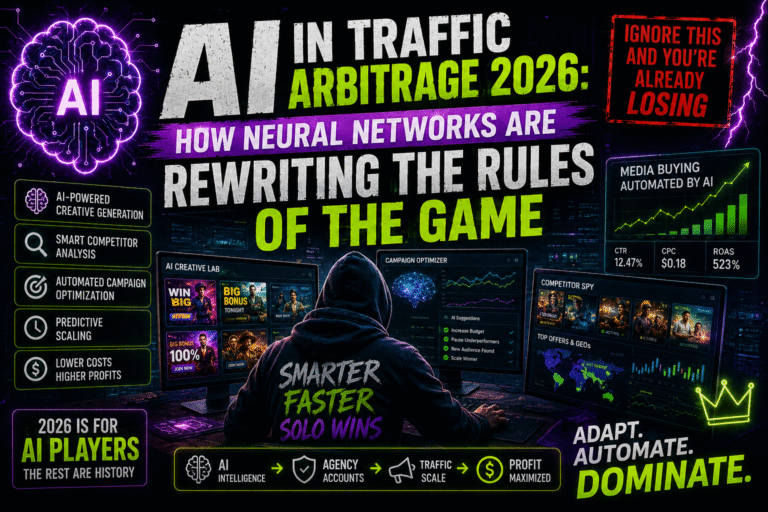
Traffic Arbitrage with AI in 2026: How Neural Networks Are Rewriting the Rules
Traffic arbitrage has changed radically over the past two years. Back in 2023, it was enough to find a working funnel, test creatives by hand, and scale whatever converted. That approach no longer gives you a competitive edge. Ad platforms are getting smarter, CPMs are climbing, and audiences burn out faster than ever. In this environment, the winners are not those who work harder — but those who work smarter. That is where artificial intelligence enters the picture.
In this article, we break down exactly how AI is transforming every stage of the arbitrage funnel: from offer research and creative generation to bid optimization and fraud prevention. No filler — just concrete tools, mechanics, and real-world results.
Important: AI is not a magic button. It is a powerful accelerator for those who already know how to run traffic. Used incorrectly, neural networks will drain your budget faster than manual work ever could.
1. Why 2026 Is a Turning Point for Arbitrageurs
The digital advertising market has entered a new phase. Several forces converged simultaneously to create an environment where survival without automation is extremely difficult:
- Tighter moderation on Facebook, Google, and TikTok Ads — platform algorithms have learned to detect typical grey-area patterns
- The death of third-party cookies — server-side tracking has become mandatory, not optional
- Rising competition — more arbitrageurs competing for the same audiences, squeezing margins
- Higher traffic costs — CPMs in Tier-1 geos have risen by an average of 30-50% compared to 2023
Against this backdrop, AI has stopped being a novelty and become a baseline tool for media buyers. Those who integrated neural networks into their workflow early are already reporting ROI that is 40-60% higher than peers operating without automation.
2. AI in Creative Production and Testing
Generating Ad Materials
This is the most obvious and already widely adopted use case. Neural networks let you produce hundreds of banner and video variations in the time it used to take to build five or ten. What does that mean in practice?
- Speed: from 3-5 days of creative prep down to 2-4 hours
- Volume: mass A/B testing of 50-100 variants instead of 3-5
- Cost: design expenses cut by a factor of 5 to 10
Key Tools for Creative Production
AdCreative.ai — generates banners and ad copy from a creative brief. Supports all standard formats and adapts output across different GEOs and verticals. Performs especially well for nutra, e-commerce, and finance offers.
MidJourney + Stable Diffusion — for generating photorealistic imagery. These tools produce unique visuals that cannot be reverse-image-searched, which is critical in verticals where stock photos have already been overused.
ElevenLabs — voice synthesis for video creatives. Supports dozens of languages and accents, which is especially valuable when scaling to new GEOs without hiring local voice actors.
Creatopy — automates creative resizing and format adaptation. Ideal for teams running campaigns across multiple platforms simultaneously.
Pro tip: never hand the final launch decision entirely to AI. The neural network generates — a human selects. The combination consistently outperforms either approach on its own.
3. Bid Optimization and Real-Time Campaign Management
Manually adjusting bids once a day — or even once an hour — is a relic of the past. AI systems analyse data in real time and make adjustments faster than any human ever could. Here is how it works in practice:
Native Platform Algorithms
Facebook Advantage+, Google Performance Max, and TikTok Smart Performance Campaign all use machine learning to optimise ad delivery. The key for an arbitrageur is knowing how to feed these algorithms quality data:
- Give the algorithm at least 50 conversions before evaluating performance — below that threshold, optimisation behaves erratically
- Use broad audiences rather than narrow ones — modern algorithms find the right users on their own
- Do not touch the campaign during the first 3-7 days — the learning phase requires stability
- Switch to server-side pixel tracking instead of browser-based — data quality directly determines optimisation quality
Third-Party AI Tools for Bid Management
Performance Mode in RichAds — autonomously rotates traffic sources and manages micro-bidding. According to the platform, clients report conversion uplifts of up to 229% and target CPA reductions of 55%.
AutoML Tables (Google Vertex AI) — for more advanced teams who want to build custom conversion-prediction models trained on their own historical data.
4. AI-Powered Fraud Prevention
Fraudulent traffic is one of the biggest ROI killers in arbitrage. Depending on the vertical, estimates suggest that 15-40% of traffic consists of bots and low-quality clicks. AI solutions can block up to 90% of invalid traffic before a single click is registered.
How AI Fraud Filters Work
Modern anti-fraud systems analyse hundreds of signals simultaneously: behavioural patterns, click velocity, geolocation, device type, time of day, and IP history. Legacy rules like “block datacenter IPs” no longer cut it — fraud has grown smarter. AI models surface anomalies that no human analyst could detect at scale.
- Amazon Fraud Detector — integrates with ad pipelines and blocks suspicious traffic in real time
- Kaminari Click — a specialised solution trained specifically on arbitrage industry data
- TrafficGuard — cross-platform protection with detailed fraud-type analytics
Real case: deploying AI anti-fraud on Brazil campaigns reduced the share of invalid traffic from 34% to 4% within two weeks. Budget that was previously wasted started generating real conversions.
5. Offer Personalisation and Dynamic Landing Pages
One landing page for everyone is a thing of the past. AI enables dynamic content that adapts based on traffic source, GEO, device type, and even time of day. Practical use cases include:
- Swapping headlines and images based on the keyword that brought the user to the page
- Adjusting language and tone to match audience demographics (Gen Z vs. 35+)
- Shifting the value proposition by source: emotional triggers for Facebook traffic, rational benefits for search
- A/B/n testing with automatic winner selection via multi-armed bandit algorithms
Personalisation Tools
Unbounce Smart Traffic — automatically routes visitors to whichever landing page variant is most likely to convert them. Reported conversion uplift: up to 30%.
VWO + AI Module — A/B testing with machine learning that not only identifies the winner but explains why one variant outperforms another.
6. Analytics and Trend Forecasting
One of the most underrated AI use cases in arbitrage is predictive analytics. Rather than reacting to what has already happened, modern tools let you act ahead of the curve.
What AI Can Forecast
- Creative fatigue: algorithms detect CTR decline before it becomes critical and automatically rotate materials
- Seasonal demand spikes: ML models analyse historical data and flag approaching surges in competition within specific niches
- Audience saturation: the system identifies when an audience has grown tired of an offer and recommends broadening targeting segments
- New GEO potential: based on patterns from existing markets, AI scores the viability of expanding into new geographies
Looker Studio paired with custom ML models is the standard for advanced teams. All KPI monitoring lives in a single dashboard, anomalies are surfaced automatically, and alerts arrive before the budget is exhausted.
7. A Practical Pipeline: What AI-Powered Arbitrage Looks Like in 2026
Here is what a typical workflow looks like for a team that has fully integrated AI at every level:
- Audience analysis using neural networks — mapping target audience pain points, triggers, and objections
- Generation of 50-100 creative variants via AdCreative.ai and MidJourney
- Human selection of the top 10-15 variants (strategic curation, not a technical task)
- Campaign launch with broad audiences, handing the learning phase over to the algorithm
- AI fraud filtering through connected anti-fraud systems
- Monitoring in Looker Studio — deviations from baseline trigger automatic alerts
- Scaling winners + automatic shutdown of underperforming funnels
- Dynamic landing page personalisation by traffic segment
The core principle: humans set the strategy, test hypotheses, and make business decisions. AI handles the repetitive work, the speed, and the data processing. This symbiosis is not the future of arbitrage — it is the present.
8. The Most Common Mistakes When Introducing AI into Arbitrage
Many arbitrageurs got burned on their first encounter with neural networks precisely because they expected fully autonomous operation with no human involvement. These are the most common pitfalls:
- Blind trust in prompts without testing — an AI-generated creative needs to be tested just as rigorously as anything made by hand
- Ignoring cultural context — a neural network does not understand local nuance. French humour does not automatically translate into German
- Failing to monitor metrics — automation does not mean letting go of the wheel. Review KPIs daily
- Using AI for only one task — maximum impact comes from end-to-end automation of the entire funnel
- Neglecting data quality — garbage in, garbage out. Without clean tracking, AI optimisation is meaningless
9. Verticals Where AI Delivers the Biggest Impact in 2026
Neural networks add value across all verticals, but some see disproportionately large gains:
Gambling and betting: intense competition and strict moderation make AI optimisation not just beneficial but essential. Automatic creative rotation and fraud prevention deliver the greatest returns here.
Nutra: personalisation targeting specific audience pain points combined with dynamic landing pages multiplies conversion rates. AI-generated content dramatically reduces copywriting budgets.
Finance offers (crypto, investments): predictive analytics helps you catch market waves ahead of competitors. Personalisation matched to each audience segment’s investment profile significantly improves approval rates.
E-commerce: dynamic product feeds, automated retargeting sequences, and AI-powered recommendation personalisation are already table stakes, not differentiators.
Conclusion: Traffic Arbitrage in the Age of AI
Traffic arbitrage in 2026 is not a profession for people who can follow a template. It is a discipline that demands simultaneous mastery of technology, data, and market psychology. AI has lowered the barrier to entry for smart newcomers while raising the ceiling for those willing to keep developing.
The good news: most of the tools described in this article are available right now. The uncomfortable truth: they are available to your competitors too. The winner is not the person who knows about these tools — it is the person who applies them systematically.
AI-powered arbitrage is not a replacement for expertise. It is an amplifier of it. The deeper your understanding of traffic, the more powerful neural networks become in your hands.
Start with one AI tool — the one that addresses your biggest bottleneck. Master it, measure the results, and scale the approach. That is how you build an AI-driven arbitrage operation that generates consistent profit, not a one-time spike.
While others are getting banned — you’re already running ads with ppcrebels.com 🚀
Google Ads agency accounts with 7+ years of trust.
No resellers. No delays. Launch on the same day.
To buy Google Ads agency accounts, contact us on Telegram: @ppc_rebels_alex
Article tags: #trafficarbitrage #AI #neuralnetworks #mediabuying #CPA #automation #ppcrebels