Google Ads Agency Accounts in 2026: What They Are, Why You Need One, and How to Use Them Safely
Running paid traffic in 2026 means navigating a much more aggressive moderation environment than affiliates faced just two or three years ago. Google’s automated systems have become remarkably capable at flagging new accounts, detecting payment anomalies, and suspending campaigns before they ever spend a meaningful budget. For media buyers working in competitive or grey verticals, the answer to this problem isn’t more cloaking layers or throwaway accounts — it’s starting from a position of trust.
That’s exactly what a Google Ads agency account provides.
What Is a Google Ads Agency Account?
A Google Ads agency account — often called a manager account (MCC) or an agency-tier advertising account — is a Google Ads account that has been established and aged under a certified or recognized advertising agency. Unlike a freshly created personal account, these accounts carry an established trust history with Google’s systems. They’ve processed real spend, maintained payment compliance, and built a behavioral profile that looks nothing like a throwaway.
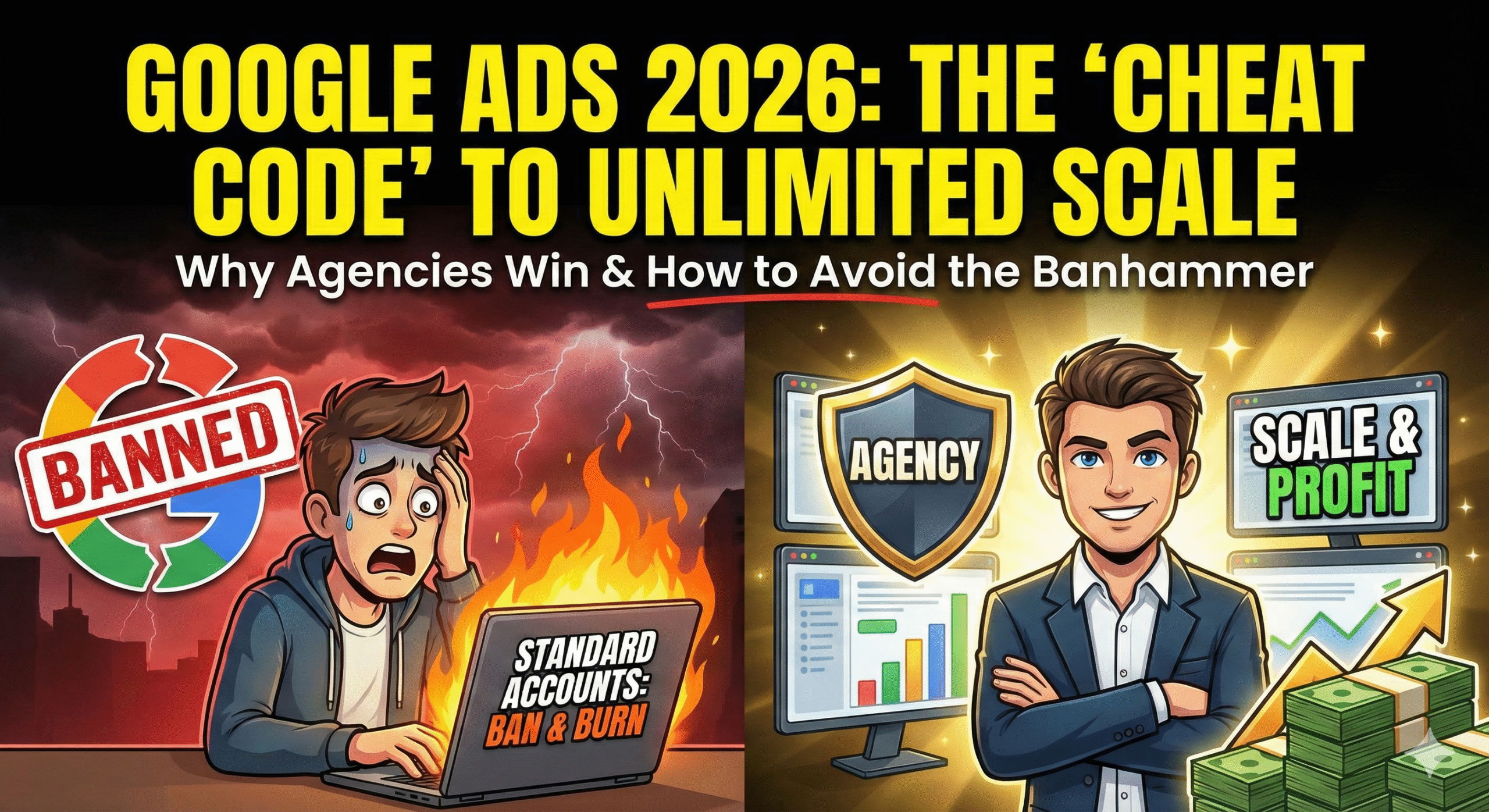
When you run campaigns from an agency account, you inherit a significant portion of that trust. Google’s internal risk scoring assigns a much lower fraud probability to these accounts from the very first campaign, which means lower CPMs on display, smoother approval on sensitive keywords, and — critically — fewer sudden account suspensions mid-flight.
Why Standard Self-Created Accounts Fail in 2026
To understand why agency accounts matter, it helps to understand what Google’s systems actually analyze when they evaluate an advertiser.
It’s not just your landing page or your ad copy. Google’s anti-fraud and policy enforcement infrastructure now evaluates the full advertiser fingerprint: the age and history of the account, the payment method reputation, the IP environment where the account was created and accessed, the velocity of spending (how fast you ramp up budget), the behavioral patterns inside the interface, and the domain history of whatever URLs you’re promoting.
A brand-new self-created account fails on almost every single one of these dimensions. It has zero history, an unknown payment instrument, a fresh IP signal, and zero proof of legitimate advertising behavior. It starts life under heightened scrutiny, and a single borderline creative or aggressive budget increase is often enough to trigger a suspension that never gets reversed.
This is why experienced affiliates and media buyers have moved toward rented or purchased agency accounts — not as a workaround, but as a legitimate infrastructure decision.
Key Advantages of Running From an Agency Account
Higher trust scores from day one. An aged agency account has already demonstrated that it belongs to an entity that pays bills on time and runs real advertising. Google’s systems treat it differently, which translates into real, measurable operational advantages.
More stable campaign delivery. Campaigns launched from trusted accounts go through moderation faster, experience fewer random pauses, and are less likely to be caught in broad policy sweeps that affect new advertisers disproportionately.
Access to higher spending thresholds. Agency-tier accounts frequently come with elevated daily and monthly spending limits that self-created accounts take months to unlock. For affiliates trying to scale quickly, this is a critical operational bottleneck that agency accounts eliminate.
Dedicated account support. Many agency accounts come with access to a dedicated Google Ads representative, which means policy questions, billing issues, and appeal processes can be resolved far faster than through standard support channels.
Reduced exposure per campaign. When you operate within an MCC structure managed by an experienced agency, your individual campaign risk is isolated. If one campaign gets flagged, it doesn’t necessarily cascade into a full account shutdown.
How Agency Accounts Are Typically Structured
Most agency account providers operate through a Manager Account (MCC) that sits above one or more individual ad accounts. The MCC holds the billing and trust history; the sub-accounts beneath it inherit that trust while allowing the advertiser to compartmentalize their campaigns.
This structure means you can run multiple offers or verticals in separate sub-accounts without cross-contamination of risk, while still benefiting from the trust umbrella of the parent MCC.
Reputable providers — like PPC Rebels — handle the account provisioning and billing layer, giving you clean, warmed-up sub-accounts to operate within. This is the model that serious affiliates use when they want stable, scalable infrastructure without building it from scratch.
What to Look for When Choosing an Agency Account Provider
Not all agency account providers are equal, and the wrong choice can leave you worse off than starting with a personal account. Here’s what to evaluate:
Account age and spend history. An account that has processed significant legitimate spend is genuinely more trusted than one that was simply aged without activity. Ask providers about the real history behind the accounts they’re renting.
Transparent billing arrangements. You need to understand exactly how billing is structured. Some providers front the ad spend and invoice you later; others require prepayment. Understand the cash flow implications before committing to a volume agreement.
Escrow and dispute resolution. Reputable providers work with established escrow services to protect both parties in a transaction. This is a meaningful signal of legitimacy — agencies that don’t offer escrow options represent a higher risk of fraud.
Vertical experience. An agency that has experience running accounts in your specific vertical — whether that’s nutra, gambling, finance, or another category — will give you better guidance on safe operating practices and help you avoid policy triggers specific to that space.
Support responsiveness. When a campaign gets flagged at 2 AM, you need to be able to reach someone. Evaluate the support model before you’re in a crisis.
Operating Safely Within an Agency Account
Accessing a trusted account doesn’t mean you can ignore the factors that cause suspensions. The account trust extends your runway, but it doesn’t eliminate risk. Here’s how experienced media buyers operate to protect their rented infrastructure:
Warm up spending gradually. Even on an aged account, rapid budget escalation from zero to large daily spends triggers automated risk flags. Ramp budgets methodically over the first week or two to establish a credible spending pattern.
Maintain clean ad infrastructure. Your landing pages, domains, and creatives still need to pass Google’s policy review. The trust from an agency account makes the review process smoother, but it doesn’t make compliance optional.
Separate campaigns by risk level. If you’re running a mix of straightforward offers and more sensitive campaigns, keep them in separate sub-accounts. This prevents a problematic campaign from creating spillover risk for your clean offers.
Avoid simultaneous logins from multiple locations. Account access from widely different geographic locations in a short time window is a known fraud signal. Use consistent access patterns and stable connection infrastructure.
Monitor account health dashboards proactively. Don’t wait for a suspension notice. Check your account status, payment health, and policy notifications daily. Early flags can often be addressed before they escalate.
The Economics of Agency Accounts vs. Account Farming
A common alternative to renting agency accounts is farming — creating and aging large numbers of self-managed accounts to replace the ones that inevitably get suspended. This approach has a surface-level appeal but a poor economic profile when analyzed carefully.
Account farming requires significant time investment, carries constant overhead costs for proxies, payment methods, and infrastructure, and produces accounts that are fundamentally lower quality than aged agency accounts. The operational complexity is high, the failure rate is significant, and the time spent managing account infrastructure is time not spent optimizing campaigns.
At scale, renting high-quality agency accounts from a reputable provider is almost always more cost-effective — and it produces better traffic stability, which compounds into better ROI on the media spend itself.
Final Thoughts
The media buying landscape of 2026 rewards affiliates who invest in infrastructure quality, not just campaign optimization. An agency account is infrastructure. It’s the foundation from which stable, scalable campaigns can actually be run — without the constant disruption of account suspensions eating into your results.
If you’re serious about running Google Ads at volume in any competitive vertical, the conversation about your account structure is as important as the conversation about your creatives or your offers. Starting from a position of trust isn’t a shortcut — it’s the professional approach.
PPC Rebels provides verified Google Ads agency accounts for media buyers and affiliates operating at scale. All accounts are provided with full billing transparency and backed by escrow-verified transactions. Contact us via Telegram to discuss your account needs.