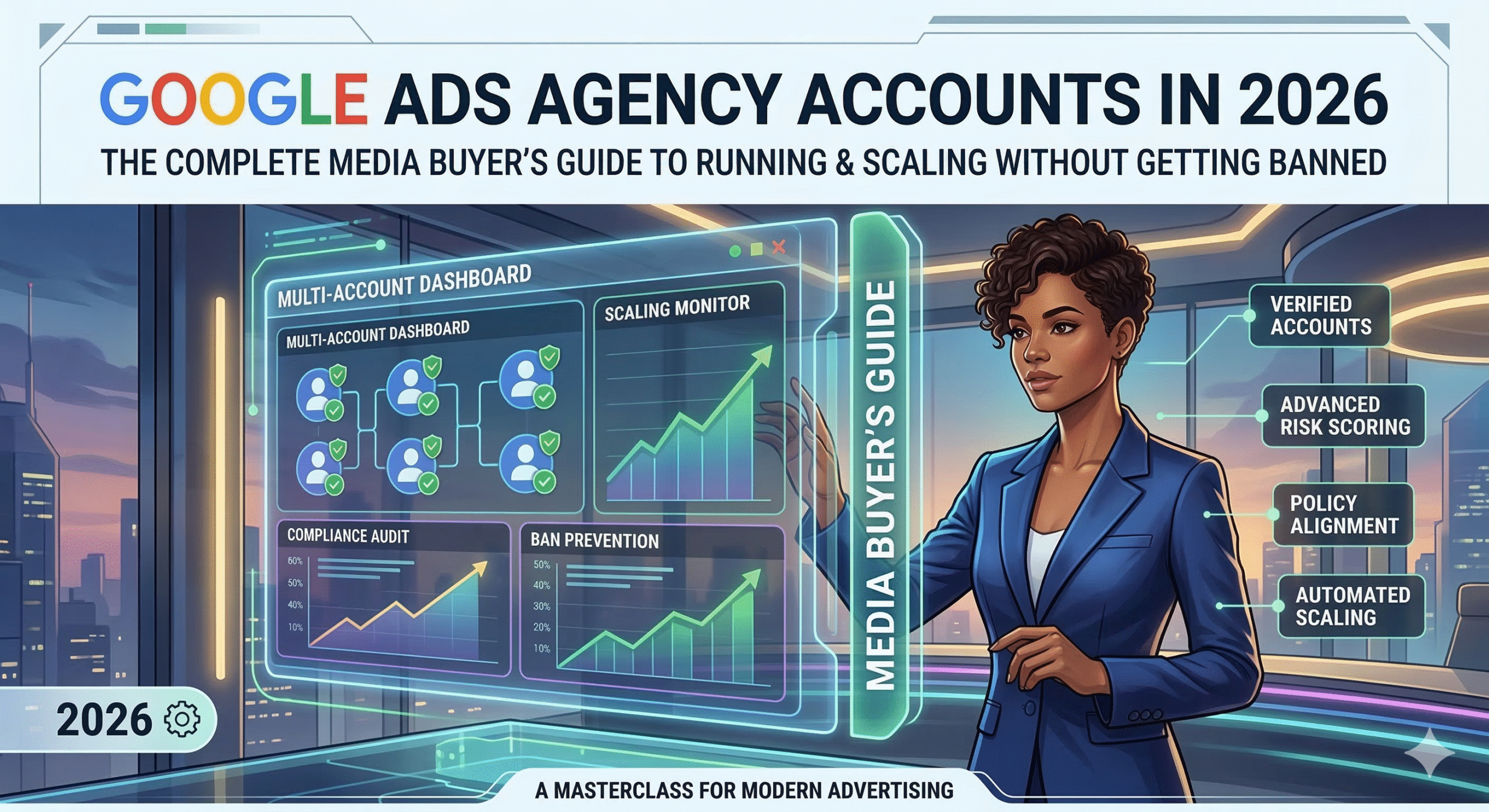
Google Ads Agency Accounts in 2026: The Complete Media Buyer’s Guide to Running and Scaling Without Getting Banned
Why Your Self-Reg Account Is Already Dead
Let’s skip the preamble.
If you are running traffic in 2026 — gambling, nutra, crypto, binary, lead gen, or anything with teeth — and you are still trying to spin up self-registered Google Ads accounts, you are not a media buyer. You are a test pilot in a plane that was discontinued two years ago.
Google’s AI-driven enforcement has fundamentally changed the game. Accounts launched from fresh Gmail addresses get flagged before the first dollar of ad spend. Billing anomalies trigger “Suspicious Payments” suspensions within 72 hours. And “Circumventing Systems” — once a rare ban — is now the default outcome for any funnel that doesn’t look like a Fortune 500 company.
The professionals who are still printing money on Google Ads in 2026 are doing one thing differently: they are running on Google Ads agency accounts.
This guide covers everything — what agency accounts actually are, why they outperform self-regs by a factor of 5–10x, how to choose a trustworthy provider, and the exact workflow to warm up, scale, and protect your campaigns.
Table of Contents
- What Is a Google Ads Agency Account?
- Self-Reg vs. Agency Account: The Hard Numbers
- Why Google Bans Self-Regs So Fast in 2026
- What Makes an Agency Account “Trusted”?
- How to Choose a Google Ads Agency Account Provider
- Step-by-Step: How to Warm Up an Agency Account
- Campaign Structure That Keeps You Alive
- Scaling on Agency Accounts: From $500/Day to $5,000/Day
- What Happens When You Get Banned Anyway?
- FAQ
1. What Is a Google Ads Agency Account?
A Google Ads agency account is an advertising account managed under an authorized Google Partner or Premier Partner umbrella. Unlike a standard self-registered account — created from a personal Gmail with a fresh billing method — agency accounts come with:
- Established account history (months or years of spend data)
- High trust score built through compliant campaign history
- Dedicated support lines and faster policy review processes
- Higher daily and monthly spending limits pre-unlocked
- Billing infrastructure already verified and whitelisted
In practical terms, an agency account starts where a self-reg would take 4–6 months to reach — if it ever gets there at all.
There are two primary models in the market:
Renting: You pay a monthly fee (or a percentage of ad spend) to run your campaigns inside an account owned and managed by the provider. You get MCC access or sub-account access. The account stays with the provider.
Buying: You purchase full ownership of a pre-aged, pre-trusted account. Higher upfront cost, but full control and no ongoing revenue share.
For most media buyers running aggressive verticals, renting is the smarter play — the provider absorbs the infrastructure risk, and you focus on what you do best: running traffic.
2. Self-Reg vs. Agency Account: The Hard Numbers
Let’s make this concrete. Here is what the average media buyer experiences in 2026:
| Metric | Self-Reg Account | Agency Account |
|---|---|---|
| Time to first suspension | 3–7 days | 30–90+ days |
| Daily spend limit at launch | $150–$300 | $1,000–$10,000+ |
| Account survival rate (30 days) | ~15% | ~75–85% |
| Policy review speed | 5–10 business days | 24–48 hours |
| Avg. CPM in restricted verticals | +40–60% vs. clean | Baseline |
| Time to scale to $2,000/day | Rarely achieved | 2–3 weeks |
The account survival rate alone tells the whole story. An affiliate running a gambling offer on a self-reg has roughly a 1-in-7 chance of still being live after 30 days. On a properly maintained agency account with the right warm-up protocol, that number flips to 3-in-4.
When you factor in the time cost of account farming — creating new GMAILs, setting up proxies, re-verifying billing, rebuilding campaign structure — the ROI of simply renting a quality agency account becomes obvious.
3. Why Google Bans Self-Regs So Fast in 2026
Understanding why self-regs fail so quickly helps you run agency accounts smarter.
Google’s Trust Score System
Every Google Ads account has an internal trust score. This is not publicly visible, but it influences everything: which ads enter the auction, what CPMs you pay, how fast your creatives get reviewed, and how quickly suspicious behavior triggers a flag.
Trust score is built from:
- Spend history — accounts that have spent consistently over time are treated as lower risk
- Payment method age and verification status — a 3-year-old credit card on a $50K spending history is miles ahead of a prepaid Revolut card registered last Tuesday
- Account behavioral fingerprinting — login location, device, browser, IP, and usage patterns are all tracked
- Advertiser-domain relationship history — Google knows if the destination URL has been associated with policy violations before
- Creative history — accounts that have run compliant ads in the past get more benefit of the doubt on borderline creatives
A self-reg starts at zero on every single dimension. An agency account starts near the top.
The 2026 Algorithm Update
March 2026 brought a wave of mass suspensions that wiped out a significant portion of the self-reg farming ecosystem. Google’s updated enforcement AI now correlates:
- Account creation clusters (multiple accounts from the same IP range)
- Payment method reuse across accounts
- Creative similarity across accounts flagged for violations
- Landing page fingerprinting (same HTML structure = connected accounts)
If you are farming 50 self-reg accounts and even 3 of them share a billing fingerprint, the contamination can cascade across all 50 within 24 hours. This is the “network ban” problem, and it has become the #1 account loss vector in 2026.
Agency accounts exist outside this contamination network by definition.
4. What Makes an Agency Account “Trusted”?
Not all agency accounts are equal. The market has expanded, and with expansion comes noise. Here is what genuinely separates a high-quality agency account from a rebranded self-reg with a fake spend history:
Verified Partner Status
The provider should be operating under a real Google Partner or Premier Partner relationship. This is verifiable. Ask for the MCC ID and cross-reference it in Google’s Partner directory. If a provider cannot or will not share this, walk away.
Spend History Depth and Cleanliness
A trusted account has months or years of uninterrupted, policy-compliant spend. The history should show gradual scaling — not a sudden spike from $0 to $50K, which is a red flag of artificial inflation.
Vertical-Specific Track Record
A provider who has successfully run gambling, nutra, or crypto offers on their accounts has learned the nuances of keeping those accounts alive. This operational knowledge — which domains to pre-warm, which creative patterns attract review, how to structure the billing — is worth more than the account itself.
Transparent Billing Architecture
You need to understand exactly how billing flows. Is it the provider’s payment method on the account? Are there shared billing limits across their MCC? Who is responsible if a charge dispute triggers an account flag? Transparency here is non-negotiable.
Escrow-Backed Transactions
Reputable providers in 2026 offer escrow-backed arrangements for deposits and ongoing access fees. If a provider refuses to work with escrow, factor that risk premium into your decision.
5. How to Choose a Google Ads Agency Account Provider
There are dozens of providers advertising agency accounts in forums, Telegram channels, and at affiliate conferences. Most of them will waste your money and your time. Here is the filtering process that works:
Step 1 — Verify the partner status. Ask for the MCC ID or the Google Partner badge URL. Confirm it is real.
Step 2 — Check community reputation. Look for the provider’s name in affiliate forums (STM, AffiliateFix, BlackHatWorld). Threads that are 6+ months old and not flooded with “shill” patterns are more credible than recent testimonials.
Step 3 — Request a pilot. Any serious provider will offer a 7–14 day pilot arrangement where you run a modest budget ($500–$1,000) before committing to a larger deposit. If they refuse, that tells you everything.
Step 4 — Test the support response time. In the middle of a campaign launch, you need answers in hours, not days. Send a support inquiry before you commit and measure the response time.
Step 5 — Understand the ban policy. What happens if the account gets suspended? Is there a replacement SLA? Is your deposit protected? Get this in writing.
Step 6 — Assess vertical compatibility. Some providers specialize in white-hat accounts and will not touch gambling or nutra. Others are built for grey-hat verticals. Match your needs to the provider’s actual capability, not their sales pitch.
6. Step-by-Step: How to Warm Up an Agency Account
Even a trusted agency account needs to be warmed up properly before you dump $5,000/day into a gambling funnel. Think of it as calibrating the relationship between your traffic patterns and the account’s existing behavioral baseline.
Phase 1 — Days 1–3: Baseline Establishment
Goal: Appear as a normal, compliant advertiser.
- Launch 1–2 white-hat campaigns. An e-commerce brand or a SaaS lead gen campaign works perfectly.
- Set budgets at $50–$100/day.
- Let Google crawl and review your landing pages without issue.
- Log in from a consistent IP and device. Never use public WiFi or switch between 3 different VPNs on day one.
- Do not make major campaign edits. Let the algorithm learn.
Phase 2 — Days 4–7: Gradual Budget Increase
Goal: Establish a credible spend history.
- Increase budgets to $200–$500/day across your warm-up campaigns.
- Introduce your real domain if it is clean. If not, use a cloaker or a compliant redirect architecture at this stage.
- Begin adding ad groups and keywords that are adjacent to your actual offer vertical.
Phase 3 — Days 8–14: Transition to Target Vertical
Goal: Move the account toward your real campaign without triggering a pattern break.
- Pause warm-up campaigns and launch your actual offer.
- Start at 30–40% of your target daily budget.
- Monitor the Search Impression Share and Quality Score closely. A sharp drop signals algorithm scrutiny.
- Avoid changing billing information, account name, or contact details during this phase.
Phase 4 — Week 3+: Scale
- Increase budget 20–30% every 48–72 hours if performance is stable.
- Diversify ad groups to avoid single-point-of-failure from a policy review.
- Maintain at least one compliant campaign running in parallel as a trust anchor.
7. Campaign Structure That Keeps You Alive
The technical setup of your campaigns is as important as the account quality itself. Here are the structural principles that separate affiliates who survive from those who get banned every two weeks.
Cloaking Architecture
For restricted verticals, a properly configured cloaker is not optional — it is the foundation. The cloaker serves a compliant page to Google’s review bots and your actual offer page to real users. Key principles:
- Use a dedicated IP-based cloaker, not a shared one (shared cloakers get blacklisted en masse)
- Keep your compliant page genuinely compliant — not just “less bad.” It needs to pass a real human policy review
- Rotate offer pages regularly, even if they are converting well
- Never point an account’s entire traffic to a single domain. Split across 2–3 domains minimum.
Ad Creative Strategy for Restricted Verticals
Google’s creative review AI in 2026 is significantly more sophisticated than it was even in 2024. Tactics that worked 18 months ago now reliably trigger flags. What still works:
- Native-style creatives that do not scream “ad” — soft CTAs, editorial tone
- Benefit-first headlines that describe outcomes without making prohibited claims (“Feel lighter in 30 days” vs. “Lose 15kg guaranteed”)
- Dynamic keyword insertion used judiciously — it signals relevance to the algorithm
- Video assets in RSAs — accounts with video assets in their asset pool receive statistically lower CPMs in competitive verticals
Landing Page Compliance Buffer
Your landing page is the first thing a human reviewer sees when a campaign gets flagged for manual review. Even if you are cloaking, your compliant-facing page needs to be genuinely solid:
- Real privacy policy and terms of service (not copy-pasted templates — Google’s AI recognizes them)
- Contact information that resolves to an actual entity
- No countdown timers or fake “X units remaining” urgency unless you can actually back it up
- Page speed under 2.5 seconds. Core Web Vitals affect Quality Score in ways that compound over time.
8. Scaling on Agency Accounts: From $500/Day to $5,000/Day
The ceiling on agency accounts is dramatically higher than on self-regs, but reaching that ceiling requires a disciplined scaling protocol.
The 72-Hour Rule
Never increase a campaign budget by more than 30% within a 72-hour window. Budget spikes are one of the primary signals Google’s algorithm uses to identify accounts that have recently changed behavior — which is exactly what triggers the “suspicious activity” review queue.
The Portfolio Approach
Instead of running one account at $5,000/day, most serious media buyers in 2026 run 3–5 accounts at $1,000–$2,000/day each. The reasons are straightforward:
- Single-account concentration means a ban wipes your entire operation
- Multiple accounts allow you to test different creative angles, bidding strategies, and funnel variants in parallel
- Diversification across providers means no single point of failure in your infrastructure
Smart Bidding Configuration for Agency Accounts
Agency accounts with historical conversion data allow you to use Smart Bidding strategies that are simply inaccessible to fresh self-regs. Specifically:
- Target ROAS bidding becomes powerful after 50+ conversions per campaign per month — agency accounts often arrive with this threshold already met
- Enhanced CPC is the safer starting point for new campaigns on a trusted account — it preserves manual control while allowing algorithmic micro-optimization
- Maximize Conversions with a target CPA cap works extremely well for nutra and lead gen verticals once the learning phase is complete
9. What Happens When You Get Banned Anyway?
Even on agency accounts, bans happen. The question is not whether you will face a suspension — it is whether you have the infrastructure to absorb it without losing your operation.
Immediate Actions (First 24 Hours)
- Do not appeal immediately. A hasty appeal that does not address the actual violation reason will be rejected and reduces your credibility for subsequent appeals.
- Diagnose the suspension reason. “Suspicious Payments” requires a different response than “Circumventing Systems.” Read the suspension email carefully.
- Pause all campaigns in the affected account to prevent further ad spend on a flagged account.
- Contact your provider. A quality provider has seen this before and has established escalation paths.
The Appeal Process
For agency accounts, the appeal process is materially different from self-regs. Your provider’s relationship with their Google rep gives you access to:
- Expedited manual review (48 hours vs. 5–10 business days for self-regs)
- Direct communication with the policy team instead of the automated response queue
- Context-aware appeals that reference the account’s historical compliance record
Continuity Planning
Every serious media buyer operating in 2026 maintains at least one warm standby account. This is not paranoia — it is basic operational hygiene. The warm standby has a 2-week history of low-spend compliant traffic and can be scaled up within 48 hours when your primary account goes down.
10. FAQ
Q: How much does it cost to rent a Google Ads agency account? Pricing in 2026 ranges from $300–$800/month for basic access plus a 3–8% revenue share on ad spend, or a flat fee model for larger buyers. For accounts with Premier Partner status and $50K+ monthly capacity, expect $1,000–$2,500/month plus spend share. Always compare total cost including the spend percentage against the ROI improvement from higher account trust.
Q: Can I run gambling offers on a Google Ads agency account? Yes — but only in jurisdictions where online gambling advertising is legally permitted and where the advertiser holds the appropriate licenses. Google enforces gambling advertising restrictions on a country-by-country basis. A reputable provider will advise you on which GEOs are viable and help you structure your certification correctly.
Q: What is the difference between an MCC account and an agency account? An MCC (My Client Center) is the management layer that allows agencies to oversee multiple child accounts from a single dashboard. When you rent an “agency account,” you are typically getting access to a child account within a trusted MCC — which is where the trust inheritance comes from. The MCC itself carries the spend history and partner relationship.
Q: How long does account warm-up take? For a standard warm-up before launching a grey-hat vertical, allow 10–14 days minimum. For high-risk verticals like gambling in competitive GEOs, a 21-day warm-up with $200–$500/day in compliant traffic before transitioning is the safer approach.
Q: What should I do if my provider disappears with my deposit? This is why escrow matters. Always use an escrow arrangement for deposits over $500. If you are already in a dispute without escrow protection, document everything (screenshots, Telegram logs, transaction records) and pursue resolution through the payment method’s chargeback mechanism if the payment was made by card.
Conclusion: Agency Accounts Are the Infrastructure, Not the Strategy
Running on agency accounts does not guarantee success. Affiliates who think a trusted account is a magic solution burn through high-quality infrastructure just as fast as they burned through self-regs — just with fewer accounts and more expensive failures.
What agency accounts give you is time and room. Time before a review. Room to scale before hitting artificial limits. Room to test creative approaches without immediately triggering a ban. Room to build a real optimization loop.
The media buyers winning in 2026 use that time and room intelligently: disciplined warm-up protocols, diversified account portfolios, compliant creative architecture, and providers they have vetted properly.
The ones losing are doing what they always did — just with a more expensive account.
Choose your infrastructure wisely. Work with providers who are transparent about their partner status, back their services with escrow, and have a documented track record in your vertical. Then run your traffic like a professional.
That is what separates rebels from the rest.
Looking for a reliable Google Ads agency account provider? PPC Rebels works with media buyers in gambling, nutra, crypto, and lead gen verticals — with Premier Partner-backed accounts, escrow-protected transactions, and a team that has seen every ban pattern in the book.
Run your ads like a savage with PPC Rebels.
Why struggle with bans and fresh accounts when you can launch on battle-tested, high-trust Google Ads agency accounts starting from just $7?
No weak setups. No посредников. No waiting.
Only elite-level accounts trusted by Google, built for those who scale hard and move fast.
While others are getting flagged…
You’re already printing traffic.
👉 Get in now: ppcrebels.com