Google Ads Smart Bidding 2026: How to Train the Algorithm Before It Trains You
Most affiliates think Smart Bidding is a setting. The top 1% know it’s a negotiation — and they always go in prepared.
Here’s the uncomfortable truth: Google’s Smart Bidding isn’t neutral. It’s a machine that learns from what you give it. Feed it garbage signals — and it will spend your budget chasing ghost conversions. Feed it precision — and it will print money on autopilot.
In 2026, with manual CPC nearly extinct and AI controlling 90% of auction decisions, understanding how to shape Smart Bidding behavior isn’t optional. It’s survival.
The Signal Hierarchy Nobody Talks About
Smart Bidding pulls from hundreds of contextual signals: device, time, audience, search intent, landing page behavior, conversion history. But here’s what Google won’t admit publicly — not all conversions are equal in the algorithm’s eyes.
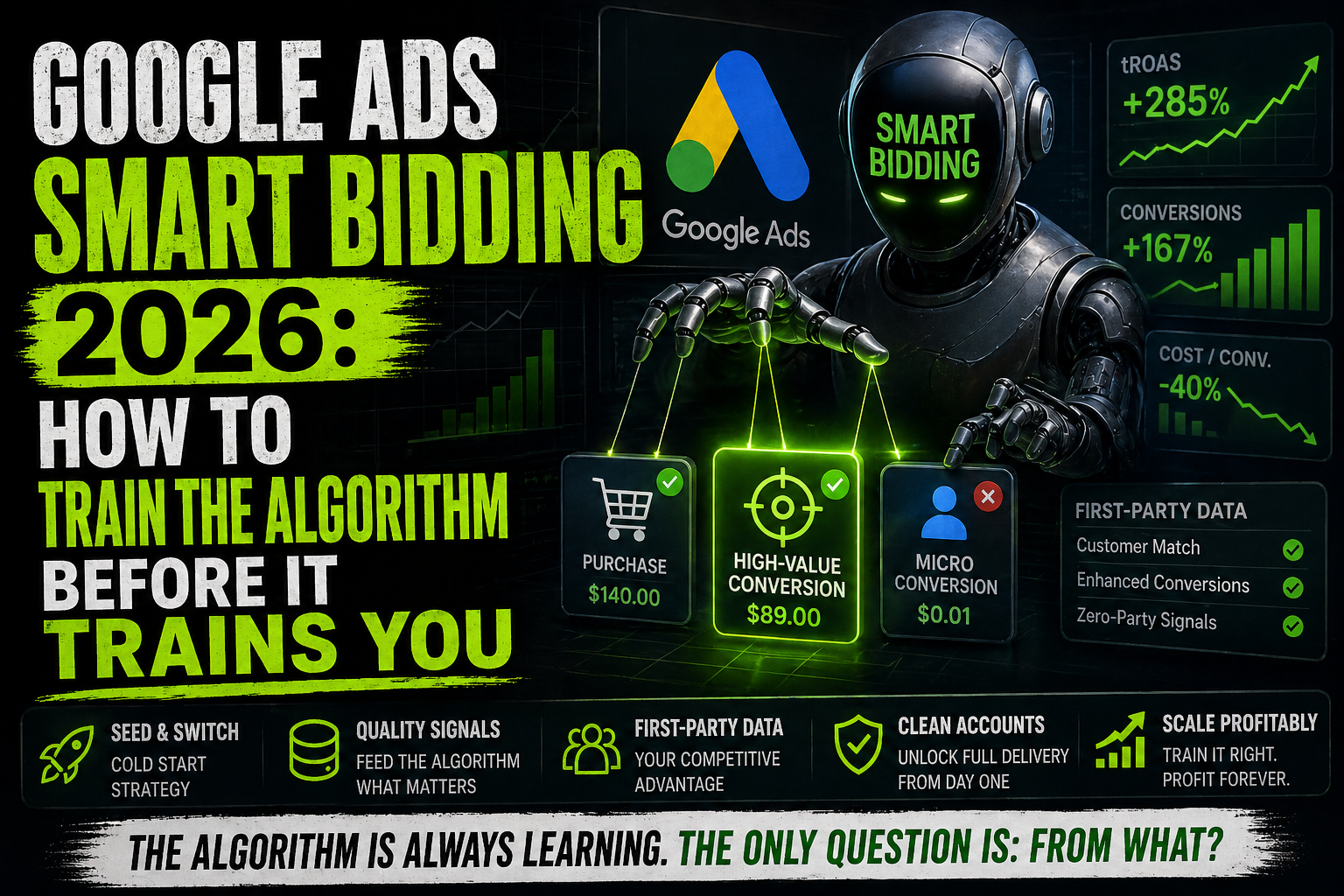
A micro-conversion fired 0.3 seconds after landing? Worthless noise. A purchase with a $140 average order value, confirmed through enhanced conversions with first-party data? Pure gold.
Most media buyers mix these signals in a single campaign and wonder why tROAS goes sideways.
The fix: Segment your conversion actions by quality tier. Create separate goals for high-intent events. Tell the algorithm what winning actually looks like — in your language, not Google’s defaults.
The “Cold Start” Trap That Kills New Campaigns
You launch. You set tCPA at $12. You have zero historical data. Smart Bidding panics, throttles delivery, or — worse — overspends chasing any click that breathes.
Top affiliates in 2026 use the “Seed & Switch” method:
Launch on Maximize Conversions (no target) for the first 50–80 conversions. Let the algorithm feed. Then switch to tCPA or tROAS once it has real data to anchor on. The difference in CPL? Up to 40% lower — without touching a single ad.
First-Party Data Is Now Your Bidding Weapon
Google’s deprecation of third-party cookies shifted the power balance. Advertisers with clean first-party data now get preferential signal matching through Customer Match and Enhanced Conversions.
If you’re not uploading hashed customer lists to seed your Smart Bidding — you’re bidding blind while competitors bid with a map.
The Rebel’s Checklist Before Touching Any Bidding Strategy
Before you change a single target, answer these:
1. Do you have 30+ conversions in the last 30 days? 2. Are your conversion events actually meaningful (not just pageviews)? 3. Is enhanced conversion tracking active and verified? 4. Have you excluded irrelevant placements and audiences? 5. Is your landing page speed under 2.5 seconds on mobile?
If even one answer is “no” — Smart Bidding will punish you for it. Silently. Expensively.
Final Thought
Smart Bidding isn’t the enemy. Lazy signal hygiene is. In 2026, the affiliates scaling profitably aren’t fighting Google’s algorithm — they’re training it like a weapon and pointing it at the right targets.
The algorithm is always learning. The only question is: from what?
Running restricted verticals? Agency accounts with clean history give your campaigns the trust score Smart Bidding needs to unlock full delivery from day one. See how PPC Rebels can help →