Spy Tools in Traffic Arbitrage: Strategic Instrument or Just Copy-Paste?
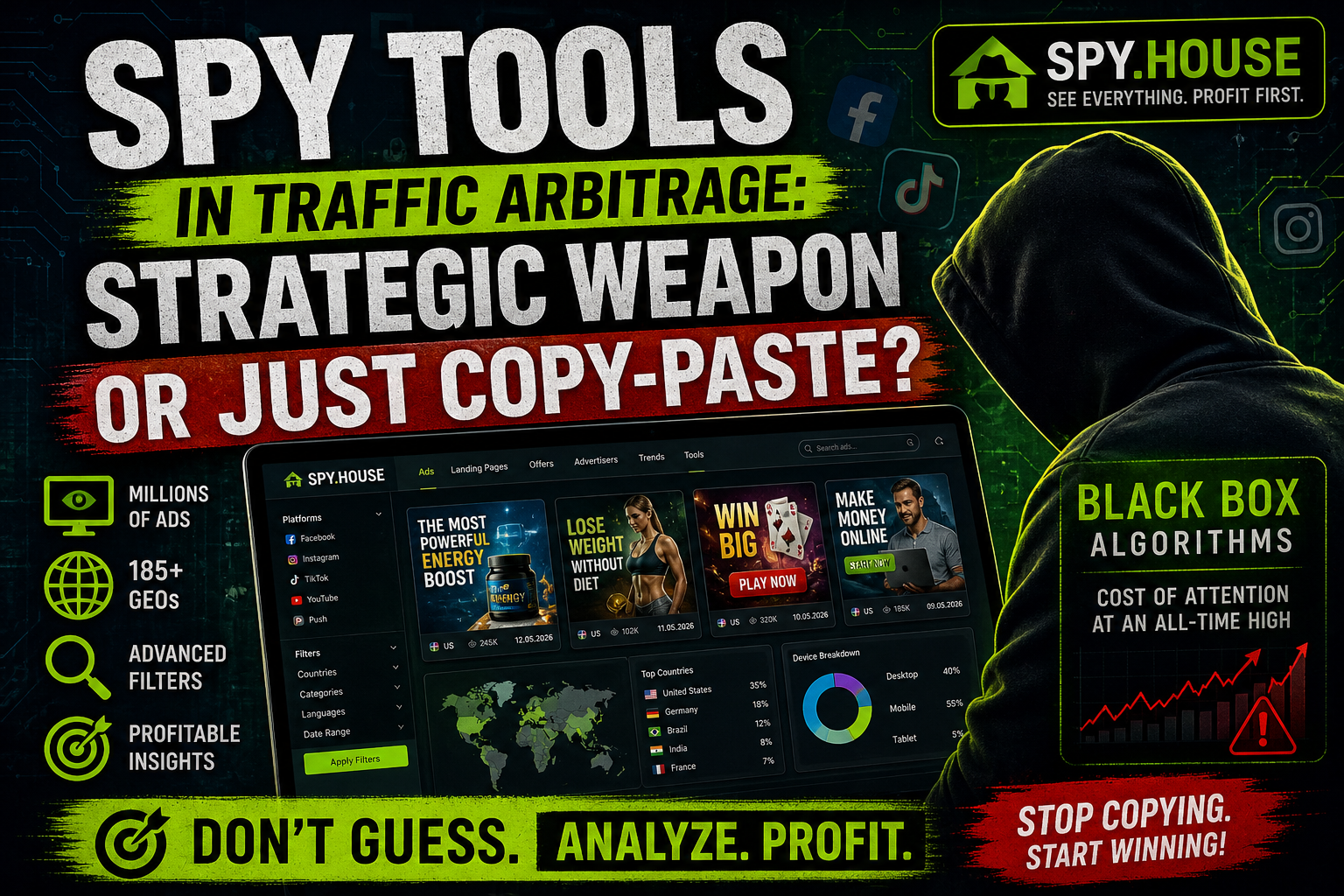
Media buyers often live by one rule: “Either you invest in tests and learn from your own failures, or you buy access to a Spy service and analyze everyone else’s.” In 2026, when ad network algorithms have become closed “black boxes” and the cost of user attention has hit an all-time high, ad monitoring tools are no longer a nice-to-have — they are a baseline necessity.
In this article, we break down how spy tools work under the hood, their real-world value, and the working methods that let you build unique, profitable content based on market data.
The Architecture of Spy Services: What Happens Under the Hood
A modern Spy service is a high-tech system operating at the intersection of Big Data and anonymization tools. To provide users with a database of millions of ads, the service solves three core tasks:
- Scraping and global monitoring: Using massive account farms and residential proxies, bots mimic the behavior of real users. They scroll TikTok, Facebook, and Instagram feeds, follow links, and simulate interest in content. To neural networks, such a bot looks like an ordinary user from anywhere in the world — which allows the system to “catch” even narrowly targeted ads.
- Bypassing traffic filtering systems: Arbitrageurs often use cloaking to hide offers (for example, in the gambling niche) from moderation. Powerful spy tools can bypass these filters, showing the real final landing page — the one an actual player or buyer sees — rather than a placeholder.
- Indexing and intelligent search: All data (images, videos, texts) passes through filters. This allows you to search for funnels not only by keywords, but also by visual similarity, specific advertisers, or geo-locations.
Five Use Cases for Spy Tools
It’s a mistake to think that a “spy” is only useful for stealing someone else’s banners. Professionals use it as a powerful analytics hub:
- Finding profitable offers: Instead of guessing or blindly trusting affiliate managers, you watch the dynamics. If the number of ads for a specific product is growing sharply — that offer is making money right now.
- Testing marketing hypotheses: You can see which approaches are dominating — the “medical” angle in nutra, storytelling, or aggressive hype.
- Analyzing the technical side of the funnel: You can study the entire customer journey — from clicking on a video to filling out a form on a landing page. This gives you insight into which scripts, spin wheels, or quizzes actually boost conversion.
- Evaluating scalability: If the same creative is duplicated across dozens of domains, that’s a signal: a buyer has found a working scheme and is pouring big budgets into it.
- Cutting testing costs: Analyzing the market through a spy tool lets you rule out ideas that are clearly dead on arrival, saving hundreds of dollars on Facebook or Google tests.
Specialization by Traffic Source
Today the Spy tool market is segmented by platform type:
- Social giants (FB/Instagram): Popular solutions (such as Spy.House) focus on reactions — likes and comments. This helps you gauge the engagement level and “virality” of an ad.
- TikTok: Creatives here have a short lifespan. Specialized services allow you to catch fresh trends, popular soundtracks, and visual filters in real time.
- Native advertising: Tools for Taboola or MGID help you build whitelists of placements where your offer performs best.
- Push traffic: Here it’s critical to track notification chains and how headlines are adapted for different time zones and GEOs.
Filtering Technique: How to Find the “Gold”
To avoid wasting time on advertising “junk,” use a proven filter strategy:
- Ad lifespan: The most important parameter. Filter for ads that have been active for more than 5–7 days. Nobody runs an unprofitable ad for that long.
- Impression frequency: Focus on ads with maximum reach — this reveals the strategies of the biggest players.
- Negative keywords: Exclude brand names (Apple, Samsung) to stay focused on arbitrage niches.
- Domain search: Found a great pre-landing page? Enter the domain into the service’s search and you’ll see your competitor’s entire ad network.
Copying vs. Uniquification
Arbitrageurs are split into two camps:
Direct copying: Fast launch, but high risk of getting banned. Platform algorithms easily detect duplicates via metadata digital fingerprints, which leads to a drop in reach.
Deep uniquification (the pro’s choice): You take the idea and structure, but completely change the “packaging” — colors, video footage, voiceover, and text. For the ad network, it’s unique content. For you, it’s a battle-tested mechanic.
The Cost Question: Is the Subscription Worth It?
Professional software costs between $100 and $500 per month. For a beginner this may seem steep, but one failed campaign launched “blind” usually costs more.
For those just starting out, there are budget-friendly options like Spy.House, with plans starting at $29 or a free trial period — letting you test the tool without a large upfront investment.
The Technology Roadmap in 2026
The Spy service industry is evolving fast:
- AI-powered suggestions: Systems analyze CTR and advise on which button color or font will perform better.
- Sentiment analysis: Automated comment parsing helps you understand the real objections customers have.
- In-app tracking: The ability to look inside mobile apps (WebView) and see the funnel that plays out after installation.
Conclusion
In 2026, a Spy service is your “X-ray machine” for the ad market. It doesn’t replace creativity, but it gives you a solid foundation for making business decisions. Remember: the winner isn’t the one who simply copied — it’s the one who took a working mechanic and made it 20% better.