Local Advertising in 2026: Geotargeting as Strategy — Radiuses, Value Zones and Calls as Conversions
“Turned on delivery for my city” is not geotargeting — it’s an imitation of it. Real local advertising begins where you understand that a customer from the next block and one from across town cost differently, convert differently and search differently (“near me,” “downtown,” “delivery to X”). Geo is a full strategy layer: from radiuses around locations to bids by value zones.
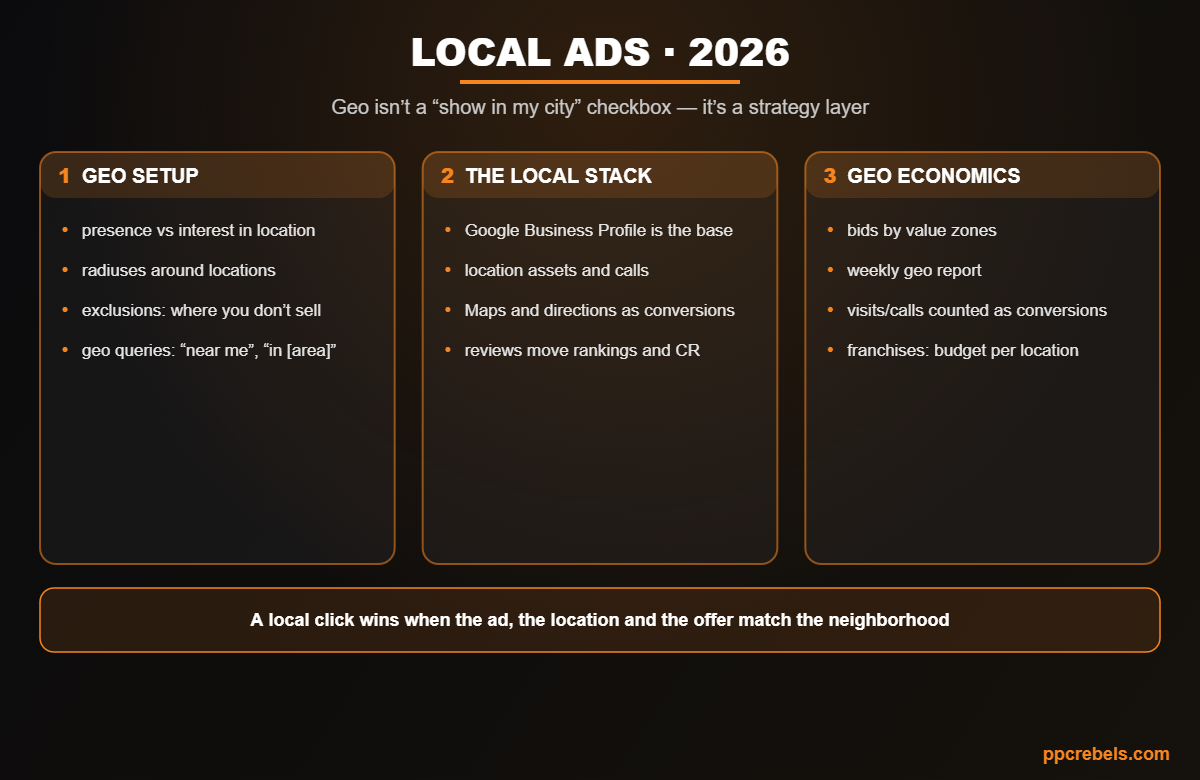
Geo setup: the details that decide
- Presence vs interest: by default Google also shows to people merely “interested in” a location while sitting elsewhere. Offline locations almost always need “presence” — otherwise you pay for other cities’ tourists.
- Radiuses around locations, not “the whole city”: the real accessibility zone (walking/driving/delivery) — with bids decaying by distance.
- Exclusions are mandatory: no-delivery districts, zones with incompatible economics, territories dead to you.
- Geo queries are their own keyword set: “X near me,” “X in [district],” “X by Y station” — dedicated ad groups mentioning the place, per the match types logic.
Google’s local stack
- Google Business Profile is the foundation: without a complete, verified profile there are no location assets, no Maps delivery, no “near me” pack.
- Location assets and calls: the address, the directions button, the phone number — for a local business a call and a plotted route ARE conversions; make sure they’re counted.
- Maps as a surface: Google Maps delivery via local formats and PMax with visit goals is a separate source of hot traffic.
- Reviews are a multiplier: the rating moves both local rankings and ad CR. A district-specific landing page with the address and a map converts better than a generic one — the rules from our landing page conversion guide.
Geo economics: value zones
- Bids by zone: adjustments (or separate campaigns) for districts with different AOV, competition and logistics — targets from each zone’s economics, per the bidding strategies rules.
- A weekly geo report: spend/conversions by district — leaks are instantly visible: paid traffic from zones you don’t serve is a classic audit finding.
- Visits and calls as conversions: hook up call tracking and (where available) store visits — or local campaigns look “unprofitable” while the shop is full.
- Franchise/chain: budget and targets per location, local pages per location — not one campaign “for the brand.”
Common mistakes
- “Interest in location” mode for an offline point — paying for other cities.
- “The whole city” in one slab without radiuses or exclusions.
- An empty or unverified Business Profile.
- Calls and directions not counted — and campaigns “don’t pay off” on paper.
- One landing page and one message for every district and location.
FAQ
For offline businesses and local services — presence. Leave “interest” to cases where the customer plans a trip: travel, real estate, relocation.
The real accessibility zone: 1–3 km for walk-in business, 5–15 km for drive-in, the delivery zone for services. Beyond that — only with negative adjustments.
Calls (call tracking or Google’s call reporting), plotted directions, store visits where available, plus bookings and requests. Without them, local campaigns are undervalued by multiples.
When districts differ meaningfully in economics or need their own budget and message — yes. For minor differences, per-zone bid adjustments within one campaign are enough.
The profile is the foundation: it’s free, it moves local rankings, and it unlocks local ad formats. Profile and reviews first, budget scaling second.
Bottom line
Local advertising in 2026 treats geo as a strategy layer: presence mode and radiuses instead of “the whole city,” geo keywords with their own ads, the Business Profile and reviews as the foundation, calls and directions in conversions, and bids by value zones. Build that layer — and the local auction, where most advertisers tick the “my city” box, becomes your cheapest customer source.