Google Ads Account Audit in 2026: The Checklist That Finds Where You Lose Money Silently
The account has been running for months, money keeps leaving, the reports look “fine” — and profit doesn’t grow. Nine times out of ten there are silent leaks inside: duplicate conversions, junk queries, brand mixed with generic, winners choked by budget. A Google Ads audit is how you find those leaks systematically instead of “checking CTR and nudging bids.” Below is the working 2026 checklist in the right order: measurement first, then structure, then money.
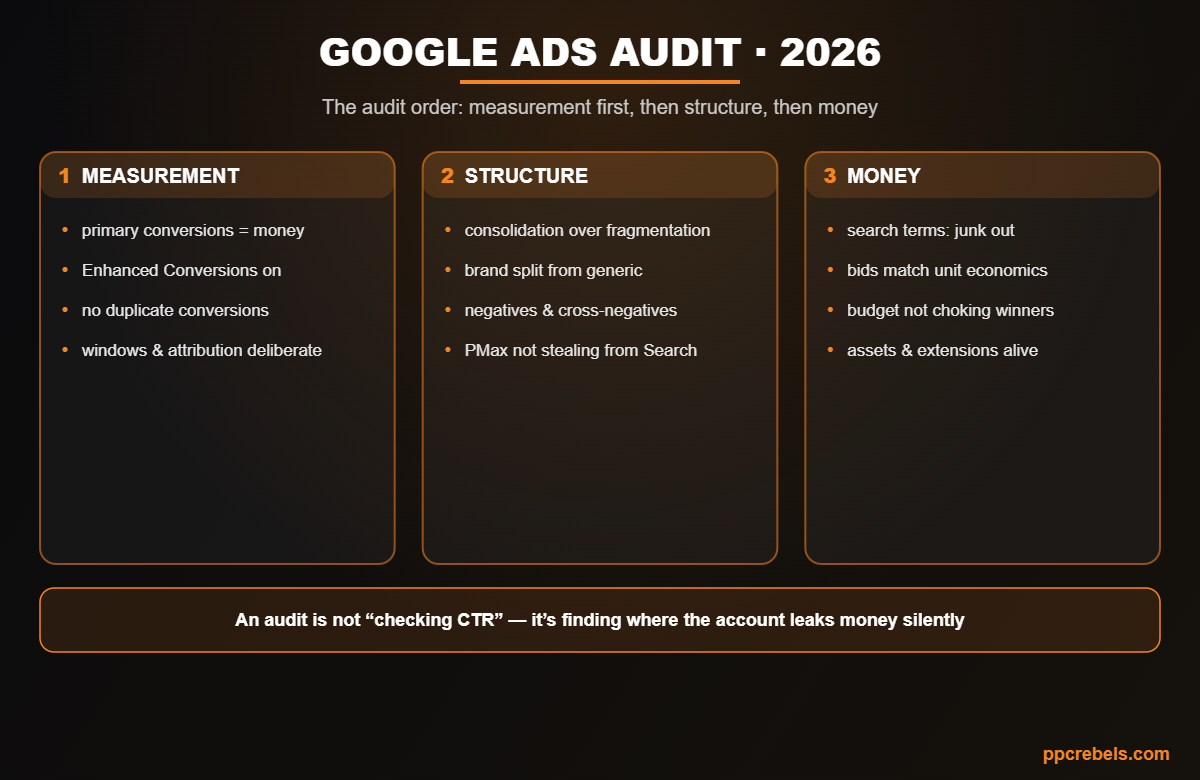
The order is critical: there’s no point optimizing bids while conversions count with duplicates, and no point cleaning queries while brand is mixed with generic. We go layer by layer.
Layer 1. Measurement: what the account learns from
- Primary conversions = money. Purchases, paid orders, qualified leads. Button clicks, unfiltered calls, and “viewed 5 pages” go to secondary. Smart bidding learns only from primary.
- No duplicates: the same sale must not be counted by the tag and a GA4 import at once. Duplicates inflate “success” and break tCPA/tROAS.
- Enhanced Conversions and server-side tagging are on — otherwise part of the conversions is lost and the algorithm bids blind. Measurement fundamentals are in our tracking and analytics in arbitrage guide.
- Conversion windows and attribution are deliberate choices, and channel comparison happens in an external coordinate system — how to read it is in the GA4 attribution guide.
Layer 2. Structure: where the account fights itself
- Consolidation over fragmentation. Dozens of micro-campaigns with 2–3 conversions each mean starving smart bidding. The full breakdown is in Google Ads account structure at scale.
- Brand split from generic: a separate exact-match campaign; brand terms negated everywhere else, including PMax.
- Negatives and cross-negatives: campaigns don’t compete with each other for the same query.
- PMax under control: campaign-level negatives, URL controls, and a check that it adds conversions rather than intercepting Search — details in the complete Performance Max guide.
Layer 3. Money: leaks and choked winners
- The search terms report: regular junk cleanup and promoting strong queries to exact match. The fastest money return in any audit.
- Bids match the goal: tCPA/tROAS set from unit economics, not “how it’s always been.” Sharp edits break learning more often than they help.
- Budget isn’t choking winners: your best campaigns sit at “Limited by budget” while laggards eat the daily cap — the classic silent leak.
- Assets and extensions are alive: callouts, structured snippets, images filled in; weak RSA assets replaced.
- The landing page isn’t wasting paid clicks: speed, relevance, and trust — per the checklist in landing page conversion for paid traffic.
How often to audit
A full layered audit — quarterly and at every account handover. A mini-audit (search terms, “Limited by budget,” conversion statuses, weak assets) — every 2–4 weeks. After major changes (new structure, bid strategy change, PMax launch) — a control check 2–3 weeks later, once data has accumulated.
Typical audit findings
- Duplicate conversions (tag + GA4 import) and micro-actions marked “primary.”
- Brand lumped with generic — and a pretty but fake ROAS.
- Search terms not cleaned for years.
- PMax without negatives intercepting Search.
- Top campaigns sitting at “Limited by budget.”
FAQ
With measurement: primary conversions, duplicates, Enhanced Conversions, windows. While conversions count wrong, any conclusion about bids or structure is guesswork.
A checklist mini-audit — 1–2 hours. A full layered audit of a mid-size account — half a day to two days depending on size and history.
Money: cost per conversion / ROAS against unit economics, junk share in search terms, “Limited by budget” on winners, and correct conversion counting. CTR and Quality Score are supporting signals.
An audit finds systemic leaks layer by layer (measurement → structure → money); optimization is the routine tuning inside an already healthy system. Audit first, optimize second.
Optimization Score and auto-recommendations are Google’s hints, and some of them grow spend rather than profit. Apply them selectively and only after your own layer checks.
Bottom line
A Google Ads audit is a discipline of layers: first make sure the account learns from the right money, then that the structure isn’t fighting itself, and only then tune bids and clean queries. Run the full checklist quarterly and the mini version every couple of weeks — and the leaks stop eating your margin silently.