Keyword Match Types in Google Ads 2026: Close Variants, Priority and Broad Match
An advertiser adds a keyword in exact match, expects to appear only on that query, and a week later finds dozens of search terms in the report that look nothing like an exact copy. Nothing is broken: keyword match types in Google Ads stopped being a string filter years ago and now work as an instruction about meaning. This is what each type actually does in 2026, how serving priority is resolved when several keywords qualify, why negative keywords follow entirely different rules, and what role match type kept after AI Max arrived.
What you get: a reach table by type, the precise close-variant rules, the order in which the system picks a keyword, a dedicated section on negatives, and a 20-minute audit checklist.
Three keyword match types and one that disappeared
Three types remain in the interface, but the history matters: broad match modifier (+keyword) was retired and its logic absorbed into phrase match. Google keeps the official definitions in its help article on keyword matching options. Accounts that have not been restructured in a few years are still running keyword sets designed for rules that no longer exist.
| Type | Syntax | What it serves on | Word order | Reach |
|---|---|---|---|---|
| Exact | [keyword] | Queries with the same meaning: rewordings, synonyms, reordering where meaning is unchanged | Can change if meaning survives | Narrowest |
| Phrase | “keyword” | Queries that include the meaning of the phrase; words may appear before and after | Meaningful order preserved | Middle |
| Broad | keyword | Topically related queries, including terms absent from the keyword | Irrelevant | Widest |
The practical translation for keyword match types: exact match in 2026 does not mean “this exact string”, it means “this exact intent”. Plurals, misspellings, reordering, synonyms and added function words still count as the same meaning. But a qualifier that shifts intent — “buy” versus “reviews”, “price” versus “how to install” — moves a query out of an exact keyword’s reach.
What counts as a close variant
- Misspellings and typos, including keyboard-adjacent errors.
- Singular and plural forms, stemmings and abbreviations.
- Synonyms and paraphrases where a word is swapped for an equivalent.
- Reordered words when the meaning is unchanged.
- Function words — prepositions and conjunctions that do not affect intent are ignored.
- Implied words that are obvious from context.
Google does try to protect cases where order carries meaning: “flights from Boston to Denver” is not supposed to collapse into the reverse route. Treat that as behaviour, not a guarantee — which gives the central rule of match types in 2026: your reach is defined not by the brackets but by the triad of match type, negative keywords and a weekly read of the search terms report. We cover that loop in the piece on negative keywords and search terms analysis.
Which keyword wins: serving priority inside the account
The second most common confusion after “exact serves on odd queries” is not knowing which keyword fires when several qualify. The order is:
- An identical match wins. If the account contains a keyword identical to the query, it is preferred regardless of other candidates’ match types and regardless of bid.
- With no identical match, eligible candidates compete and Ad Rank decides: bid, expected CTR, relevance, landing page experience. The mechanics are in our breakdown of Quality Score and Ad Rank.
- Low rank removes a keyword from the auction and serving passes to the next eligible one — which is how a tightly written keyword with poor quality silently loses to a broad one with good quality.
If one query converts through different keywords in different campaigns, that is not a duplicate to clean up. It is a signal that structure is not deciding the outcome — rank is. Clean up only what breaks measurement: conflicting landing pages, mismatched strategies, different goals.
Negative keywords follow different match rules
This is the most expensive asymmetry in the system, and knowing it saves budget. Negative keywords do not use close variants: excluding “free” will not stop a query containing “freely” or a misspelling of it. Three consequences:
- Add negatives in every meaningful form — plurals, common misspellings, spacing variants.
- A negative phrase in quotes blocks queries containing that exact sequence; a negative exact in brackets blocks only the identical query.
- A negative broad keyword blocks a query only when all of its words are present, in any order.
In practice: keep an account-level list for junk intent (jobs, salary, free, DIY, torrent, “how to make”) and campaign-level lists for vertical overlaps. Regularity beats completeness: ten minutes a week in the search terms report outperforms one heroic quarterly cleanup. The operating cadence is part of our Google Ads account audit checklist.
What AI Max changed — and why match type did not die
With AI Max for Search, a campaign can serve beyond your keyword list: the system finds relevant queries itself and additionally adapts headlines and the landing page. Which revived the claim that keywords no longer matter. That is an overstatement, for three reasons.
First, keywords still define the demand core that expansion builds from — the sharper the core, the less waste on the edges. Second, negatives remain the primary constraint, and in expansion modes their importance rises rather than falls. Third, through 2026 Google has been testing text ads in AI Mode specifically for exact and phrase match keywords on direct-intent queries — meaning the restrictive match types gained access to a new surface. The practical conclusion: maintaining a deliberate exact and phrase structure for priority intents is worth it even when most of your volume runs on automation. How the mode itself works is in our guide to AI Max for Search campaigns, and what it actually exposes in reporting is in the unified AI Max journey report.
One more wrinkle: landing pages. In expansion modes the system may substitute the final URL within an allowed set, so the keyword-to-page mapping stops being your decision. The limits of that control are in final URL expansion in PMax and AI Max.
Choosing keyword match types: the working model
| Situation | Primary type | Why |
|---|---|---|
| New account, no data | Phrase, plus a few exact on the core | You need query volume to learn from, without blind spend |
| Brand terms | Exact and phrase | Prevents drift onto competitors and unrelated meanings |
| High-cost lead gen, narrow service | Exact as the base | The cost of a wrong click is high and expansion delivers junk leads |
| Low search volume | Phrase or broad | Exact volume will not be enough to exit the learning period |
| Exploring a new market | Broad with a strict negative set and a capped budget | The goal is a map of real queries, not immediate payback |
| Scaling proven demand | Phrase plus automated modes | The core is known; what you need is incremental volume |
What not to do: duplicate the same keyword across all three types in separate ad groups “to be safe”. In 2026 that produces three outcomes, all bad — data fragments across keywords, learning slows, and serving is still decided by rank. One meaning, one keyword, one type; negatives handle the rest. That is the simplest way to keep keyword match types readable in reports.
When broad match earns: four conditions
Broad match is not a default, it is a setup that pays off only when the account gives it the right inputs. Remove any of these and broad reverts to its old reputation.
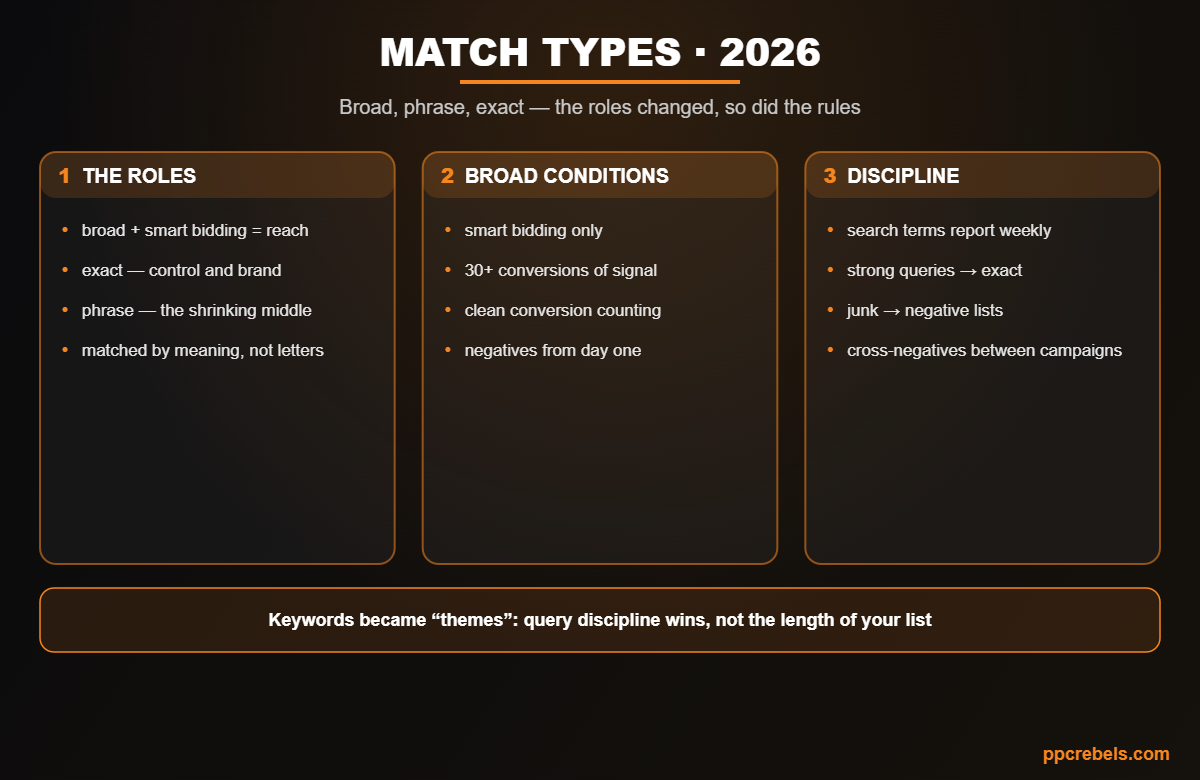
- Smart bidding only (tCPA or tROAS): broad hands query selection to the algorithm, and a goal-driven bidder must steer it. Which goal to set is covered in the bidding strategies guide.
- Signal: 30+ conversions a month and clean counting, with no duplicates or micro-goals as primary conversions. Otherwise semantic matching learns from noise.
- Negatives from day one: obviously junk themes, competitor brands where you do not want them, informational queries with no intent.
- Brand kept separate on exact and excluded from broad campaigns and Performance Max. Otherwise the “wide” campaigns paint their ROAS on your own brand demand.
The weekly search terms routine
- Search terms report, every week: junk goes to the negative list, strong converting queries are promoted to exact with their own bid.
- Cross-negatives where they change the economics: exact campaigns protected from broad interception (and vice versa) so campaigns do not bid against each other.
- Account-level negative lists: one shared list of junk themes attached to all campaigns.
- A quarterly review as part of the account audit. Query hygiene is the fastest money return in most accounts.
A 20-minute audit: six checks
- Search terms report, last 30 days, sorted by cost. Flag everything that misses the intent — that is today’s negative list.
- The “Search term match type” column. Compare which type delivered the traffic and the cost. If 80% of your exact keywords’ spend arrives through close variants, your “exact” campaign is effectively phrase.
- Duplicate keywords across campaigns with different landing pages. Split them by intent or keep one.
- Negative keyword forms. Take your top ten negatives and verify that plurals and frequent misspellings are present.
- Keywords with zero impressions over 90 days. Either there is no demand or they lose on rank — either way they only make the report harder to read.
- Reconcile with conversions. If a match type shows cost without conversions over a long window, verify measurement first: see Google Ads and GA4 conversion discrepancies.
Common mistakes
- Treating exact match as a string filter. The most expensive myth: reach is set by meaning and constrained by negatives.
- Adding negatives in one form only. Close variants do not apply to negatives — matching is literal.
- Fixing irrelevance with bids instead of structure. Lowering a bid removes volume wholesale, not just the irrelevant slice.
- Switching broad match off “just in case”. On thin demand that is a reliable way to stay in the learning period forever.
- Excluding a converting query because it “does not look like the keyword”. Economics decides, not phrasing.
- Running broad match on manual bids “as a test”. Without per-auction bidding the test becomes a leak.
- Judging broad match by the first three days. Semantic matching needs data and time before the search terms settle.
There is a parallel layer: match type governs the query, channel priority governs the surface. Both are worth setting in one pass — priorities are covered in the companion article on channel prioritization and budget caps. And the third layer is what the visitor meets after the click: correct methodology in landing page A/B tests for paid traffic.
If you are building structure from scratch, our Google PPC agency overview explains how we approach it on live accounts, and access questions for manager-account setups are covered under Google Ads agency accounts.
A worked example: one query, four setups
Take a service business — emergency fridge repair in Denver — and watch how one user query is handled by four different account configurations.
| What the account contains | Query: “fridge not cooling fix today denver” | Outcome |
|---|---|---|
| Only [fridge repair denver] | Close in meaning, but “today” adds urgency — a qualifier, not a rewording | Serving is possible but not guaranteed; reach depends on how the variant is interpreted |
| Phrase “fridge repair” | The phrase meaning is present with words before and after | Serving expected; statistics accumulate on one keyword |
| Broad fridge repair | Captures this, plus “fridge repair diy” and “appliance repair technician jobs” | Needs a strict negative set, otherwise 30–40% of spend drifts to non-commercial intent |
| Phrase plus added [emergency fridge repair denver] | A narrow keyword now matches the intent directly | The narrow keyword takes priority; the urgent intent gets its own stats, ad and landing page |
The transferable lesson: promote converting phrasings into their own keywords not for the sake of tidy structure, but to gain control — a separate bid, a separate ad, a separate page. Let phrase match catch everything else.
Keyword sets in 2026: how many keywords each match type needs
Old-school instinct says build a few thousand keywords and split them one per ad group. In a world where reach is defined by meaning, that produces the opposite of control: a thousand keywords on one intent fragments the statistics so that none of them ever accumulates enough data to act on.
The working reference we apply on lead-gen accounts:
- One intent, one ad group, one to five keywords. Go wider only when the phrasings genuinely demand different ads.
- Every keyword should earn at least a few clicks a week. A keyword that collects no data in a month is a line in a report, not a control.
- Split ad groups when the ad or the landing page changes. If copy and page are identical, splitting buys nothing but fragmentation.
- Cross-group negatives belong only where the overlap genuinely changes the economics. Blanket cross-negation often hurts in 2026, because it cuts off close variants that were converting.
There is also a ceiling question. In large accounts, forcing every intent into its own group collides with entity limits; the numbers are collected in Google Ads account limits. Before designing a structure with thousands of groups, confirm it survives another year of growth.
Keyword match types and automated bidding
A layer that rarely gets factored in. An automated strategy prices each auction from a large set of signals, and the keyword’s match type is only one of them. The practical consequences:
Broad match performs better under automated bidding than under manual bids. The logic is simple: a manual bid is identical for every query the keyword caught, while an automated bid is set per auction. That is exactly why broad match — long regarded as a way to burn budget — became a legitimate scaling tool alongside tCPA and sound conversion tracking. One condition: the conversion data must be honest, otherwise the strategy learns from noise. The verification order is in enhanced conversions.
Restrictive types remain the way to ring-fence priority demand. When an account has a query segment that reliably pays back, keep it on dedicated exact and phrase keywords so you can steer its bid, ad and page separately instead of dissolving it into a shared pool.
Negatives matter more than match type. Under automated bidding the real constraint shifts to them: the type defines the search space, negatives carve out what does not belong. If you have one hour, an hour in the search terms report pays better than an hour rearranging quotation marks.
Bottom line
Keyword match types in 2026 are a division of roles. Broad with smart bidding mines reach and new queries, exact holds control and brand, and phrase covers the middle. A weekly routine of search terms and negatives turns the “wide” campaign from roulette into a system. Fewer keywords, more data, stricter hygiene, and keywords work for you again.
FAQ
How many keyword match types exist in Google Ads in 2026?
Three: exact, phrase and broad. Broad match modifier was retired and its behaviour folded into phrase match.
Why does exact match serve on queries that are not identical?
Because it selects queries by shared meaning rather than shared text. Rewordings, synonyms, plurals, misspellings and reordering that preserves meaning all count as close variants.
Can close variants be turned off?
There is no switch for it. You constrain reach with negative keywords and a regular pass through the search terms report.
Which keyword wins when several qualify?
A keyword identical to the query takes priority. If none is identical, the eligible candidate with the highest Ad Rank serves.
Will a higher bid force my preferred keyword to serve?
No. When an identical match exists, it is preferred regardless of bid. Bid only influences selection among non-identical candidates.
Do close variants apply to negative keywords?
No. Negative matching is literal, which is why meaningful forms and frequent misspellings must be added manually.
How does a negative phrase differ from a negative exact?
A negative phrase in quotes blocks queries containing that word sequence. A negative exact in brackets blocks only the identical query.
Do I still need keywords if AI Max is on?
Yes. Keywords define the demand core the expansion builds from, and negatives remain the main constraint. On top of that, Google has been testing text ads in AI Mode specifically for exact and phrase keywords on direct-intent queries.
Should I duplicate a keyword across all three types?
No. It fragments data, slows learning and does not control the serving outcome, which rank decides anyway. One meaning, one keyword.
How do I tell that an exact-match campaign is behaving like phrase?
Add the “Search term match type” column to the search terms report. If most of the cost arrives via close variants, your effective reach is wider than intended.
Why does a keyword get no impressions?
Either there is no demand, or it loses on Ad Rank to other eligible keywords in the account, or the match type is too narrow for how people actually phrase the query. Start with the search terms report and landing page quality.
What should I do with a converting query that is far from my keyword?
Add it as its own keyword in exact or phrase match. It then gains serving priority and its own statistics, and the algorithm stops guessing at that intent.
Is broad match still “evil”?
No, under three conditions: smart bidding with a correct goal, 30+ conversions of clean signal, and negatives discipline. Remove any of them and broad reverts to its 2015 reputation.
When should you use exact match?
Brand, your highest-value transactional queries, cannibalization protection, and anywhere you need predictable bid and copy control for a specific intent.
Is phrase match still needed?
As a transition format, yes: when broad feels scary and exact is too narrow. But its zone keeps shrinking, and most 2026 setups live on the broad + exact pair.