Meta Advantage+ in 2026: What to Hand to the AI and What to Keep — The Meta Ads Automation Guide
Google has Performance Max, TikTok has Smart+, and Meta’s flagship AI loop is called Advantage+. The idea is the same: you hand the algorithm audiences, placements and creative combinations, and keep the signal, the creative and the guardrails. Those who understand this division of roles scale cheaper than manual setups; those who just “pressed the button” feed the algorithm junk and wonder where the budget went.
Let’s break down how Advantage+ campaigns work in 2026, what’s genuinely worth handing to automation, which levers to keep in your hands, and what discipline turns Meta’s “black button” into manageable performance.
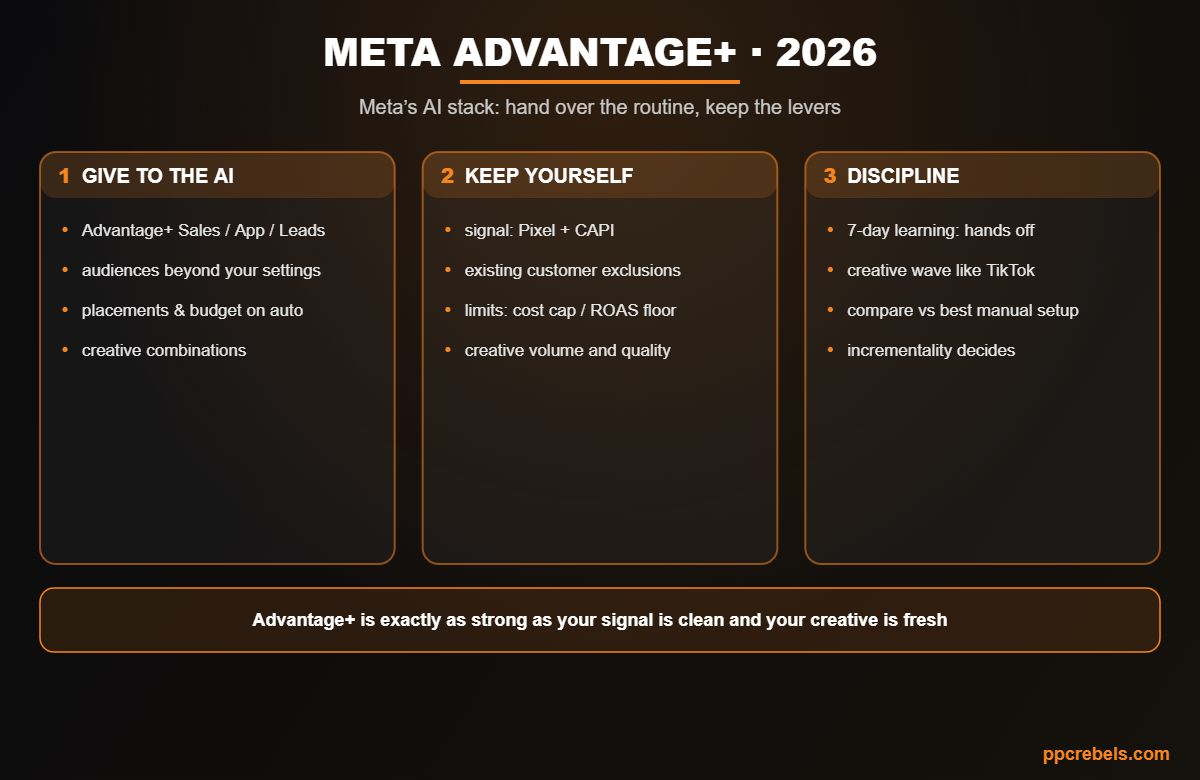
What Advantage+ is and what to give the AI
- Advantage+ Sales (the former ASC), App and Leads — campaigns where Meta assembles audiences, placements and budget allocation for the goal itself. It’s the direct sibling of Performance Max and the Smart+ from our TikTok advertising breakdown.
- Audiences: the algorithm goes far beyond interests and lookalikes — your settings become a hint, not a boundary.
- Advantage+ creative: automatic enhancements, format variants and combinatorics from your assets.
- Placements: auto across all surfaces (feed, Stories, Reels, Audience Network) — trimming them by hand almost always costs more than it seems.
What to keep in your hands
- The signal is sacred: Pixel + Conversions API with deduplication, events = money. Advantage+ learns from what you feed it — the setup is in our Meta Ads conversion tracking guide.
- Exclusions: purchasers and existing customers handled separately (ASC has an existing-customer share cap for this) — otherwise “new sales” turn out to be remarketing, same logic as in retargeting.
- Economic guardrails: cost cap / ROAS goal from unit economics, not “whatever happens.”
- Creative: volume and freshness are your job. Auto-enhancements won’t save three tired banners.
Launch and evaluation discipline
- Hands off for the 7-day learning: budget/goal edits in the first days restart calibration.
- A creative wave: 6–10 assets at launch, rotate tired ones every 2–3 weeks — Meta’s feeds need the same conveyor as TikTok.
- An honest comparison: Advantage+ versus your best manual setup on identical signal and windows — decided by cost per result, not by hype.
- Incrementality: watch total sales growth and the share of new customers, not just campaign ROAS.
Common mistakes
- Launching Advantage+ on a leaky pixel without CAPI — automation multiplies a broken signal.
- No customer exclusions — “new sales” from your own buyers.
- Three creatives per campaign and faith in auto-enhancements.
- Poking budget and goal every two days.
- Judging on day three instead of a full post-learning week.
FAQ
Not fully: it’s strong at scale on broad audiences; manual setups remain for hypothesis tests, narrow segments and hard control. Most accounts run both.
6–10 varied assets at launch (statics, video, vertical) with regular rotation. Combinatorics needs something to combine.
Most often it’s selling to existing customers. Check the exclusions/existing-customer cap and watch incrementality and the new-customer share.
Yes. The browser pixel loses a meaningful share of events, and automation without a full signal bids blind. Pixel + CAPI with deduplication is the mandatory base.
When the signal is broken, conversions are scarce (nothing to learn from), or there’s no resource for a creative conveyor. Basics first — automation second.
Bottom line
Advantage+ in 2026 is a division of roles: the algorithm gets audiences, placements and combinatorics; you keep the clean signal (Pixel + CAPI), customer exclusions, economic guardrails and the creative wave. Add 7 days of patience and incrementality-based evaluation — and Meta’s “button” becomes a manageable scaling channel.