Retargeting in 2026: Bring Back the Ones Who Left Without Burning Out Your Audience — Data, Segments, Frequency
TL;DR: Retargeting brings back warm audiences cheaper than cold traffic, but it burns out fast. Segment by funnel depth, cap frequency and refresh creatives. Clean data and lists matter more than aggressive impressions. This guide shows how to run retargeting in 2026 without annoying your audience.
Someone adds a product to the cart, checks the price — and leaves. For most advertisers that’s a lost click you paid for. For those who know retargeting, it’s the warmest segment in the account: the person already knows the offer, you just need to bring them back and close. But in 2026 retargeting works nothing like it did five years ago: cookies crumbled, iOS strips identifiers, and users are tired of banners stalking them for weeks.
Let’s break down how to build retargeting that adds profit instead of just reallocating it: what data it now runs on, how to slice segments so you don’t burn out your audience, and how to tell whether your remarketing is actually incremental.
What changed: retargeting survived the death of cookies
Classic retargeting lived on third-party cookies: pixel tags the visitor, banner chases them. That model didn’t die overnight, but the reliability of browser tagging collapsed: Safari ITP, iOS ATT, ad blockers, and in-app browsers strip identifiers long before an audience can fill up. Chrome ultimately kept its third-party cookies (Google reversed the deprecation in April 2025), but betting on one browser is not a strategy.
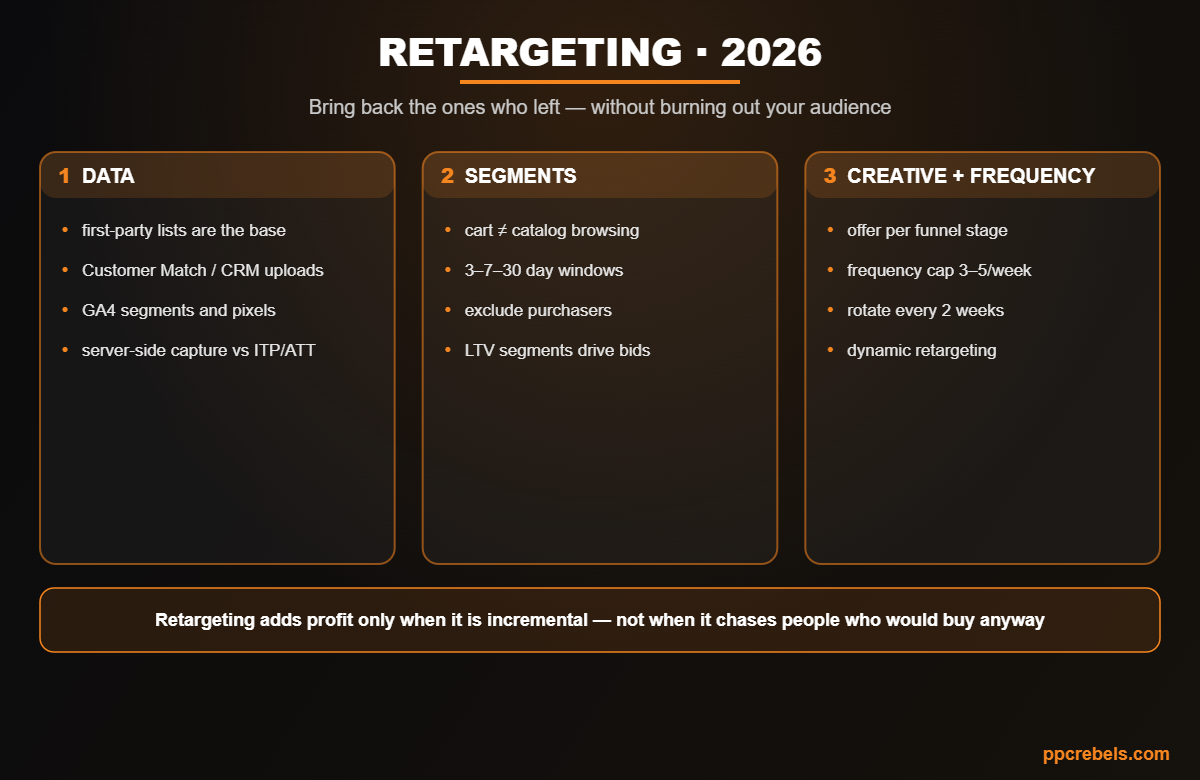
The new foundation is first-party data: your own lists (emails, phone numbers) via Customer Match and its equivalents, site events through server-side capture, GA4 segments. The less you depend on someone else’s cookie, the more stable your audiences. For building the signal itself, see our tracking and analytics in arbitrage guide and the Meta Ads conversion tracking breakdown: without a server-side layer, your retargeting lists fill up half-way at best.
Segmentation: retargeting is not “chase everyone”
One “all visitors, 30 days” audience with one banner isn’t retargeting — it’s carpet-bombing. The money is in segments by intent and recency:
- By intent depth: abandoned cart ≫ viewed a product page ≫ just visited the site. Those are three different bids and three different offers.
- By windows: 3 days (hot, aggressive bid), 7 days (warm), 30 days (gentle reminder). The older the segment, the lower the bid.
- Exclusions are mandatory: purchasers leave the selling segments (and enter upsell/repeat-purchase flows). Chasing someone with the product they bought yesterday burns budget and goodwill.
- LTV segments: returning and high-value customers deserve a higher bid than one-timers.
Frequency and creative: don’t turn remarketing into stalking
- Frequency cap: aim for 3–5 impressions per person per week. Above that, CTR drops, irritation grows, and your brand becomes synonymous with pushiness.
- Rotate every ~2 weeks. The same banner for a month equals banner blindness.
- Offer per stage: abandoned carts get a reminder plus objection-handling (shipping, returns); catalog browsers get bestsellers and social proof; older segments get something new or a reason to come back. A universal “10% off” for everyone just eats margin.
- Dynamic retargeting (the exact product from the cart) is the strongest e-commerce format — but it lives by the same frequency and exclusion rules.
Incrementality: the real question of retargeting
Retargeting always shows a beautiful ROAS — it skims the warmest people, some of whom would have bought anyway. The real question: how many sales did it add, not claim. Warning signs: retargeting “delivers” a huge share of account conversions on a tiny reach; view-through attribution windows are inflated; pausing the campaign for a week changes nothing in total sales. In practice: test by switching it off for part of the audience (or a geo), judge by total account conversions rather than one campaign’s report, and keep attribution windows sane.
Where to send people back
Retargeting brings the person back — the page converts them. Return people to context: abandoned cart → the cart, product viewer → the product page, not the homepage. And keep the page itself fast and convincing — the speed/relevance/trust breakdown is in our guide to landing page conversion for paid traffic. For the specifics of cold social traffic that later feeds your segments, see the TikTok advertising guide.
Common mistakes
- One “all visitors, 30 days” segment with one banner and no frequency cap.
- Not excluding purchasers — and chasing them with what they already bought.
- Judging retargeting by campaign ROAS instead of incremental account sales.
- Relying on the browser pixel alone — no server-side capture, no first-party lists.
- Sending everyone to the homepage instead of the context they left.
FAQ
In practice they’re synonyms: bringing back people who already interacted with your site or brand. Historically “remarketing” was Google’s term (including email win-backs) while “retargeting” meant banner chasing. Today the distinction has blurred away.
Yes, but on a new foundation: first-party lists (Customer Match), server-side event capture, GA4 segments. Chrome ultimately kept third-party cookies, but Safari/iOS and ad blockers made browser-only tagging unreliable long ago.
A working benchmark is 3–5 impressions per person per week with creative rotation every ~2 weeks. More than that raises irritation and lowers CTR while adding almost no conversions.
The classic ladder: 3 days — hot (max bid), 7 days — warm, 30 days — a light reminder with a minimal bid. For expensive products with long cycles, stretch the windows.
Because it works the warmest audience and often claims conversions that would have happened anyway. That’s why you judge it by incrementality — growth in total account sales — not by one campaign’s report.
Audiences need to fill up: on low traffic your segments will be too small for stable delivery (platforms enforce minimum list sizes). If traffic is thin, start with one or two broad segments and split them as you grow.
Bottom line
Retargeting in 2026 is a discipline, not “turn on the chase.” Your own data instead of someone’s cookies, segments by intent and recency instead of “everyone, 30 days,” an offer per funnel stage, a hard frequency cap — and an honest incrementality check. That’s when remarketing turns from a pretty report into real added profit.