Demand Gen in Google Ads in 2026: How to Create Demand When Search Is Already Bought Out
Search captures existing demand. But what do you do when that demand is bought out, the auction is overheated, and there’s nowhere left to scale? You create demand yourself — and that’s exactly what Google built Demand Gen for: campaigns for its visual feeds (YouTube, Shorts, Discover, Gmail) that work like Meta’s feed, but inside Google’s ecosystem. For a media buyer it’s the way beyond Search without leaving the familiar dashboard.
Let’s break down how Demand Gen differs from PMax and Search, how to build audiences (including the returned lookalike segments), what creative works here, and how to evaluate campaigns that by definition live at the top of the funnel.
What Demand Gen is — and how it’s not PMax
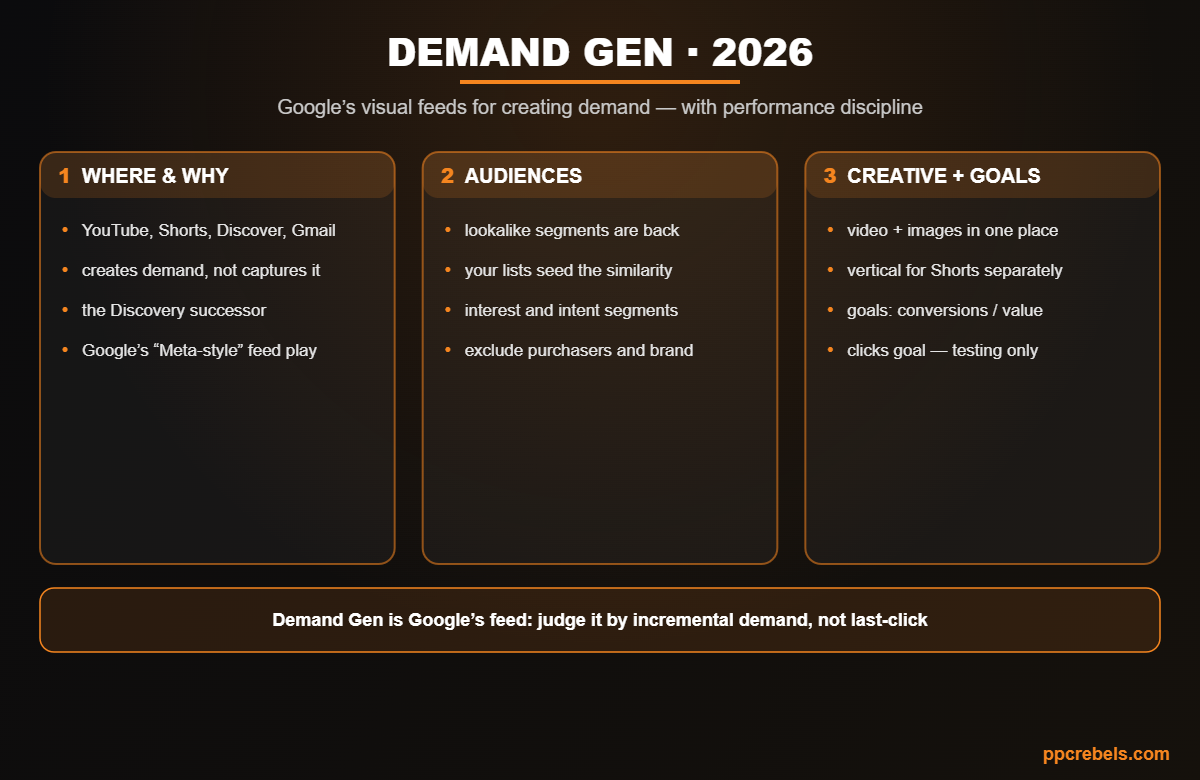
Demand Gen is the successor to Discovery campaigns: it serves in Google’s visual feeds (YouTube and Shorts, Discover, Gmail) and is built for creating demand — showing the offer to people who weren’t searching for it but resemble those who buy. The key differences: versus Search, there’s no query — you create the intent; versus Performance Max, you choose the placements and audiences yourself, while PMax decides for you and covers the whole funnel at once. The selection logic: PMax — “cover everything and optimize on money”; Demand Gen — “a controllable top of funnel with audience and creative control.”
Audiences: lookalikes are back in Google
- Lookalike segments are Demand Gen’s headline feature: Google builds similarity from your first-party lists. Seed quality decides everything: purchaser and high-value customer lists produce far better segments than “all visitors.”
- Your data is the seed. Customer Match, site segments, and video viewers are the foundation for both lookalikes and follow-up — collection rules are covered in our retargeting guide.
- Interest and intent segments — for a cold start when your own lists are thin.
- Exclusions are mandatory: purchasers and brand audiences stay out of demand-creation campaigns, or Demand Gen will beautifully “re-discover” people who are already yours.
Creative and goals: a feed is a feed
- Video + images in one campaign. For Shorts — vertical 9:16 as a separate creative; the hook and nativeness laws are the same as in video ads for performance.
- The first frame/image sells the click: in Discover and Gmail you compete with content, not ads — stock banners get scrolled past.
- Goals: conversions or conversion value (tCPA/tROAS/Max Conversion Value) on a countable signal. The clicks goal is for short creative tests only, not for living.
- Rotation: feeds burn creative fast — several variants in testing and a refresh every 2–4 weeks.
Evaluation: incremental demand, not last-click
Demand Gen lives at the top of the funnel, and last-click chronically undervalues it: someone sees the video today and buys next week from Search. Judge by incrementality: growth in total account conversions, growth in brand and direct traffic, conversion paths and model comparison in GA4 attribution. A separate health marker is the share of new users among conversions: Demand Gen must bring new people, or it’s just expensive remarketing.
Common mistakes
- Judging Demand Gen by last-click ROAS and killing the channel in two weeks.
- Building lookalikes from a junk seed (“all visitors, 540 days”).
- Not excluding purchasers and brand — and paying to “re-discover” your own.
- One horizontal banner for every placement, Shorts included.
- Launching without a countable signal — smart bidding has nothing to learn from.
FAQ
PMax covers all channels and the whole funnel at once, deciding for you; Demand Gen is a controllable top of funnel on visual placements where you pick the audiences, placements, and creative yourself.
Yes — lookalike segments are Demand Gen’s key capability. Quality depends on the seed: purchaser and high-value lists build better similarity than broad visitor segments.
Conversions or conversion value on a correct signal (Enhanced Conversions, server-side tagging). The clicks goal is for short creative tests only.
By incrementality: growth in total conversions, brand searches, and the share of new users. One campaign’s last-click report is a knowingly understated picture for the top of the funnel.
When search demand isn’t bought out yet, the signal isn’t countable, or there’s no resource for proper visual creative. Basics first — Search, tracking, landing page — then demand creation.
Bottom line
Demand Gen is Google’s feed for those who’ve outgrown Search: lookalikes from your own data, feed-native visual creative, conversion goals, and evaluation by incremental demand. Keep the exclusions, the vertical for Shorts, and a countable signal — and the channel creates new customers instead of recounting old ones.