Marketplace Advertising in 2026: Retail Media One Click from the Cart — Listings, ACOS and the Organic Loop
Retail media is the fastest-growing ad segment for a reason: marketplace advertising catches the shopper one click from the cart, wallet in hand, intent formed. But this auction has its own laws: there’s no landing page — there’s a listing; no traffic of “your own” — there’s the platform’s algorithm; and the bid is computed from a margin the marketplace has already taxed with commission, logistics and storage. Carry Google Ads habits here unadjusted — and you’ll pay for someone else’s sales.
How marketplaces differ from “regular” PPC
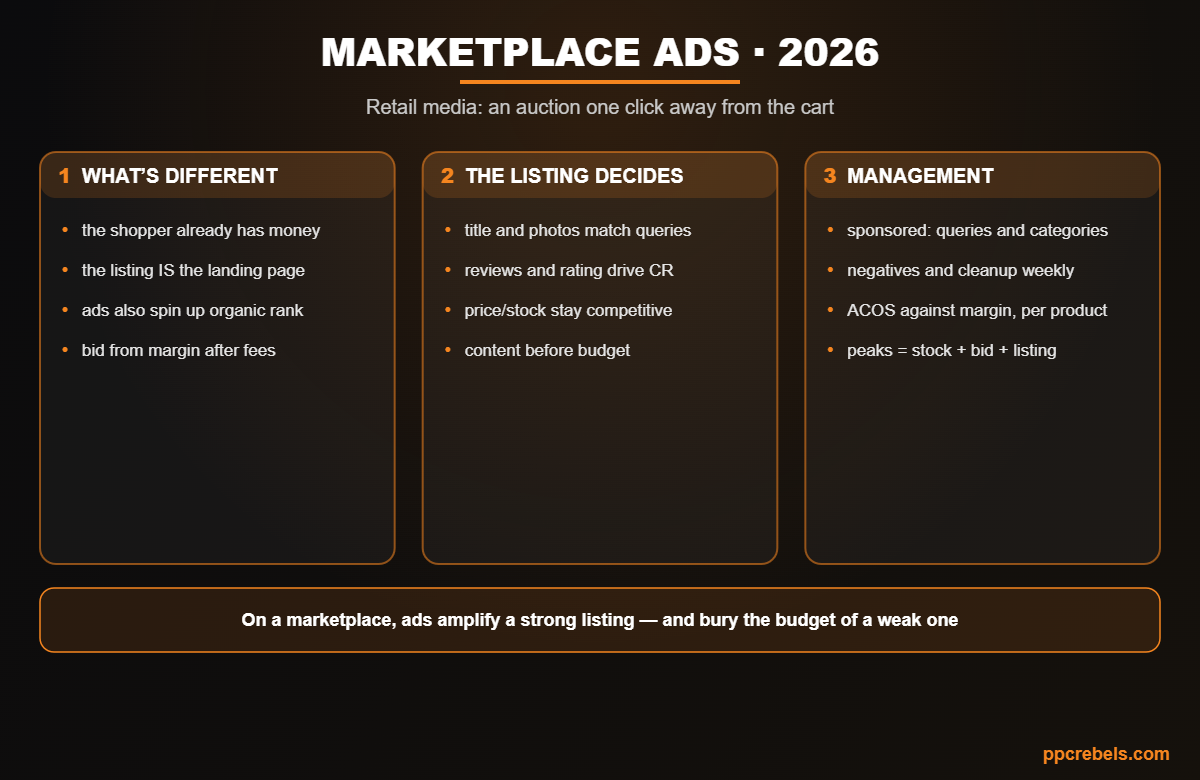
- The shopper sits at the bottom of the funnel: they’re already searching for the product with money in hand — conversion is higher, but so is shelf competition.
- The listing IS the landing page: you don’t control the page, only the listing content. Everything you knew about landing pages compresses into photos, the title, specs and reviews.
- The ads → sales → organic loop: ad-driven sales lift the listing’s organic rank — a well-run campaign pays back twice. That’s the key difference from Google Shopping, where there’s no organic flywheel.
- Economics after fees: the bid derives from margin minus platform commission, logistics, storage and returns — per the unit economics math, or a “profitable ACOS” turns out to be a cash-register loss.
The listing decides: content before budget
- A query-driven title: the shopper’s keywords at the front of the name — the listing matches the platform’s search the way a feed matches product campaigns.
- Photos and rich content: the main image wins the click from the shelf; the gallery and infographics inside win the conversion.
- Reviews and rating are a CR multiplier: a listing rated below competitors leaks ad budget; review collection is part of the ad system.
- Price and stock: an uncompetitive price or an empty warehouse kills both ads and organic rank. Promoting a listing without inventory is burning money.
Campaign management
- Sponsored formats per job: search placements on queries are the workhorse; category/product-page placements add reach; display serves launches and brand.
- Weekly query hygiene: the search-term report, junk to negatives, converters promoted to exact campaigns — the same discipline as in match types.
- ACOS against margin, per product: each item has its own acceptable percentage; for new products a temporary ACOS above margin is the price of spinning up organic rank — deliberate and time-boxed.
- Peaks follow the platform’s calendar: marketplace sale events are stock, bids and listings prepared in advance, per the seasonal planning logic.
Common mistakes
- Ads on a weak listing — CR buries any budget.
- ACOS ignoring commissions and logistics — “profit” that doesn’t exist.
- One average ACOS across an assortment with mixed margins.
- Promoting a product with a draining warehouse into a peak.
- Launching without weekly query cleanup — budget on irrelevance.
FAQ
With the listing: a query-driven title, photos, reviews, a competitive price and stock. Then a sponsored search campaign on target queries with weekly cleanup.
Per product: the ceiling = margin after fees and logistics minus target profit. New products can run a temporarily higher ACOS — as an investment in organic rank.
They’re one loop: ads drive sales, sales lift organic rank, organic reduces ad dependence. Managed well, the ad share of sales falls over time.
No: budget goes to drivers and high-margin items with strong listings; the tail lives on organic or minimal bids. Segment like product campaigns.
2–3 weeks out: stock against the forecast, listings and prices refreshed, bids and budgets raised gradually. During the peak itself — monitoring only, no sharp edits.
Bottom line
Marketplace advertising in 2026 is retail media with its own laws: the listing instead of a landing page, bids from post-fee margin, the ads → sales → organic loop and weekly query hygiene. Listing and economics first, budget second — and the auction one click from the cart becomes your shortest path to sales instead of the most expensive one.