
Seasonality and Budget Planning in 2026: Buy Traffic Cheap and Meet the Peaks Ready
November: the auction is boiling, CPMs at the ceiling, and your best campaigns “run out of budget.” February: traffic is cheap, but the budget’s already cut “because it’s off-season.” That’s reactive money management — and it consistently loses to planning. Seasonality in performance marketing isn’t a surprise, it’s a schedule: demand peaks and valleys repeat year after year, and budget can be mapped to them in advance.
Step 1. The demand map: when your vertical breathes
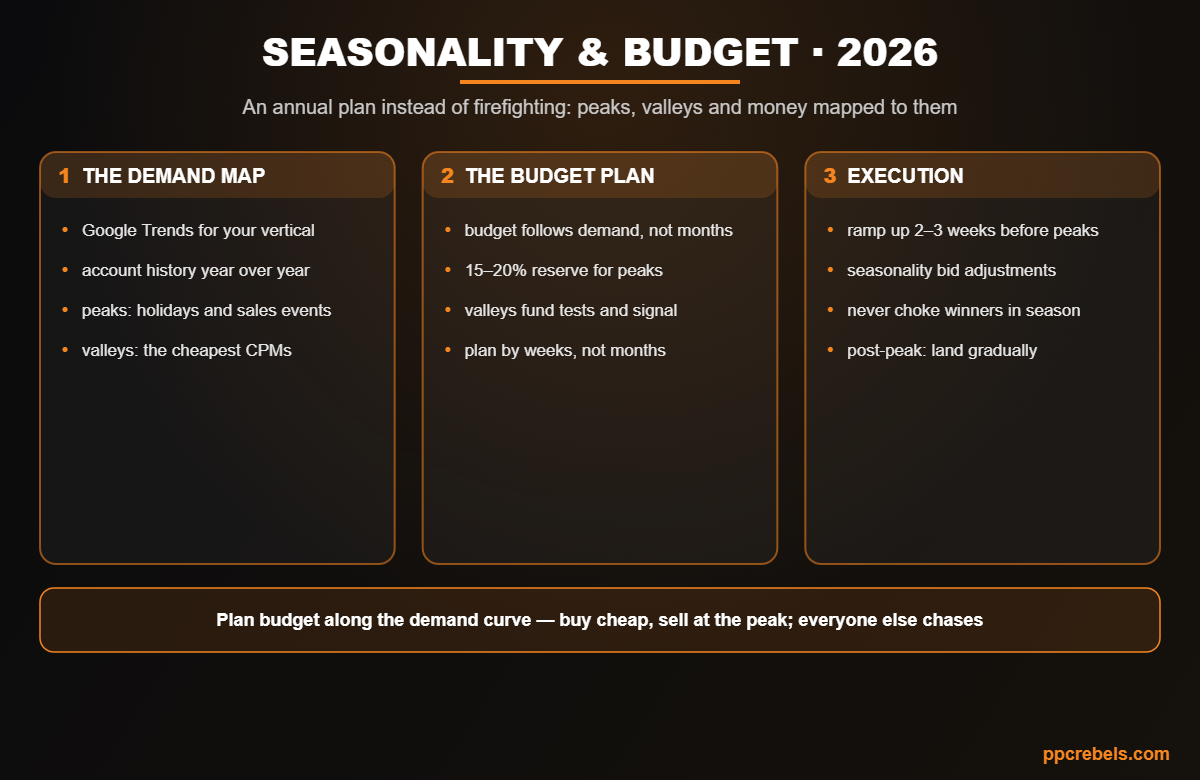
- Google Trends for your vertical’s key queries over 3–5 years: peaks, valleys, shifts. Plus the Performance Planner and demand forecasts inside the dashboard.
- Account history year over year: CPM/CPC, CR and CPA by week. Your own data beats any external source.
- The peak calendar: Black Friday and November sales, holidays, gift dates, back-to-school, industry seasons. Each peak has its own ramp-up length.
- Valleys aren’t “dead time” — they’re cheap traffic: the year’s lowest CPMs are the best moment for tests and conversion-signal building.
Step 2. Money along the curve, not in equal slices
- Weekly budget proportional to demand and margin: flat monthly caps are how you underbuy the peak and overpay the valley. Targets come from unit economics — in season, your max CPA is often higher thanks to better CR and AOV.
- A 15–20% reserve for peaks and anomalies: sudden viral demand or a cheap auction must never hit “budget exhausted.”
- Valleys fund R&D: creative tests, new campaigns and combinations on cheap traffic; the winners meet the season ready.
- E-commerce: feeds and stock prepped for the peak — titles, prices and availability per the Google Shopping checklist, done before the ramp, not during it.
Step 3. Execution: ramp, peak, landing
- Ramp up 2–3 weeks out: budgets and targets rise gradually (10–20% per step) so smart bidding recalibrates without a rollercoaster — the rules from the bidding strategies guide.
- Seasonality adjustments are for short sharp events (a 1–7 day sale) with a predictable CR jump: a hint to the algorithm instead of breaking targets by hand.
- Never choke winners at the peak: “Limited by budget” on your best campaigns in high season is direct loss; the reserve exists precisely for this.
- Land after the peak: lower budgets and restore targets gradually; chopping everything on the 1st breaks learning and the demand tail.
Common mistakes
- A flat monthly budget “for tidiness.”
- Entering the peak with cold campaigns and stale creatives.
- Sharp budget and target edits mid-season.
- Cutting valley spend to zero — and losing cheap signal.
- Planning by months instead of weeks: peaks live in weeks, not quarters.
FAQ
Google Trends over 3–5 years for your vertical’s queries plus the market’s sales calendars. Log your own weekly stats from year one — by year two the plan gets precise.
Usually 2–3 weeks out: budgets and targets up in 10–20% steps, fresh creatives and full feeds ready at ramp start, not at the peak itself.
Not go to zero: a cheap auction is the time for creative and combination tests, signal building and remarketing-base growth. It’s an investment in the next peak.
Only for short events (1–7 days) with a predictable CR jump — a flash sale, a holiday. For long seasons the algorithm adapts on its own.
15–20% of the annual budget for peaks, anomalies and “Limited by budget” on winners. An unspent reserve at year-end is a pleasant problem.
Bottom line
Seasonality is a schedule, not weather: a demand map from Trends and your own history, weekly budgets along the curve with a 15–20% reserve, a 2–3 week gradual ramp, valley-time tests and a soft post-peak landing. That plan turns high season from a fire drill into a harvest — and the off-season from downtime into preparation.