Ad A/B Testing in 2026: How to Test RSAs When Google Assembles the Ad Itself
Search A/B testing used to be simple: two ads in rotation, the higher CTR survives. RSA broke that mechanic: Google assembles the ad from your headlines and descriptions, the combinations run into the thousands, and “ad A vs ad B” no longer exists. But ad A/B testing didn’t die — it moved up a level: you now test messages, angles and offers, not word shuffles.
What to test: messages, not synonyms
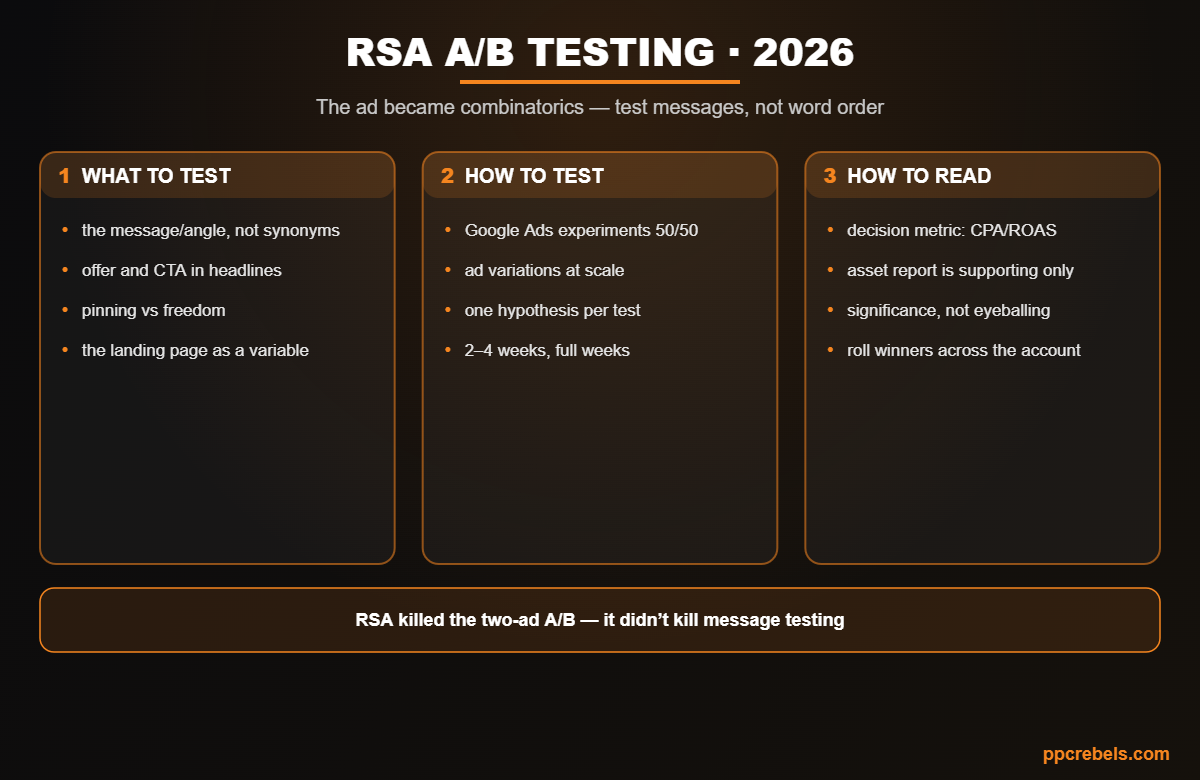
- The offer angle: price vs speed, guarantee vs status, pain vs gain. It’s the variable with the biggest deltas — just like in feed creatives.
- Offer and CTA in headlines: specifics (“from 30 minutes,” “−20% until Friday”) against generic phrasing.
- Pinning vs freedom: a pinned brand/offer in Headline 1 buys control but cuts combinatorics. That trade is itself a testable hypothesis.
- The landing page as a variable: one message, different pages — the “ad + page” pair tested as a whole, per the rules from our landing page conversion guide. The query-to-message fit follows the logic from match types.
How to test: tools and discipline
- Google Ads experiments (Custom experiments): an honest 50/50 traffic split between the base and test campaign — the main tool for message- and landing-level hypotheses.
- Ad variations: account-wide text swaps with an automatic split — ideal for testing one element at scale.
- One hypothesis per test: changing the angle? Don’t touch the CTA or the page. Otherwise the result is unreadable.
- Duration: 2–4 full weeks with enough conversions per arm; a five-conversion test is fortune-telling. Don’t move bids or budgets mid-test — the same stability rules as in bidding strategies.
How to read the results
- The decision metric is CPA/ROAS; CTR is supporting: a clicky headline with expensive conversions is a loss.
- The RSA asset report (“Best/Good/Low,” impressions per asset) signals which lines to replace — but it doesn’t isolate variables, so it’s no substitute for an experiment.
- Significance, not eyeballing: Google’s experiments include a confidence readout; a 3% delta on a small sample is noise.
- Roll winners out account-wide: the winning message goes to every sibling campaign and into your angle library for the next tests.
Common mistakes
- “Two RSAs” in one ad group — combinatorics and ad status make the split dishonest.
- Five variables in one test — and no conclusion.
- Deciding on CTR while CPA sank.
- Stopping the test after three days because “it’s already obvious.”
- Finding a winner — and forgetting it: without the rollout the test never pays back.
FAQ
Yes — not “ad vs ad” but message-level hypotheses via experiments (50/50) and ad variations. Leave the combinatorics inside the RSA to the algorithm.
2–4 full weeks and enough conversions per arm. Stop early only for a clear emergency, not an “almost winner.”
Pinning trades combination reach for control: pin the brand and mandatory phrasing, leave the rest free. And verify that trade with an experiment, not faith.
The asset loses to others in combinations — a candidate for replacement with a new line. It’s a rotation signal, not an A/B result.
A campaign experiment with different final URLs and identical ads — or site-side split tools. The decision metric is CPA/ROAS, not behavioral stats.
Bottom line
Ad A/B testing in 2026 lives at the message level: angles and offers through 50/50 experiments, surgical swaps through ad variations, one hypothesis per test, 2–4 weeks of discipline and a CPA/ROAS decision with significance. RSA combinatorics works for you when you feed it proven messages — and every won test rolls out across the whole account.