Enhanced Conversions in Google Ads 2026: Accurate Signal from First-Party Data
TL;DR: Enhanced Conversions recover conversions lost to cookie limits by sending hashed first-party data (email, phone) with user consent. This sharpens the signal for smart bidding and lowers CPA — without breaking privacy.
Browser restrictions and third-party cookie limits quietly eat a share of your conversions: Google Ads simply does not see them and trains smart bidding on weaker data. Enhanced Conversions close that gap by sending first-party data in hashed form, with user consent. It is a white-hat measurement tool that improves signal accuracy without breaking privacy.
What Enhanced Conversions are
When a user submits a lead or buys, you already collect an email or phone number. Enhanced Conversions take that first-party data, hash it with SHA-256 in the browser, and send it alongside the conversion event. Google matches the hash to signed-in accounts and recovers conversions that would otherwise be lost. Raw data is never sent in the clear. The approach complements solid conversion tracking.
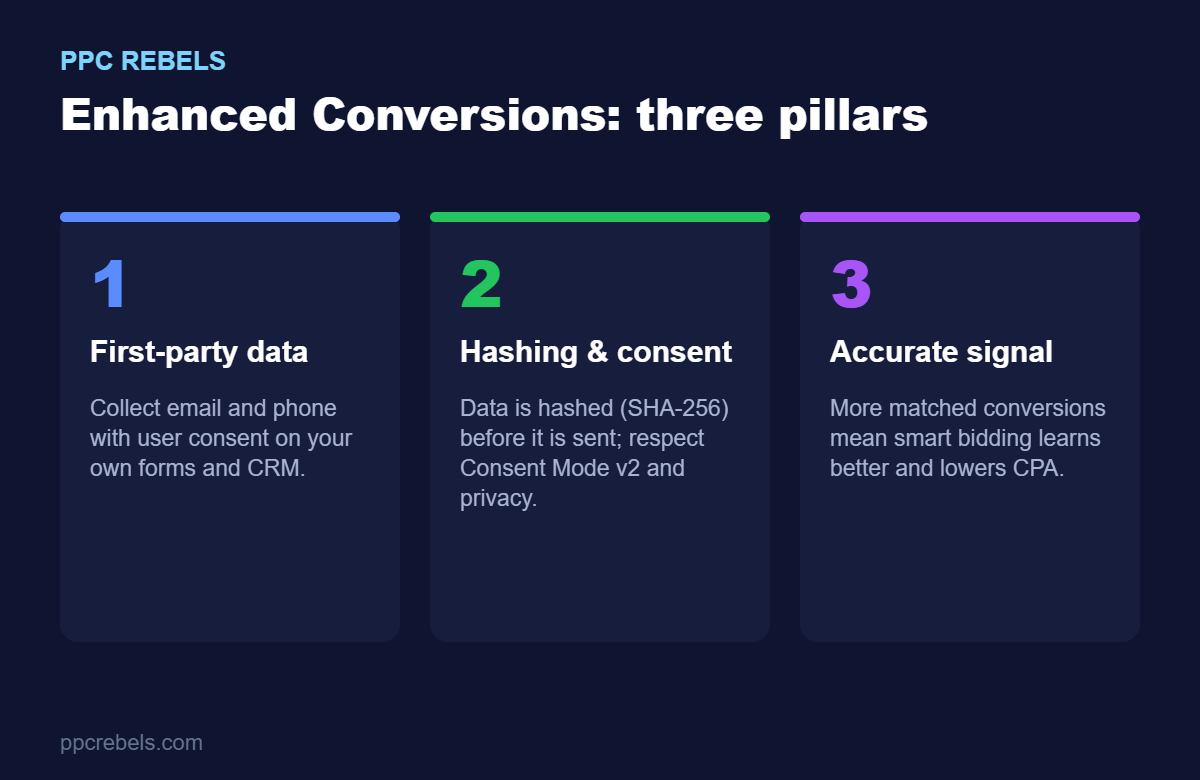
Three pillars of Enhanced Conversions
1. First-party data
The foundation is your own data, collected honestly and with consent: email and phone from forms, CRM and account areas. This is the same class of data that powers Customer Match, so a single collection and consent policy simplifies both jobs.
2. Hashing and consent
Data is normalized and hashed before it leaves the browser, and it is only sent when consent is present. Enhanced Conversions work together with Consent Mode v2: if the user declines advertising cookies, the signal is not sent. That keeps the tool aligned with privacy requirements.
3. Accurate signal
More correctly matched conversions make tCPA and tROAS sharper, because the algorithm learns on fuller data. In reports this shows up as recovered conversions and a more honest view of performance, which pairs well with offline conversion import for lead-based funnels.
How to implement without mistakes
You can set up Enhanced Conversions through the Google tag, Google Tag Manager or the API. Make sure data fields are detected correctly, hashing is enabled and consent is respected. Do not pass unnecessary fields or collect data you have no legal basis for: this is a matter of both compliance and user trust.
FAQ
Yes, when set up correctly. Data is sent hashed and only with user consent. The advertiser remains responsible for the lawfulness of collection and for Consent Mode working properly.
Customer Match uses your lists to target audiences. Enhanced Conversions use first-party data to measure conversions more accurately. The data is similar, but the jobs differ: targeting versus measurement.
It depends on the share of users signed in to Google and your data quality. There is no universal figure, but on form-based traffic the lift in recorded conversions is often visible and stable.