Offline Conversion Import in Google Ads 2026: Feed Real Sales into Smart Bidding
In 2026 the winner is not whoever pushes the most traffic, but whoever shows Google most honestly where the money is actually made. Offline Conversion Import (OCI) feeds real sales back into Google Ads — confirmed leads, payments, upsells that happen after the click — so automated bidding learns from revenue instead of raw clicks.
What offline conversion import is and why it matters
A standard pixel records an on-site event such as a form fill. But between a lead and real money sits a whole funnel: call-center confirmation, payment, refunds. OCI captures the GCLID (Google click identifier) at lead time and later, once the deal actually closes, sends the sale and its value back to Google Ads. Smart Bidding then optimizes for revenue, not for empty leads.
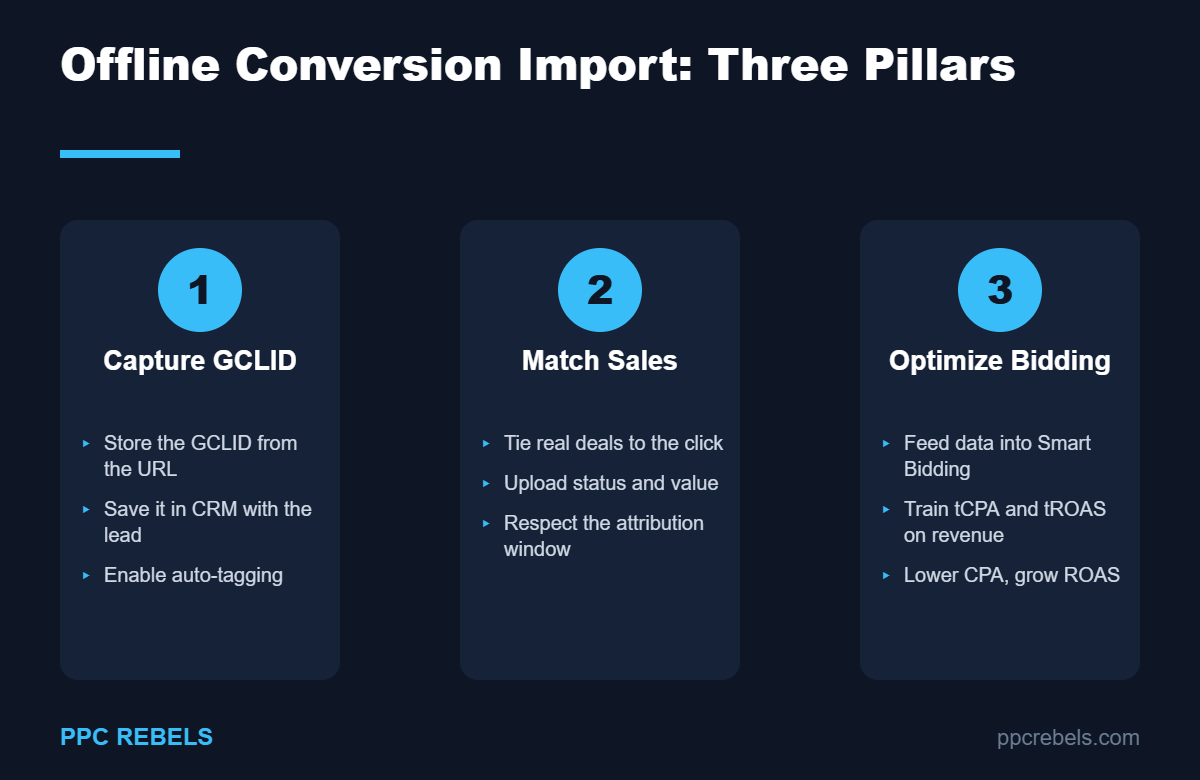
Three pillars of a working setup
Pillar 1. Capture the GCLID
Turn on auto-tagging so Google appends the gclid parameter to your landing URL. On the page, store that GCLID in a hidden form field and pass it into your CRM with the lead. Without a stored GCLID there is nothing to import — it is the foundation. If a slow landing page drops the parameter, fix speed first.
Pillar 2. Match sales in your CRM
When a deal turns to “paid”, your CRM builds a row: GCLID, conversion time, conversion action name and value in currency. Stay inside the attribution window (up to 90 days by default) and send the real value — then tROAS strategies see margin, not just lead counts.
Pillar 3. Train Smart Bidding
Imported offline conversions flow into your chosen bid strategy. Now tCPA and tROAS optimize toward confirmed sales and starve the sources of junk leads. Give the algorithm two to three weeks and enough data before changing targets.
Implementation checklist
- Enable auto-tagging and confirm
gclidappears in your links. - Add a hidden GCLID field to forms and store it in the CRM.
- Create an “Import” conversion action in Google Ads.
- Set up the sales upload (file, Google Sheets or API) with GCLID and value.
- Validate tracking quality and reconcile against the CRM.
- Move campaigns to value-based bidding.
Common mistakes
- Uploading the lead event instead of the payment — the algorithm relearns on noise.
- Losing the GCLID through redirects or weak tracking.
- Uploading conversions after the attribution window closes.
- Sending a flat value when real order values vary widely.
FAQ
No. A manual file upload or a Google Sheets link is enough to start. You only need the API when sales volume is high and you want real-time automation.
Usually within two to four weeks, once enough offline conversions accumulate for the strategy to retrain. The exact timing depends on data volume.
Yes. OCI is a native Google Ads tool. You are not bypassing review — you are showing the system the true value of your customers, fully within the rules.