
Incrementality & Geo-Experiments in 2026: How Many Conversions Ads Really Add
TL;DR: Incrementality shows how many conversions ads truly added on top of what would have happened anyway. The most practical method is a geo experiment — comparing regions with and without ads. Judge uplift and iROAS, not last-click attribution.
Last-click attribution answers who gets credit for a conversion, but not the question that matters: how many sales did advertising actually add on top of what would have happened anyway. That is what incrementality measures. In 2026, with smart bidding optimizing toward conversion signals, measuring true uplift separates real growth from flattering but misleading reports.
What incrementality means
Incremental conversions are the leads and sales that happened because of ads, rather than ones you would have won through organic search, brand demand or direct visits. Some ad clicks come from people who would have bought anyway: those conversions still show up in the report, but they are not growth. The incremental view complements your GA4 attribution, it does not replace it.
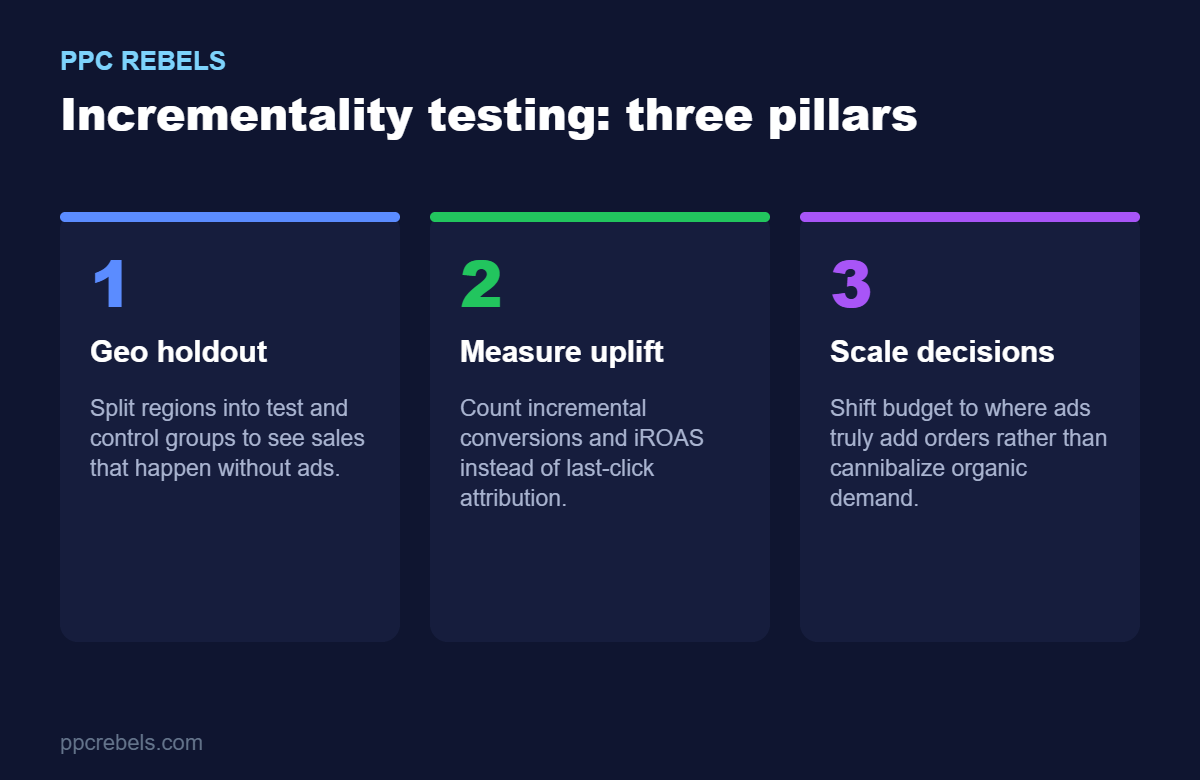
Three pillars of incrementality testing
1. Geo holdout
The most practical method for media buying is the geo experiment. Regions are split into a test group (ads on) and a control group (ads off or reduced). The difference in conversions between groups is the incremental effect. Match comparable regions and account for seasonality, or your conclusions will be biased.
2. Measure uplift
Track incremental conversions and iROAS: return on spend adjusted for the baseline. Compare the lift versus the control group, not absolute totals. This ties directly to unit economics and LTV: what matters is not just that lift exists, but what it costs.
3. Scale decisions
Turn results into action: scale channels and campaigns with high uplift and trim those that merely repackage organic demand. The methodology is close to A/B testing, except the unit of analysis is a region rather than an ad.
Common mistakes
A classic trap is treating every conversion in the report as incremental. Another is running the test on too short a window or on regions that are not comparable. And dirty traffic distorts the measurement, so clean up traffic quality before you measure uplift, as covered in our anti-fraud guide.
FAQ
Attribution splits conversions that already happened across channels. Incrementality asks how many of those would not have happened without ads. They are different questions, and the second one matters more for budget decisions.
Not necessarily, but you need enough conversions in each group and a sound design. Small or mismatched regions produce noisy results you cannot trust.
Periodically and around big changes: a new channel, a bidding-strategy switch, a seasonal peak. A one-off reading ages fast, so treat incrementality as a process, not a single check.