Traffic Anti-Fraud in 2026: Finding Bots and Click Fraud — and No Longer Paying for Them Silently
Bots don’t read your creatives, but they click them diligently. Anti-fraud in traffic buying isn’t paranoia — it’s a line in the economics: a share of every budget goes to invalid clicks, fake form fills and junk placements, and the difference between buyers is only who sees that share and cuts it, versus who pays it silently. Let’s break down what fraud looks like in web traffic, which signals catch it, and how to defend with white-hat methods.
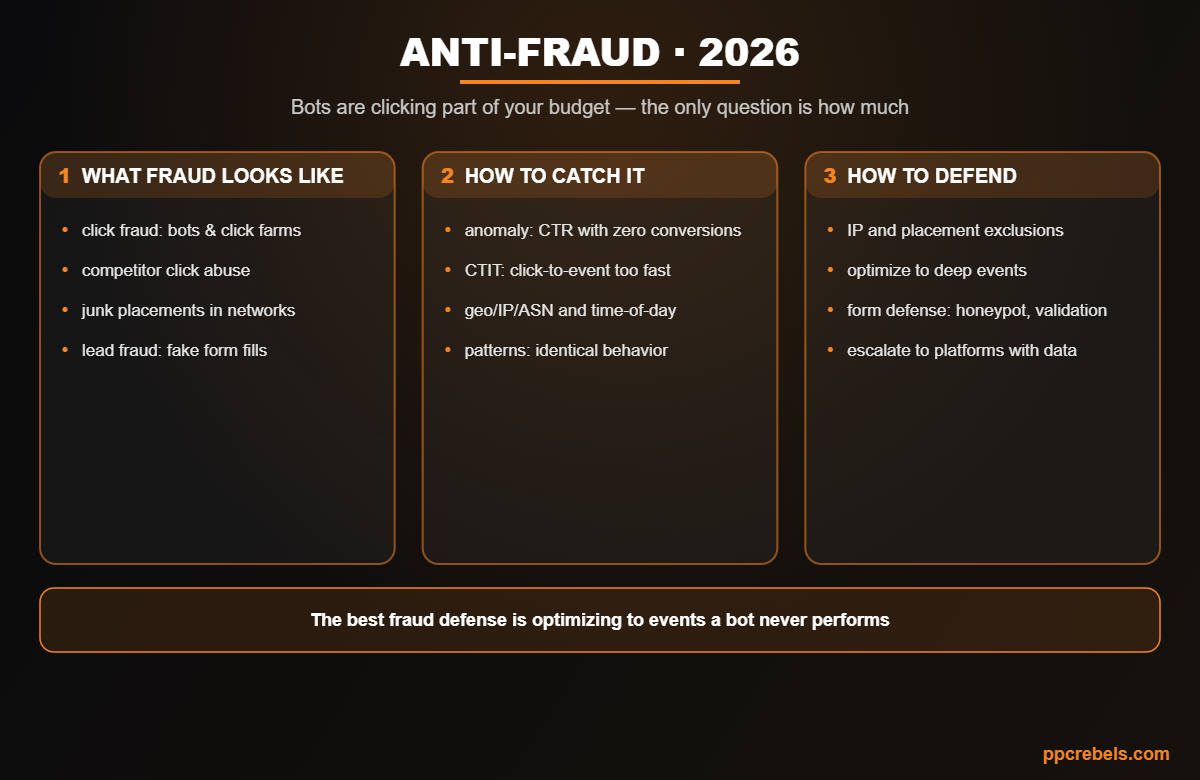
What fraud looks like in web traffic
- Click fraud: bots and click farms generating “traffic” with zero intent; it mostly lives on junk network sites and cheap sources.
- Competitor click abuse: manual or automated burning of your daily budget on expensive queries — familiar to anyone in a competitive niche.
- Junk placements: clicker apps and pass-through sites in display networks with miracle-level CTRs and zero conversions.
- Lead fraud: fake form fills — bot-driven or incentivized; for lead-gen funnels it’s the main type, hitting both the budget and the sales team. Install fraud in apps was covered in the app campaigns breakdown — here the focus is the web.
How to catch it: signals over suspicions
- The “CTR with zero conversions” anomaly: a placement or segment with above-average clickability and zero even micro-events (scroll, time) — the first blacklist candidate.
- CTIT (click-to-event time): implausibly fast submissions after the click — seconds instead of minutes — is bot handwriting; the time-to-event distribution reads in the tracker.
- Geo/IP/ASN and timing: spikes from data-center ASNs, one IP range, off-target geos and flat overnight plateaus — patterns humans don’t produce.
- Behavioral sameness: identical depth, paths and timings across “different” visitors; submissions with template names and disposable email domains. All of it belongs on the dashboard as a regular view, not a one-off investigation.
How to defend: the white-hat arsenal
- Source hygiene: IP exclusions in the platform, weekly placement/app blacklists, dropping sources where the fraud share stays high — math decides, not emotion.
- Optimize to deep events: campaign goals set to qualified lead/deal/payment instead of clicks or raw submissions: bots don’t pass qualification, and the algorithm steers buying away from fraudulent segments on its own.
- Form defense: honeypot fields, phone/email validation, real number verification where needed — a filter before the CRM, not after.
- Escalation to the platform: Google/Meta credit invalid clicks — a complaint with data (IPs, timing, patterns) beats a complaint of “it feels off.” Specialized anti-fraud services join when scale justifies the subscription.
Common mistakes
- Optimizing to clicks/submissions — an invitation for bots into your KPIs.
- Display campaigns without weekly placement cleanup.
- Data-free “everyone’s clicking me out” paranoia — and emotional decisions.
- Forms without validation — junk flowing straight into the CRM and campaign learning.
- Silently paying for fraud instead of escalating with evidence.
FAQ
The share varies wildly by source and vertical: single digits in premium search, up to tens of percent in cheap networks. Only your own signal-based analysis gives the real number.
They do — the base layer. But some passes through, especially in networks and lead forms; your own monitoring plus deep-event optimization closes what the platform filter missed.
Repeated clicks on expensive queries from a narrow IP/geo range during business hours with no conversions. Collect the log, exclude the IPs, file a data-backed complaint with the platform.
Start with the free layer: tracker signals, placement cleanup, form validation, deep goals. A service pays off at the scale where manual monitoring costs more than the subscription.
Validation and honeypots at the entrance, scoring and statuses in the CRM, campaign optimization to qualified leads via offline conversions. A bot doesn’t answer the phone — let the algorithm see that too.
Bottom line
Anti-fraud in 2026 is regular hygiene, not a one-off hunt: know the fraud types, read the signals (CTR without conversions, CTIT, IP/ASN, sameness), cut sources on data, defend the forms and optimize to events a bot never performs. Fraud can’t be zeroed out — but its share can be held at the level of statistical noise instead of a budget line.