Picking Affiliate Offers and Networks in 2026: EPC, Approval, Hold — Foundation Math over the Catalog Payout
You can configure campaigns perfectly, build strong creatives and clean tracking — and still run at a loss, because the offer selection was made off the “high payout” line in a catalog. The offer and the network are the foundation of a buyer’s economics: approval rate, hold, caps and payment reliability move profit harder than the tenth creative iteration. Let’s break down how to pick offers with math, vet networks before the first dollar, and build a portfolio instead of betting on one horse.
Offer math: what hides behind the “payout”
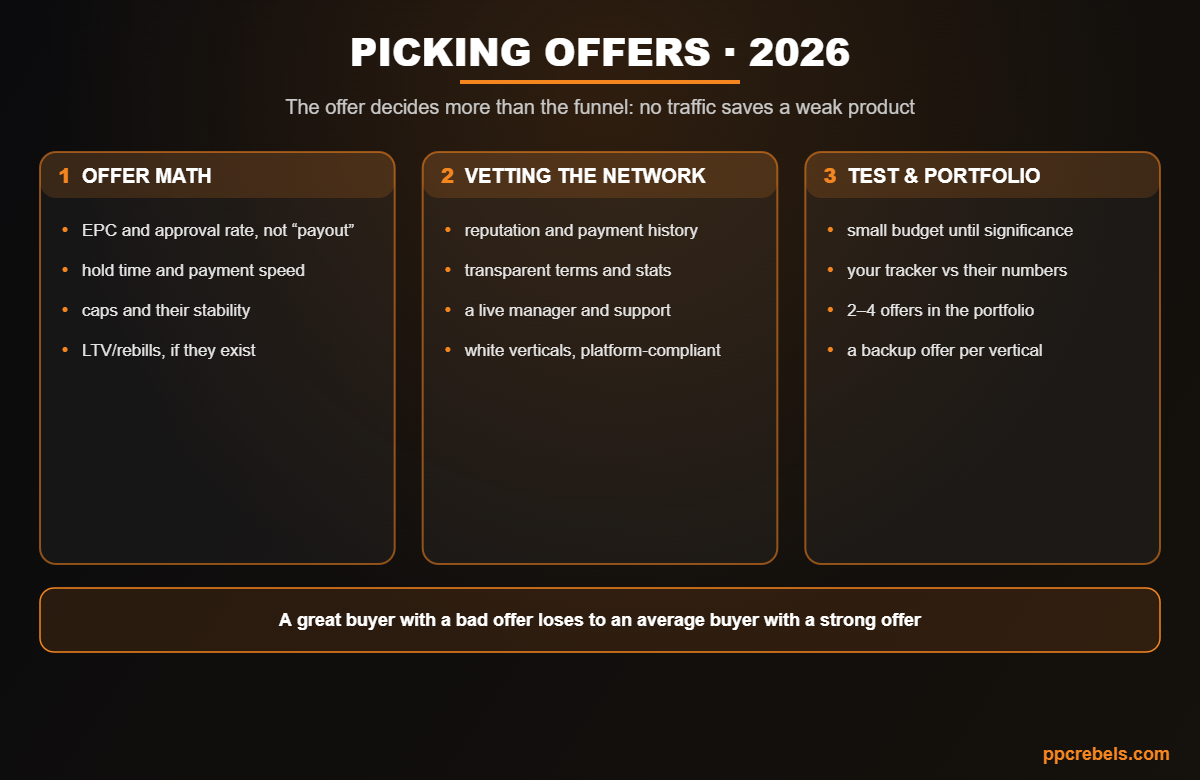
- EPC over the sticker: a $50 payout at a 30% approval rate is worse than $25 at 90%. Compute expected earnings per click/lead including approval.
- Hold is a cash gap: payment in 30–60 days means you’re financing the float from your own pocket; a long hold demands capital reserves — the same payback logic as in unit economics.
- Caps and stability: a 20-leads/day cap kills a scaling funnel; clarify caps, schedules and their change history up front.
- Rebills and LTV: offers with recurring payments change the economics — but only if the network actually pays them out and shows them in the stats.
Vetting the network: before the first traffic dollar
- Reputation and payment history: age, publisher reviews, public delay stories. Red flag: a brand-new network with “the market’s best payouts” and no track record.
- Transparency: detailed stats, rejection reasons, status access — a black-box approval process means your margin gets trimmed where you can’t see.
- A live manager: response speed before launch predicts behavior in a hold dispute; a test question to support is a cheap probe.
- White verticals, platform-compliant: the offer must pass traffic-source moderation without gray tricks — otherwise the economics end with an account ban. Transparent tracking with postbacks is a non-negotiable condition; the funnel’s own quality follows the landing page rules.
Test and portfolio: don’t bet on one horse
- A small-budget test until decision-grade stats: dozens of conversions, claimed approval reconciled with actual — a gap beyond a few percent warrants a manager conversation.
- Your numbers vs theirs: a tracker with postbacks lets you reconcile leads and statuses; discrepancies get logged in writing, immediately.
- A portfolio of 2–4 offers: adjacent offers in the vertical insure against sudden pauses, term changes or cap cuts — diversification, same as in a competitive market.
- A backup route: every key offer gets a stand-in with fast traffic switching: an offer pause must not mean an income pause.
Common mistakes
- Picking by maximum payout, ignoring approval and hold.
- All traffic on one offer at one network.
- Launching without reconciling your numbers against the network’s.
- Ignoring caps — the funnel hits the ceiling on day three.
- Gray offers that fail moderation — economics until the first ban.
FAQ
By EPC: payout × approval rate (× payment probability). Plus a hold adjustment — long money costs more than short money because of the frozen float.
It varies by vertical and conversion type; stability and transparent rejection reasons matter more. A sudden unexplained approval drop means pause traffic and investigate.
Direct usually pays more with flexible terms but needs volume and negotiation; a network offers speed, selection and dispute arbitration. The working path: start via a network, scale direct.
2–4 active per vertical plus a backup: fewer risks an income stop; many more scatters budget and attention below statistical usefulness.
No payment history, “market-best payouts” from a newcomer, closed approval stats, silent support, demands to run without tracking. Any two together — walk away.
Bottom line
Picking offers and networks in 2026 is math plus vetting: EPC with approval instead of the sticker payout, hold as the price of money, network transparency and reputation before the first dollar, a reconciled test and a portfolio of 2–4 offers with a backup. A strong offer multiplies any traffic; a weak one zeroes out the best. Choose the foundation as carefully as the funnel.