Landing Page Conversion for Paid Traffic in 2026: Why You’re Burning Paid Clicks on a Slow Page (and How to Fix It)
TL;DR: Paid-traffic conversion is won on the landing page: speed, ad-to-page message match, trust and low friction. Core Web Vitals and a clear offer lift both conversion and quality. A/B testing beats guesswork. This guide shows how to improve landing page conversion for paid traffic.
You’ve polished the campaign, clicks are cheap, traffic is flowing — but there are no sales. Sound familiar? Nine times out of ten the problem is no longer in the ad account; it’s further down the funnel, on the landing page. You’ve already paid for that traffic, and now one metric decides everything: landing page conversion. You can tweak bids and creatives forever, but if the page loses people, you’re just paying for someone else’s bounce.
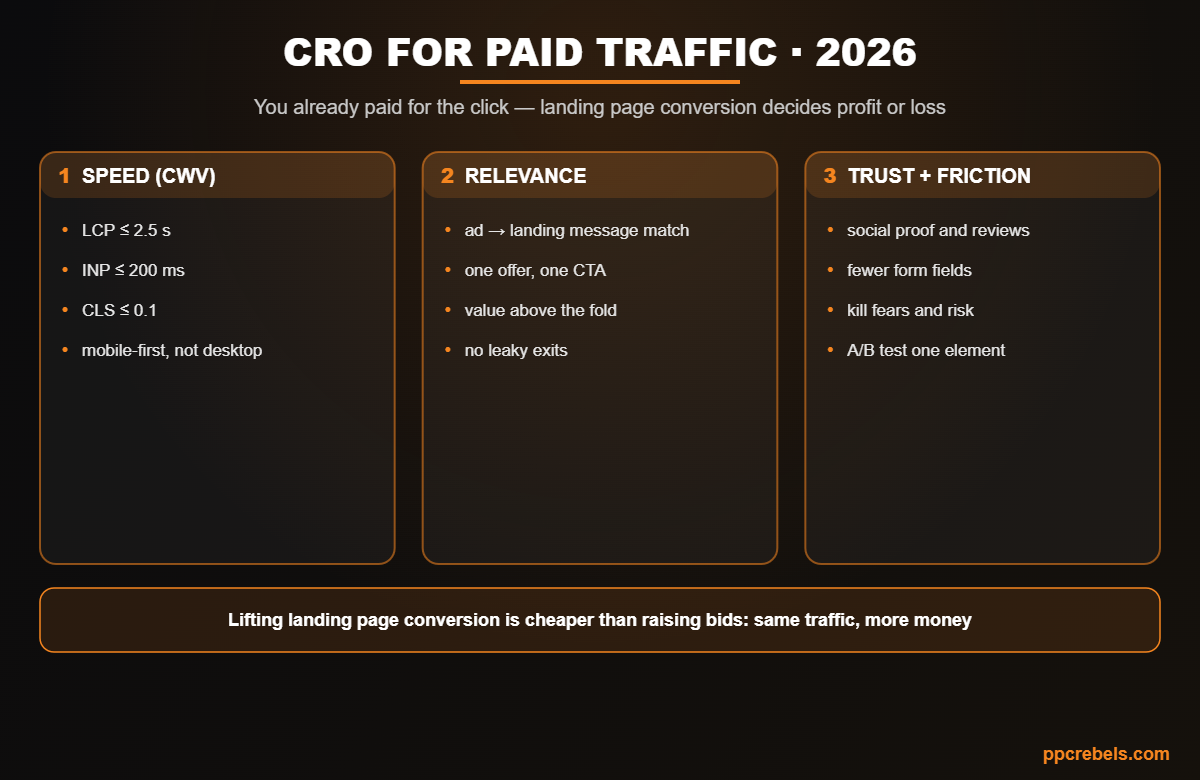
The good news: lifting page conversion is almost always cheaper than raising bids or finding a new traffic source. Same budget, same volume — more money out. Let’s break down the three pillars that hold up landing page conversion for paid traffic in 2026: speed, relevance, and trust (minus friction).
Why landing page conversion is your biggest lever in 2026
Paid traffic gets more expensive every year, auctions are overheated, and squeezing profit purely by lowering CPC keeps getting harder. The landing page, on the other hand, is a lever with a multiplier effect: lifting conversion from 2% to 3% isn’t “plus one percent” — it’s 50% more sales from the same traffic, without a single extra dollar in ad spend. And unlike bids, a conversion win stays with you for the long run.
In arbitrage this matters even more. Margins are thin, and the gap between a profitable and a losing setup often hides on the page, not in the ad account. So before you scale budget, nail the three things below.
Pillar 1. Speed and Core Web Vitals: a page that doesn’t lag
The most common and most expensive conversion killer is a slow page. Every extra second of load time drops some people before they even see the offer, and on paid traffic that’s money straight down the drain. Google measures speed through Core Web Vitals — three metrics to keep in the “green” zone:
- LCP (Largest Contentful Paint) ≤ 2.5 s — how fast the main block loads (headline, hero image).
- INP (Interaction to Next Paint) ≤ 200 ms — responsiveness to actions. This metric replaced the old FID in March 2024 and measures how quickly the page reacts to taps and clicks.
- CLS (Cumulative Layout Shift) ≤ 0.1 — layout stability: content shouldn’t “jump” as it loads, or people misclick the button.
What to fix first: compress and serve images properly (WebP, right size, lazy-load below the fold), strip heavy and render-blocking JavaScript, get decent hosting and a CDN, and set fixed dimensions on images and banners so the layout doesn’t shift. Above all, test on mobile: most paid and social traffic comes from phones, not desktop. For the official thresholds and tools, see Google’s Core Web Vitals documentation.
Pillar 2. Relevance: ad-to-landing message match
The second conversion killer is the gap between the ad’s promise and what the visitor actually sees. It’s called scent, or message match: the landing page must continue what the person clicked — the same headline, the same offer, the same image and tone. If the creative says “50% off sneakers” and the page shows an abstract catalog, the person leaves in a second — and you paid for that exit.
- One offer, one CTA. Don’t try to sell everything at once; every extra goal blurs the decision.
- Offer and value above the fold, in the first 5 seconds and without scrolling. The visitor should instantly get what it is, who it’s for, and why.
- Don’t send paid traffic to your homepage. Build a dedicated landing page per offer and campaign.
- Plug the leaks: extra menu items, external links, and distracting exits pull people away from the target action.
Pillar 3. Trust and removing friction
The visitor arrived and understood the offer — but doesn’t trust it, or can’t be bothered. Two forces work here: raise trust and remove friction.
- Social proof: real reviews, case studies, concrete numbers, logos, guarantees. Empty “5 stars from John D.” does nothing — it has to be real and verifiable.
- Kill the fears: money-back guarantee, secure payment, “no commitment,” clear terms. Every objection you leave unanswered is a lost customer.
- Fewer form fields: ask only for what you truly need. Every extra field lowers your submission count.
- Fewer steps and no forced sign-up. A clear next step and large, mobile-friendly fields (with the right keyboard types).
A/B testing: how not to fool yourself
CRO without testing is guesswork. But tests are easy to turn into self-deception if you run them wrong:
- Change one element at a time, or you won’t know what actually worked.
- Reach a sufficient sample size and statistical significance. Stopping a test at 20 clicks and cheering a “winner” is a path to wasted spend.
- Run a full business cycle — at least 1–2 weeks — to avoid skew by day of week and time of day.
- Don’t stop early. An early “leader” often swaps places with the laggard over the distance.
- Prioritize high-impact elements: headline, offer, CTA, hero block, form. Heatmaps and session recordings help you see where people get stuck.
No tracking, no CRO
You can’t improve what you don’t measure. Before testing the page, make sure conversions are tracked reliably — not just clicks — and that tests tie to real target actions. This is the foundation: if the signal is broken, you’ll optimize the page against noise. For how to build measurement, see our tracking and analytics in arbitrage guide, and for the server-side layer and event deduplication, the Meta Ads conversion tracking guide is a useful read.
Where to send traffic: a landing page per channel, not the homepage
Build a dedicated landing page per offer and campaign, tuned to the channel’s intent. These are different worlds:
- Google Search — hot intent: the person is already looking for a solution, so you can get straight to the point and the form. For scaling campaigns, see the guide on Google Ads account structure.
- Meta and TikTok — these interrupt the feed: colder traffic that needs a strong hook, an easy entry, and more warming up. We covered the channel specifics in the posts on Meta Ads tracking and TikTok advertising.
Common mistakes
- Sending paid traffic to the homepage instead of a dedicated landing page.
- A slow mobile page with failing Core Web Vitals.
- Ad-to-landing mismatch (broken scent).
- Too many CTAs and distractions instead of one target action.
- Long forms with unnecessary fields.
- No social proof and no objection handling.
- A/B tests without statistical significance, and ignoring mobile.
FAQ
It’s the share of visitors who take the target action. A “normal” rate depends heavily on niche, offer, and traffic quality: for cold traffic it’s usually low single-digit percentages, while well-built pages with hot traffic run noticeably higher, into double digits. The real benchmark is your own past rate, which you improve steadily through testing.
Keep them in the “green” zone: LCP ≤ 2.5 s, INP ≤ 200 ms (it replaced FID in 2024), and CLS ≤ 0.1. Check the mobile version first — that’s where most paid traffic comes from.
A landing page. The homepage scatters attention and almost always converts worse. Build a dedicated page per offer that continues the ad’s promise.
The minimum necessary. Every extra field lowers submissions. If you can capture a phone number and fill in the rest later, cut the form to one or two fields.
Until you reach statistical significance and at least one full business cycle (usually 1–2 weeks) to smooth out day-of-week skew. An early “winner” on a small sample is often just chance.
Usually one of the three pillars is to blame: a slow page (especially on mobile), an ad-to-landing mismatch, or too much friction and too little trust. Check them one by one — and make sure conversions are even being tracked correctly.
Both, but differently. Speed is hygiene and a threshold: a slow page cuts everyone before the offer. Relevance and a strong offer are the growth lever. Remove the lag first, then work on the offer and trust.
Bottom line
Landing page conversion is the most underrated lever in paid traffic: cheaper than bids, more reliable than new sources, and it works for you over the long run. Make the page fast (Core Web Vitals in the green), relevant to the ad’s promise, and trustworthy with minimal friction — then test steadily, one element at a time. You’ve already paid for the traffic; the landing page’s job is to keep it and turn it into money.