Performance Max in 2026: Taming Google’s “Black Box” — Control, Signal, and the Search Pairing
TL;DR: Performance Max in 2026 is Google’s black box, but you steer it through signals: feeds, audiences, budgets and conversion data quality. Control the input, not just the output. Pairing with search and clean conversions trains the algorithm better. A complete guide to taming PMax.
You launch the campaign, hand Google your budget and creatives — and then you pray: where did the money go, which queries fired, what’s happening inside. That’s what Performance Max looked like a couple of years ago, and it earned its “black box” reputation honestly. In 2026 things are different: PMax now has real control levers, and the difference between “burns budget” and “scales” is whether you know how to pull them.
Let’s break Performance Max down properly: what it is and how it works, which controls arrived by 2026, how to prepare the signal so the algorithm learns on money rather than noise, how to pair PMax with Search without letting it steal brand conversions — and when you shouldn’t launch it at all.
What Performance Max is and how it works
Performance Max is a campaign that runs across all of Google’s channels from one place: Search, Display, YouTube, Gmail, Discover, Maps. You give the system assets (headlines, descriptions, images, video), conversion goals, and audience signals — and machine learning assembles the ads and decides who sees them, where, and at what price.
The core unit is the asset group: a set of creatives plus an audience signal for one theme or product. Key point: an audience signal is not targeting — it’s a hint about where the algorithm should start. It will go far beyond your list, and that’s both the power and the risk.
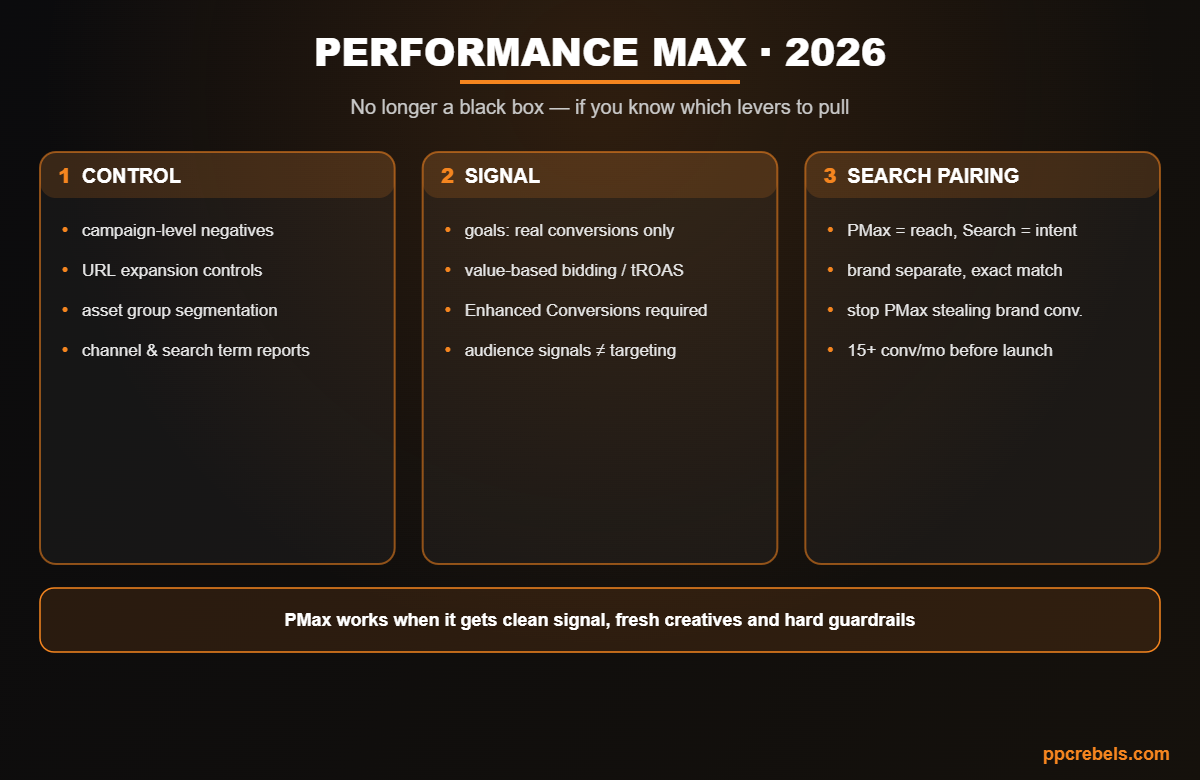
The 2026 controls: Performance Max is no longer a black box
The key updates of late 2025 — early 2026 that changed the rules:
- Campaign-level negative keywords. You can now weed out irrelevant queries, brand-unsafe themes, and competitor brand terms — just like in regular Search.
- URL expansion controls. You specify which landing pages PMax may use, and the AI stops sending traffic to random pages on your domain (including About pages and job listings).
- Asset group segmentation. Multiple groups in one campaign — each with its own signal, creatives, and message for its own segment.
- Transparency. Channel and search term reports got noticeably more detailed: you can see where the money goes and which queries drive conversions.
Bottom line: Performance Max is now structurally similar to a manageable campaign. But the levers don’t work on their own — set them up from day one, not after a month of waste.
Signal decides: what to feed the algorithm
PMax optimizes toward whatever conversions you hand it. Feed it “page views” and you’ll get cheap page views and zero money. The clean-signal rules:
- Only real money in primary conversions: purchases, paid orders, qualified leads. Micro-actions go to secondary.
- Value-based bidding and tROAS. Pass conversion values: PMax with a Maximize Conversion Value goal finds high-value customers, not just piles of cheap actions.
- Enhanced Conversions, Consent Mode, and server-side tagging are the baseline. A campaign with leaky tracking learns on incomplete data and bids blind. For how to build measurement, see our tracking and analytics in arbitrage guide and the Meta Ads conversion tracking breakdown (the philosophy is the same across platforms).
- Data density: aim for 15+ conversions per month before launching PMax. On an empty account it will drift in learning for weeks — build signal with regular Search first.
Creatives: PMax burns them faster than you think
- Fill every asset slot: max headlines, descriptions, images, and at least one video — otherwise Google will auto-build one from your images, and you won’t like the result.
- Replace weak assets based on the performance report (“Low” rating = replace) every 2–4 weeks.
- Each asset group gets its own message for its own segment, not one creative for everyone.
Performance Max + Search: a pairing, not a replacement
The most expensive mistake is “turned on PMax, turned off everything else.” The right architecture is complementary: PMax covers reach and cross-channel, dedicated Search keeps high-intent queries under manual control. For how this fits the overall account architecture, see the guide on Google Ads account structure at scale.
- Brand always gets its own Search campaign on exact match, with brand terms added to PMax negatives. Otherwise PMax claims the easiest conversions and paints a beautiful ROAS out of thin air.
- Query priority: if a query is identical to an exact-match keyword, Search wins; otherwise Ad Rank decides. Keep your important queries in Search with strong ads.
- Watch incrementality: if Search dipped after PMax launched and the total didn’t grow, PMax is cannibalizing, not adding.
When you should not launch Performance Max
- No conversion history (fewer than ~15 conversions a month) — run Search first and build signal.
- Broken tracking — fix measurement first, automate second.
- A weak landing page. PMax brings traffic but doesn’t convert for you — see our breakdown of landing page conversion for paid traffic.
- Strict brand-safety requirements without a plan for exclusions: reach channels demand placement exclusion management.
The 2026 Performance Max launch checklist
- Tracking: Enhanced Conversions + server-side tagging; primary conversions = money.
- Conversion values set (for tROAS / Max Conversion Value).
- Brand campaign separate; brand terms in PMax negatives.
- Campaign negatives: junk and irrelevant themes from day one.
- URL controls: target landing pages only.
- 2–3 asset groups for different segments, all slots filled, video included.
- A budget that survives learning (no sharp edits in the first 1–2 weeks).
- At 2–4 weeks: channel/search term reports, cleanup, refresh weak assets.
FAQ
It’s a Google Ads campaign type that shows ads across all Google channels (Search, Display, YouTube, Gmail, Discover, Maps) from a single campaign. You provide assets, goals, and signals — the algorithm assembles the ads and allocates budget.
Not anymore. By 2026 it gained campaign-level negative keywords, URL expansion controls, asset group segmentation, and detailed channel and search term reports. The control exists — you just have to use it.
A working benchmark is 15+ conversions per month on the account before launch. With less, the algorithm has nothing to learn from — build signal with Search campaigns first.
Classic brand cannibalization: PMax intercepts brand queries that would have converted anyway. The fix is a separate brand Search campaign plus brand terms in PMax negatives.
No. They’re a starting hint: the algorithm begins with the audiences you specify but quickly expands beyond them. PMax won’t restrict delivery the way classic targeting does.
No. The right pairing: PMax for reach and cross-channel, Search for control of high-intent queries, brand separate on exact match. Replacing Search with PMax almost always loses control and money.
Watch incrementality: total account conversions should grow, not migrate from Search. Plus the channel and search term reports: conversions should come from relevant queries and placements, not just brand.
Bottom line
Performance Max in 2026 is no longer a lottery — it’s a manageable tool with negatives, URL controls, asset segmentation, and real reporting. The formula is simple: clean conversion signal in, hard guardrails around it (brand separate, junk in negatives, landing pages controlled), fresh creatives in every slot — and a pairing with Search instead of replacing it. For the official reference, see Google’s Performance Max documentation — the levers are in your hands now.