Google Ads Account Structure at Scale in 2026: Why Fragmentation Burns Budget (and Consolidation Scales)
TL;DR: A scalable account structure is the foundation of stable Google Ads growth. Splitting campaigns and groups by intent, geo and margin makes bid control and algorithm learning easier. A flat, predictable structure scales better and disrupts smart bidding less. Build it around business goals, not habit.
Take two accounts with the same budget and the same offer. The first has 20 campaigns, each generating two or three conversions a month. The second has three campaigns, each generating 40–50. Guess which one scales, and which one sits in the learning phase forever and burns budget? In 2026 the answer is almost always the same: the winner is the one that fed the algorithm data, not the one who organized everything into neat little folders.
Google Ads account structure is no longer about “tidying up for the sake of tidying up.” It’s now an engineering decision: either you feed Smart Bidding enough conversion density — and it learns and scales — or you fragment your data into hundreds of tiny pieces, and every campaign optimizes blind. Let’s break down how to build a structure that scales, the right way: from the math of conversion density to Performance Max, AI Max, MCC, and naming conventions.
The 2026 shift: structure serves the algorithm, not the other way around
The old playbook — Single Keyword Ad Groups (SKAGs), a separate ad group for every keyword, manual bids by the hour — is dead. Not “outdated,” dead. The reason is simple: Google’s AI bidding and ad assembly need data volume, and hyper-granularity grinds that volume into dust. Hundreds of tiny ad groups with one conversion a month give the system nothing but noise.
The modern logic goes like this: structure exists to serve machine learning and business control — not the reverse. Consolidated, theme-based, intent-driven structures beat fragmented ones. If you’re still building your account around match types, devices, or excessive geographic splits, the platform has moved on and your structure is working against automation.
The math of conversion density — the core of all structure
This is the most underappreciated piece. Automated strategies need a minimum volume of conversion signals per campaign to learn at all. The 2026 specifics:
- A minimum of ~15 conversions per month per campaign for Smart Bidding to work at all.
- 30–50 conversions per month is the range where optimization stabilizes and becomes predictable.
- Campaigns with fewer than 15 conversions per month are operating below a reliable learning threshold — candidates for consolidation.
From this comes a practical rule for the number of campaigns, tied to your total volume:
- An account doing 60 conversions per month total → you probably should not have more than 2–3 campaigns.
- An account doing 600 conversions per month → you have room to segment by intent, product line, or geography without starving any single campaign.
The same principle applies at the ad-group level: 7–10 ad groups per Search campaign is the effective range, with each group ideally accumulating 15+ conversions per month. Google’s technical limits (up to 20,000 ad groups per campaign for standard types, 100 for Local and App campaigns, up to 25 asset groups in Performance Max) are not meant to be reached in practice — an account with 20,000 ad groups in a single campaign almost certainly suffers from severe data fragmentation.
The key question before creating a new campaign or splitting an existing one: will each resulting campaign accumulate enough conversions to exit the learning phase and maintain stable optimization? If not — don’t split.
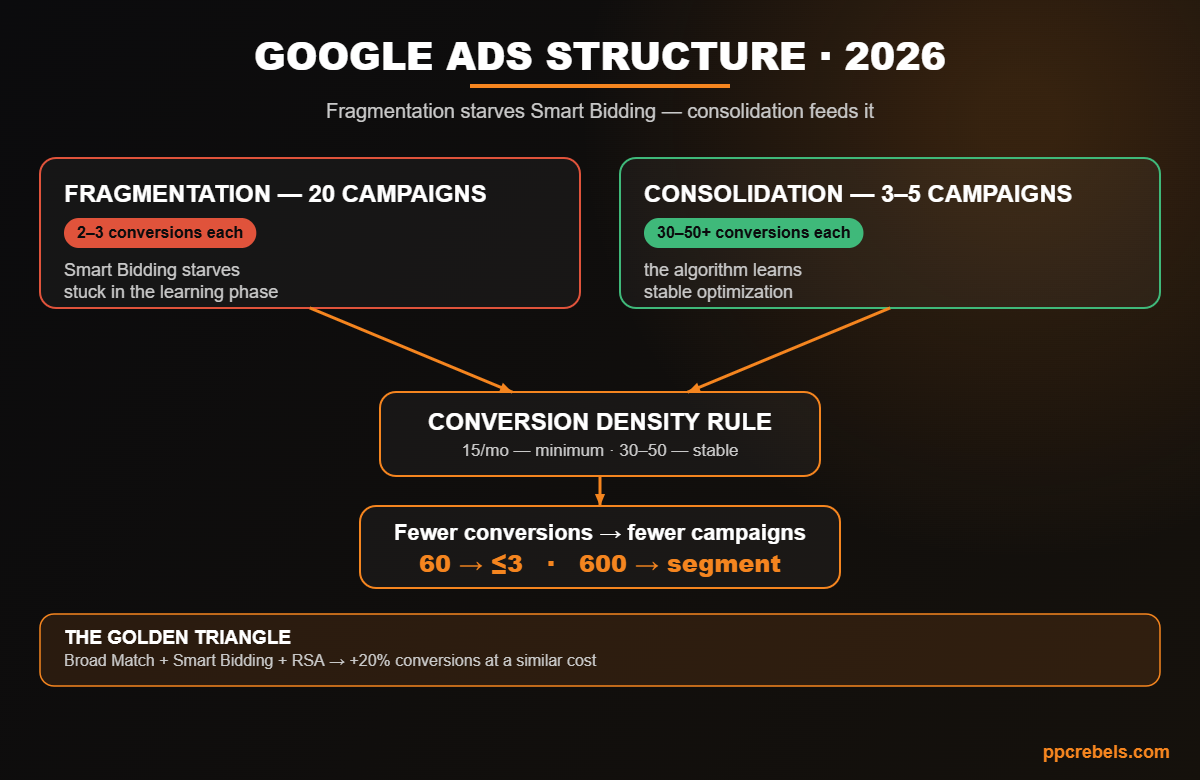
The golden triangle: Broad Match + Smart Bidding + RSA
The combination Google promotes as the default for Search in 2026: broad match + Smart Bidding + responsive search ads (RSA). According to Google, advertisers who follow this recommendation see on average 20% more conversions at a similar cost per action.
Why broad, not phrase: phrase match has become more restrictive over time and limits reach on complex, conversational queries. Broad match captures intent better, even when the query doesn’t resemble your keyword list. Keep exact and phrase for high-intent terms only, where tight control matters. But broad match without a sound structure amplifies both the benefits and the risks of automation — so the wider the matching, the more critical clean negative keyword lists and budget guardrails become.
The brand campaign — always separate
Every account needs a dedicated brand campaign for your name and close variations. It’s a defensive position: without it, competitors bid on your brand and you overpay for impressions on searches you should win every time. Brand campaigns are almost always the highest-performing in the account — the intent is already established — so don’t let Performance Max claim credit for those conversions. Structure: one campaign, 1–3 ad groups (brand, brand + product, misspellings), exact match, Manual CPC or Maximize Clicks — Smart Bidding isn’t needed here.
Bidding at scale: from Max Conversions to tROAS and Value-Based Bidding
The launch sequence for scale: start with Maximize Conversions, uncapped, to gather data; after 2–4 weeks add a target and then adjust it gradually, never by more than 20% at a time.
The key 2026 trend: for accounts with conversion data, tROAS and Value-Based Bidding (VBB) are preferred over tCPA. The difference is fundamental: instead of “find me conversions at $80,” you say “find me conversions that return $5 for every $1 spent — and here’s what each conversion type is worth.” VBB requires at least two distinct conversion values (for example, $500 for a demo, $200 for a trial, $15 for a download).
- Portfolio bid strategies — only for campaigns with genuinely similar characteristics; keep brand separate.
- Don’t share a budget across mismatched campaigns — it blends incompatible economics.
- Smart Bidding Exploration (new in 2026) lets tROAS campaigns carefully test lower-ROAS segments for new acquisition while preserving profitability. A feature for mature accounts with high data maturity.
Negatives — the main steering wheel at scale
When matching is broad, negative keywords stop being hygiene and become the primary control mechanism:
- Use account-level negative keyword lists to block entire themes (
free,jobs,cheap) across all campaigns at once. - Work at all three levels — account, campaign, ad group.
- The broader the matching and the more automation in play, the more aggressive your weeding of irrelevant queries must be.
Performance Max in 2026: no longer a black box
The main complaint about PMax was always its opacity and lack of control. In late 2025 and early 2026, Google added granular controls that make PMax structurally similar to a Search campaign:
- Campaign-level negative keywords — exclude specific queries, brand-unsafe placements, and competitor brand terms.
- URL expansion controls — specify which landing pages PMax may use and stop the AI from routing traffic to random pages on the domain.
- Asset group segmentation — multiple asset groups in a single campaign, each with its own audience signals, creatives, and messaging.
The principle that makes Smart Bidding and Performance Max work together is complementarity, not just consolidation. PMax covers reach and cross-network, while dedicated Search keeps high-intent queries under control.
AI Max for Search: a new matching layer
AI Max is a Search mode that shifts the logic from keyword-level control toward intent-signal optimization, with broader matching. What matters structurally:
- With AI Max, default to tROAS or Maximize Conversion Value, not tCPA — broader matching increases the variance in customer value.
- You need stricter negative keyword discipline and greater reliance on conversion-value signals.
- Landing pages must have complete content and structured data (Schema) — AI Max dynamically pulls text from pages to customize ads. A thin page = weak ads.
Without measurement, structure doesn’t work
You can organize campaigns perfectly and still lose if your conversion signal is broken. In the privacy-constrained environment of 2026, these are no longer “advanced options” but a baseline: Enhanced Conversions, Consent Mode, server-side tagging, and offline/CRM conversion imports. Plus a clear split between primary and secondary conversions: Smart Bidding optimizes toward primary ones, so feeding it a page view instead of a form submission means driving budget toward low-value actions.
Accounts with mature conversion tracking outperform competitors on efficiency by 20–35%. If you want to dig deeper into signals, we have a breakdown of tracking and analytics in arbitrage and a dedicated guide to Meta Ads conversion tracking (the same “clean signal” philosophy, just for a different platform).
Scaling beyond a single account: MCC (Google Ads Manager)
When campaigns and accounts multiply, Google Ads Manager (formerly MCC, My Client Center) comes into play — a centralized panel for managing multiple accounts. At scale it provides consolidated reporting, bulk operations, and a single monitoring window across the whole portfolio.
And one more item that goes from “nice to have” to “mandatory” at scale — naming conventions. When you have dozens of campaigns across dozens of accounts, enforceable names (by geo, product, campaign type, strategy) are the only way to avoid drowning in reports and to find things fast. Inconsistent names kill your analytics faster than bad bids.
The management cadence that holds at scale
- Daily: spend pacing and conversion anomalies.
- Weekly: search terms and negative keyword updates.
- Bi-weekly: bid targets and budget allocation.
- Monthly: a deep dive into structure and competitive dynamics.
Old rules to drop
- SKAGs (a separate ad group per keyword) — they starve the algorithm.
- Structuring by match type, device, or excessive geo splits — the platform has moved on.
- Enhanced CPC (ECPC) — largely superseded by fully automated strategies.
- Chasing the Quality Score number — it still influences ad rank, but matters less as a standalone metric; instead, invest in landing page speed and relevance and strong creatives.
- Hyper-granular ad groups — splitting for control ends up costing money.
FAQ
The minimum needed to serve distinct business objectives — provided each campaign has enough conversions. Rule of thumb: 60 conversions per month total → no more than 2–3 campaigns; 600 → you can segment. The criterion isn’t “how many” but “will each have enough data to learn.”
No. Single Keyword Ad Groups are dead: they fragment conversion data and prevent Smart Bidding from learning. The 2026 default is consolidated, theme-based campaigns with broad match.
At least about 15 per month per campaign to work; 30–50 to stabilize. Value-Based Bidding requires at least two distinct conversion values.
In 2026, broad match paired with Smart Bidding and RSA is the recommended default; it captures intent better. Use phrase and exact for high-intent terms only. Broad match makes strong negative keyword lists mandatory.
Not anymore. In 2026, PMax has campaign-level negative keywords, URL controls, and asset group segmentation — which make it structurally similar to Search and manageable.
AI Max broadens matching and optimizes on intent signals. It calls for tROAS or Maximize Conversion Value, strict negatives, and landing pages with complete content and Schema.
Google Ads Manager (formerly MCC) is a panel for managing many accounts: consolidated reporting, bulk operations, unified monitoring. You need it when accounts and campaigns multiply and naming conventions matter.
Bottom line
Google Ads account structure in 2026 is a balance between the algorithm’s hunger and your control. Fragmentation gives the illusion of control but starves Smart Bidding; consolidation feeds the algorithm but demands discipline in negatives, measurement, and naming. Count conversion density, keep the minimum necessary number of campaigns, give the Broad + Smart Bidding + RSA combo enough data, use the new PMax and AI Max controls — and your structure will start scaling profit instead of just looking neat in the interface.