Account Banned on Day Two: How to Relaunch Without Losing the Campaign
The account got banned on day two of the launch, and it feels like the whole campaign went with it. Stay calm: in most cases this is fixable, and panic-spinning a dozen new accounts only makes it worse. Let us break it down the white-hat way: why platforms ban on launch, how a rejection differs from a ban, what to check before you appeal, and how to build account hygiene so it does not happen again.
Why bans happen on launch
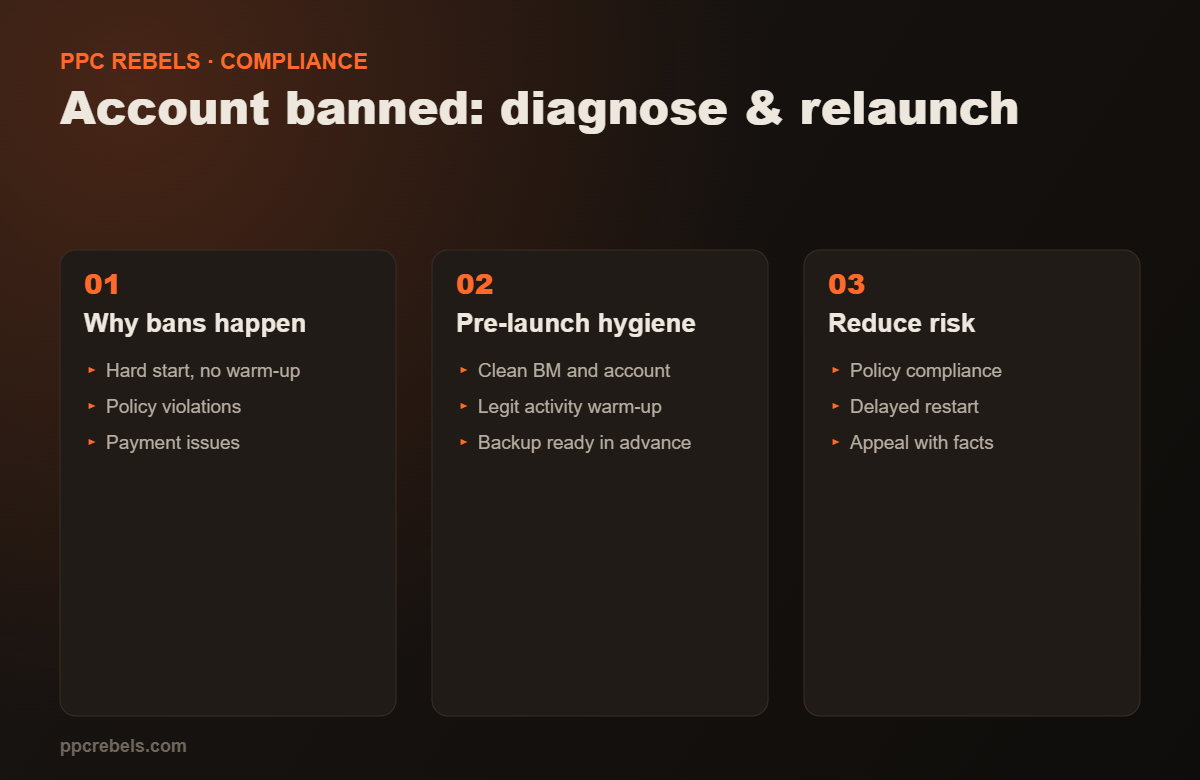
Three typical causes. A hard start with no warm-up – a new account immediately pushes a big budget on an aggressive campaign, and the platform anti-spam reads it as risk. Policy violations – the creative, landing page or vertical breaks platform rules; often it comes down to claims, disclaimers or prohibited wording. Payment issues – mismatched billing data, declined payments, suspicious geography. Step one is to honestly decide which of the three buckets your case falls into.
A rejection is not a ban: how to tell them apart
An ad rejection means a specific ad was disapproved while the account stays alive; you fix the creative or landing to match policy and resubmit. An account restriction or ban blocks the whole account or business profile. These are different situations with different actions: a rejection clears with an edit and re-review, a ban only clears with an appeal. Do not appeal something that an ad edit would fix.
What to check before you appeal
Before you write to support, gather the facts: which exact rule the notice cites, which object is blocked (ad, campaign, account, business manager), and whether there are billing problems. Bring the creative and landing into full compliance first – an appeal with already-fixed materials passes far more often than a bare please-unblock-me. Understanding the rules up front is easier with the piece on brand defense and working within search policies.
Account hygiene and a legit warm-up
A healthy account behaves like a real business: a filled-out profile, gradual budget growth, genuine activity, stable payment data. A legit warm-up is not gaming the system – it is the normal evolution of an account: soft goals and small budgets first, then smooth scaling. Sharp budget jumps and instant aggression are the main triggers of automated review.
Keep the business manager and account clean: no clutter of disapproved objects, a transparent structure. Monitoring traffic quality with systematic anti-fraud lowers risk too – platforms react to the same anomalous patterns that often travel with fraud.
A delayed restart and lowering repeat risk
After you are unblocked, do not rush back to full volume. Give it a delayed restart: a small budget, a proven clean creative, a tidy landing – and only then scale. Keep 1-2 spare accounts prepared in advance and by the rules so downtime does not kill the economics. A regular account audit catches problem objects before they trigger a new block.
When to walk away and start fresh
If the appeal is rejected twice and the cause is systemic, it is sometimes smarter to start from a clean, legitimately prepared account than to keep banging on a closed door. The key word is legitimately: with real data and within policy, not through attempts to trick review that only lead to more bans.
FAQ
Yes: bring the creative and landing into policy compliance and resubmit for review. A rejection concerns a specific ad, not the whole account.
Gather the facts and fix the violation first, then appeal – with materials already cleaned up. A blind appeal with no edits is most often rejected.
In advance and by the rules: filled-out profiles, real payment data, a light warm-up. A backup is for continuity, not for evading review.
A sharp budget jump, aggressive creative with no warm-up, and a landing that breaks policy. Remove those three and the risk drops sharply.
Need a trusted account right now? See terms and pricing on the Google Ads agency account rental page.