Brand Defense in Search in 2026: Should You Pay for Your Own Traffic — Arithmetic over Ideology
A query containing your brand is the hottest traffic in the account: the person already knows who they’re looking for. Which is exactly why competitors love bidding on your name and standing above your organic result. Brand defense is performance marketing’s eternal argument: “why pay for people who’d come anyway” versus “never surrender your own results page to someone else’s offer.” The right answer isn’t ideological — it’s arithmetic, and we’ll do the math.
Why defend the brand (and when you can relax)
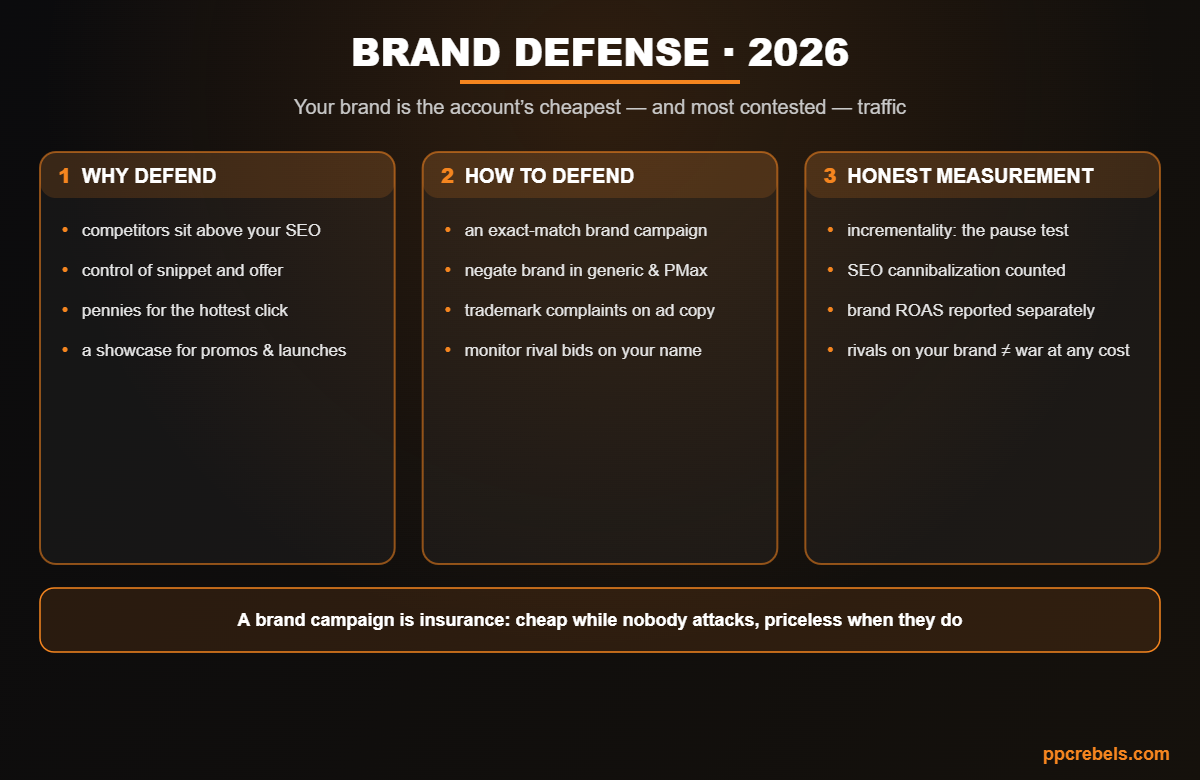
- Competitors above your SEO: the results page’s first position is an ad; if it carries someone else’s offer, a share of “your” customers leaves in one click. A one-minute check: search your own brand.
- Snippet control: a brand ad shows current promos, the right landing page and extensions — organic listings can’t be steered like that.
- The price tag: brand CPCs usually run at a fraction of category CPCs — the insurance costs pennies against the revenue it protects.
- When you can relax: nobody bids on your brand, organic sits at #1, the snippet satisfies — then the brand budget stays minimal, but monitoring remains: attacks start without warning, most often during your promo peak.
How to defend: the mechanics
- A dedicated exact-match brand campaign: its own budget, bids and reporting; brand variations and typos inside, per the match types logic.
- Brand negatives everywhere else: generic campaigns and Performance Max negated on the brand — or they paint themselves a ROAS on your own traffic while brand stats smear across the account.
- The trademark is the legal layer: competitors can’t use your mark in ad copy — a platform trademark complaint handles that; bidding on your brand as a keyword is, alas, legal almost everywhere.
- Monitoring rival bids: Auction Insights on the brand campaign plus manual checks from different geos — per the competitor analysis rituals.
Honest measurement: incrementality and cannibalization
- Brand ROAS reported separately: blended with category it decorates the report and hides the real efficiency of cold traffic.
- The incrementality test: pause the brand campaign for 1–2 weeks (or run a geo split) during calm competition — whatever revenue organic picks up is what the campaign was cannibalizing; the methodology mirrors experiments.
- Interpretation: high organic pickup + no attackers → minimal bids; visible losses or rivals on your brand → the defense pays back many times over.
- Dynamics, not dogma: test results expire — competitors come and go; review the defense at least quarterly and before peaks.
Common mistakes
- Brand not negated in generic campaigns and PMax — a “beautiful ROAS” made of your own traffic.
- Account-wide ROAS with brand inside — self-deception in reports.
- Refusing defense “on principle” — and a rival’s offer above your organic on Black Friday.
- Bid wars on competitors’ brands without the economics — an expensive sport.
- Years of a running brand campaign without a single incrementality test.
FAQ
Test it: if a pause doesn’t dent revenue and nobody bids on the brand — keep it minimal. The moment competitors appear, switch the defense on; it pays back immediately.
Bidding on your brand as a keyword is legal in most jurisdictions; using your trademark in ad copy is not. File a trademark complaint with the platform over the copy.
A 1–2 week pause or a geo split: compare total (ads + organic) brand revenue with the baseline period. The difference is the campaign’s real contribution.
Only with the economics in hand: CPCs on someone else’s brand run high, CR runs low, and a retaliatory war on your own brand is near-guaranteed. Comparison landing pages for “X vs Y” queries usually pay better.
Usually single-digit percent of the account budget: an exact campaign holding high impression share on the brand is cheap. Spend only spikes under attack — and then it’s justified.
Bottom line
Brand defense in 2026 is arithmetic, not ideology: an exact-match brand campaign with clean negatives everywhere else, legal control of the trademark, monitoring of rival bids and a regular incrementality test. While nobody attacks, it costs pennies; when they do, it returns every dollar with interest.