How to Test Ad Creatives Without Burning Budget: A System, Not Roulette
Every new offer means a fresh batch of creatives, and if you test them by eye, the test budget turns into a lottery ticket. A testing system differs from roulette in three things: a structured matrix, early signals, and pre-set decision thresholds. Let us take them one by one.
How many creatives to test
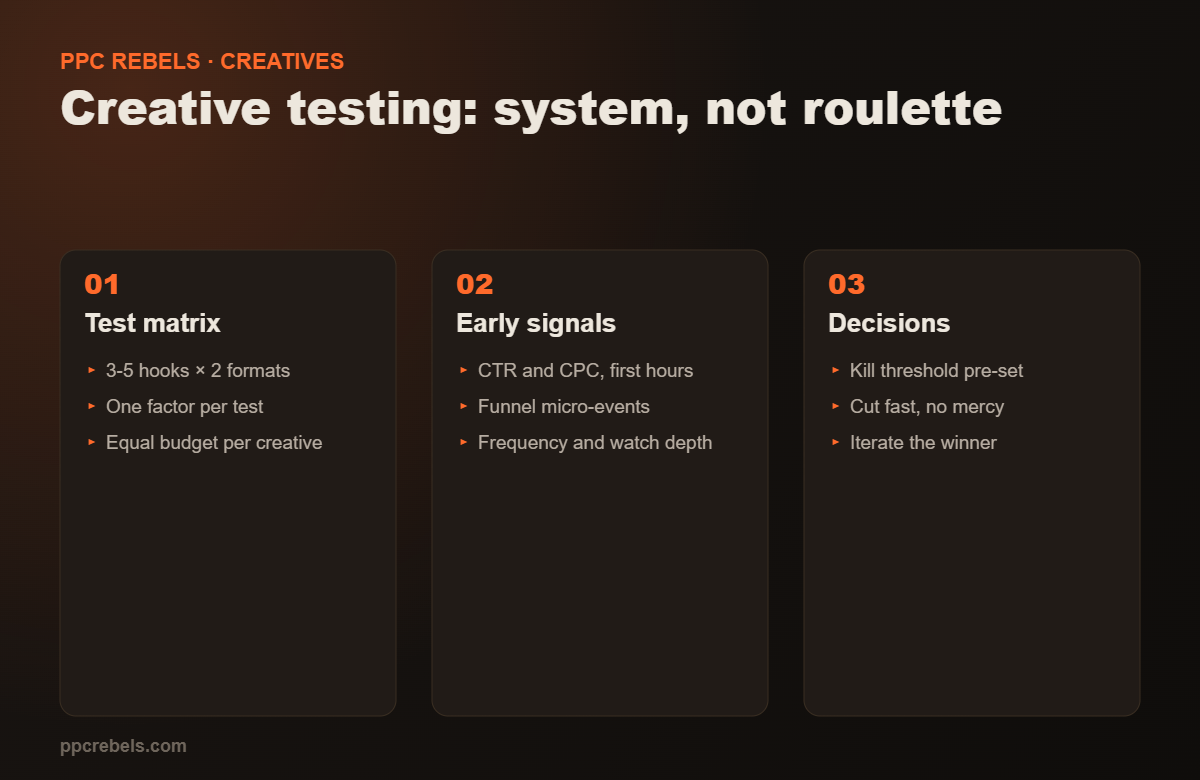
The working format is 3-5 distinct hooks in 1-2 formats: static and video, or two delivery styles. The hook is the promise of the first seconds, and it decides the most. Change one factor per test: if the hook, the format and the audience all change at once, you will never learn what worked.
The hook × format matrix
Build a table: rows are hooks (pain, benefit, curiosity, social proof, fear of missing out), columns are formats. Each cell is a separate ad with an equal budget. One test cycle of this matrix answers two questions at once: which message lands and in which packaging. Platform-specific packaging is covered in creatives for feeds; search ads follow their own testing logic – see RSA A/B testing.
Test budget and duration
The test budget is the price of information, not an attempt to profit. Benchmark: give each creative enough for a statistically meaningful number of clicks and micro-events in your niche, and keep it equal across all matrix cells. Duration – at least a day or two, to capture different audience activity hours.
Early signals: do not wait for sales
There may be no sales at test volume at all – decisions run on early signals: first-hours CTR and CPC, video watch depth, button clicks, funnel micro-conversions (lander visits, scroll, form starts). Weak CTR on normal reach means the hook does not land. Good CTR with a dead funnel means the creative promise does not match the lander.
Decision thresholds: kill fast
Before launch, lock the kill threshold: for example, a creative goes off after N clicks with CTR below the bar or zero micro-events. A pre-set threshold saves you from just-a-little-longer syndrome. Winners go into iteration: new variations of the best hook, then careful campaign scaling.
FAQ
3-5 hooks in 1-2 formats. More dilutes the budget per cell and delays conclusions; fewer gives no comparison.
At a pre-set threshold: N clicks with no micro-events or CTR below the bar. Decide by the threshold, not by mood.
The creative promises something the lander does not show, or the traffic is off-target. Match the ad first promise with the lander first screen.