Micro-Conversions and Funnel Optimization in 2026: The Small “Yeses” That Feed the Algorithm When Deals Are Scarce
Smart bidding wants dozens of conversions; you have five leads a week and an algorithm reading tea leaves. Sound familiar? The way out isn’t “spend more” — it’s one floor down: micro-conversions — the user’s small “yeses” on the way to money (deep scroll, a price click, a form step, add-to-cart) that outnumber deals by an order of magnitude. Chosen well, they feed the algorithm signal, build audiences and show exactly where the funnel tears.
What to track: events with intent
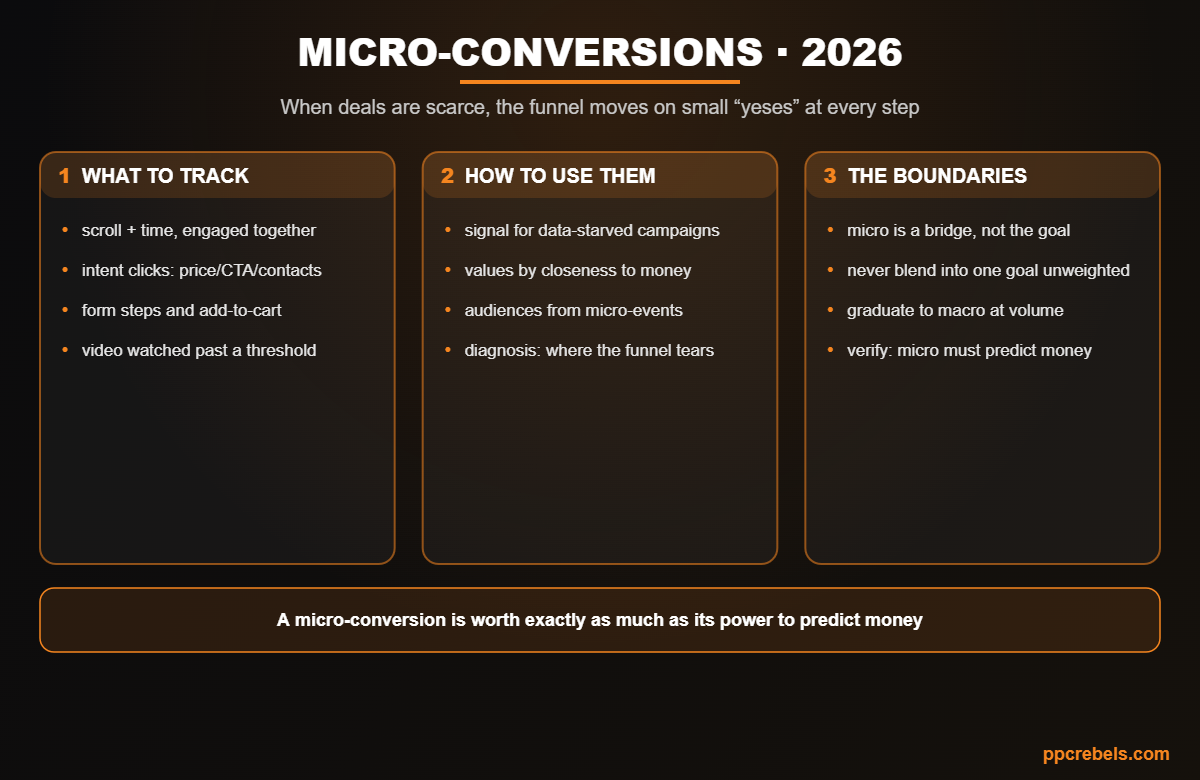
- Engagement with a threshold: 75–90% scroll plus time on page — together, not separately: naked scroll gets inflated even by bots.
- Intent clicks: on pricing/plans, the CTA, contacts, the messenger button — the user reached toward the money.
- Funnel steps: form start, each multi-step form stage, add-to-cart, checkout start — the classics of e-commerce and lead gen.
- Media thresholds: the key landing-page video watched to 50–75%. The technical event setup follows the GA4 guide; here we’re about what to do with them in buying.
How to use them: signal, audiences, diagnosis
- Signal under macro scarcity: a campaign with five weekly leads can learn on “form started” or add-to-cart — hundreds of events instead of a handful; the data-density rules match bidding strategies.
- Values by closeness to money: a checkout start is worth multiples of a scroll — set the weights and the algorithm’s value engine starts telling “almost bought” from “just browsed.”
- Audiences from micro-events: “reached the pricing, didn’t submit,” “abandoned on form step two” — ready-made retargeting segments with a message tailored to the exact break.
- Funnel diagnosis: conversion between micro-steps shows precisely where people are lost — click→scroll→CTA→form→lead; the bottleneck gets a targeted CRO fix, not a “rebuild everything.”
The boundaries: micro is a bridge, not the destination
- Never blend into one goal: scroll and purchase in one unweighted “conversion bundle” — and the algorithm gleefully buries you in scrollers.
- Verify predictive power: once a month, check whether your micro-events actually convert to money; an event that doesn’t correlate with deals gets cut from the goals.
- Graduate to macro at volume: as soon as leads/purchases suffice for learning, the goal moves up the funnel; micros stay on as values and audiences.
- Micro ≠ a success report: scrolls up while deals are down isn’t “improved engagement” — it’s an alarm.
Common mistakes
- Optimizing to scroll — traffic of page-flippers with no money.
- All events in one goal without values.
- Micro-events chosen by “what’s easy to tag” instead of closeness to money.
- Not a single “micro → money” verification in the account’s lifetime.
- Living on micro forever despite sufficient macro volume.
FAQ
Form start and multi-step stages, contact/CTA clicks, the scroll+time pair. Rank them by actual correlation with submissions on your own data.
Product view, add-to-cart, checkout start, payment steps — with values rising toward the money. Add-to-cart is almost always the best bridge signal.
When macro events reliably suffice for learning (benchmark: dozens per week per campaign). Migrate gradually and one change at a time, like any goal switch.
By cohort: the share of event-doers who reach money versus non-doers. No difference — the event is empty; cut it from goals and values.
Show them — yes, as funnel diagnostics; sell them as the result — no. The result is money; micros explain why it’s this much and where to find more.
Bottom line
Micro-conversions in 2026 are the bridge across data scarcity: intent events instead of naked scrolls, values by closeness to money, audiences for specific funnel breaks and a monthly “micro → money” verification. Use them to accelerate learning and find the funnel’s holes — and hand the wheel to macro-conversions the moment the data allows.