Hiring and Delegating Media Buying in 2026: Building a Team Without Buying Yourself a Second Job
A solo buyer hits the ceiling of hours: campaigns need hands, tests need attention, reports need time — and growth stops not because of the market but because of the calendar. Delegating media buying is the next rung of scale — and the biggest graveyard of margin: a bad hire burns budgets faster than any fraud. Let’s break down when to hire, who to look for, how to onboard with playbooks and control by money — without becoming a micromanager.
When and who to hire
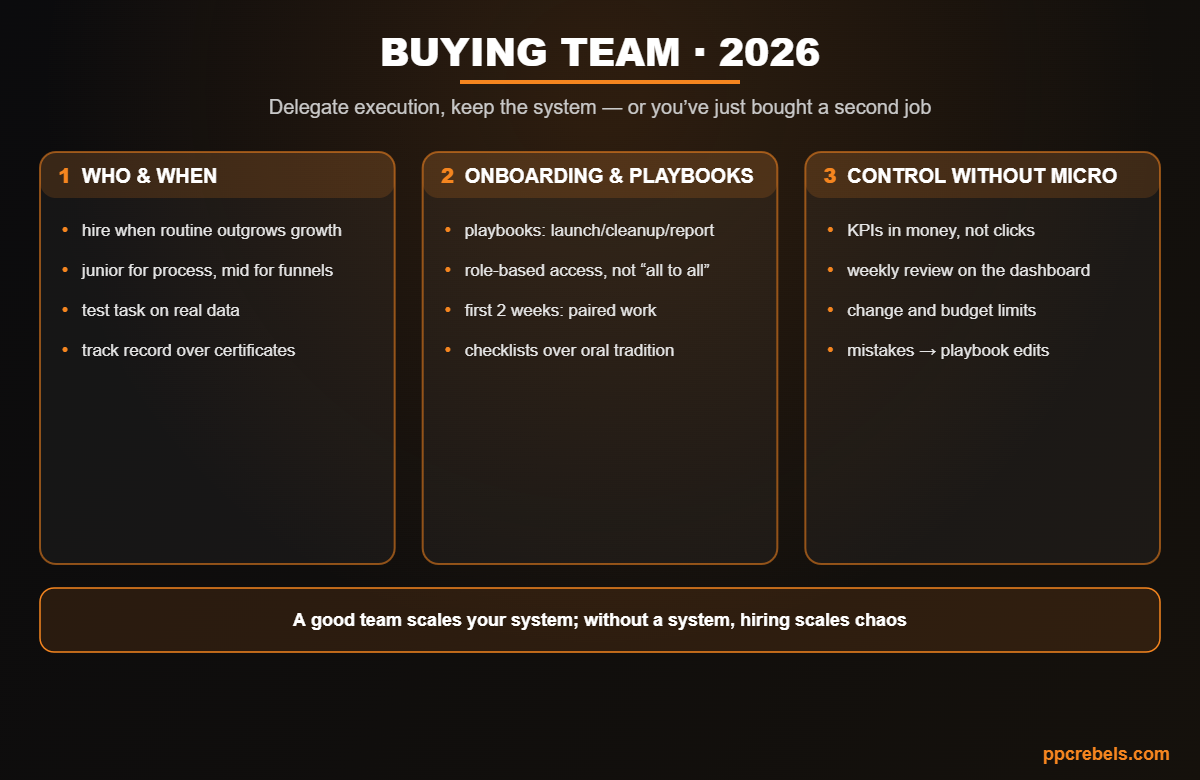
- The hiring signal: routine eats growth. When query cleanup, creative rotation and reports leave no time for strategy and tests, and automation is already squeezed dry — it’s time to split the work.
- Junior for process, mid for funnels: the junior takes playbook operations (hygiene, reports, creative prep) under supervision; the mid runs campaigns and tests with their own KPI. Hiring a “star for everything” into a small team is expensive and fragile.
- A test task on real data: reviewing an anonymized account or case (“find the leaks, propose a plan”) reveals thinking better than any interview — essentially a mini audit.
- Track record over certificates: “what did you do hands-on, what were the numbers, what went wrong” separates practitioners from course theorists.
Onboarding: a system instead of oral tradition
- Playbooks before the hire: campaign launch, weekly cleanup, anomaly response, report format — if the process lives only in your head, there’s nothing to delegate.
- Role-based access: the junior gets working accounts without billing; the mid gets their own perimeter; “all passwords to everyone” ends predictably.
- The first two weeks are paired: the newcomer repeats your operations by checklist, and you fix the checklist where they stumble — onboarding stress-tests the playbooks for free.
- Checklists over memory: every “but I told you” marks a hole in the playbook, not the employee’s guilt.
Control without micromanagement
- KPIs in money: CPA/ROAS against the unit economics target, volume while holding the target, test velocity. Clicks and “activity” are not KPIs.
- A weekly review on the dashboard: one screen of truth for everyone kills the “my platform shows different numbers” argument and keeps the conversation concrete.
- Limits instead of surveillance: a budget/bid change threshold requiring sign-off, a spend cap per test, stop-rules on anomalies — freedom inside guardrails instead of policing every click.
- Mistakes edit the playbook: blameless reviews ending in a new checklist line, so the error never repeats — with this hire or the next.
Common mistakes
- Hiring before playbooks — the newcomer scales the chaos.
- A “star for everything” instead of roles per task.
- Activity- and click-based KPIs instead of money.
- Full access for everyone from day one.
- Policing every action — micromanagement that kills both your hours and the team’s motivation.
FAQ
When routine steadily crowds out strategy and testing, automation is maxed, and the economics carry payroll with a buffer. Hiring “for growth” without workload burns margin.
For playbook processes — a junior trained on your checklists; for independent funnels — a mid with cases. The first hire is usually a junior for routine: it frees your hours at the lowest cost.
A paid test task on anonymized data: find the problems, propose a plan, explain the logic. Watch the thought process and the questions they ask — not just the answer.
Boundaries instead of surveillance: change limits, stop-rules, a weekly dashboard review rhythm. Inside the guardrails the employee decides — and answers for the result in money.
Freelance/agency buys fast expertise without payroll, but the knowledge stays outside. In-house compounds the system internally. The working scheme: a core in-house, peak and niche tasks outsourced.
Bottom line
Delegating media buying in 2026 means scaling a system, not handing out passwords: playbooks before the hire, roles per task, a test on real data, checklist onboarding, money KPIs and limit-based control instead of surveillance. Build the system — and the team multiplies it; without a system, hiring multiplies only chaos and costs.