Lead Forms in 2026: Two-Tap Leads — and How Not to Drown in Junk Submissions
The classic “click → landing page → form” chain loses mobile users at every step: the page loads, fields don’t fill, thumbs miss. Lead forms (native lead ads) remove those steps: the form opens right inside the ad, fields pre-fill from the profile, the lead arrives in two taps. Cost per lead drops — but so does quality, unless you manage the process. Let’s break down how to take the cheapness of native forms without drowning in junk submissions.
Where lead forms work and when they beat a landing page
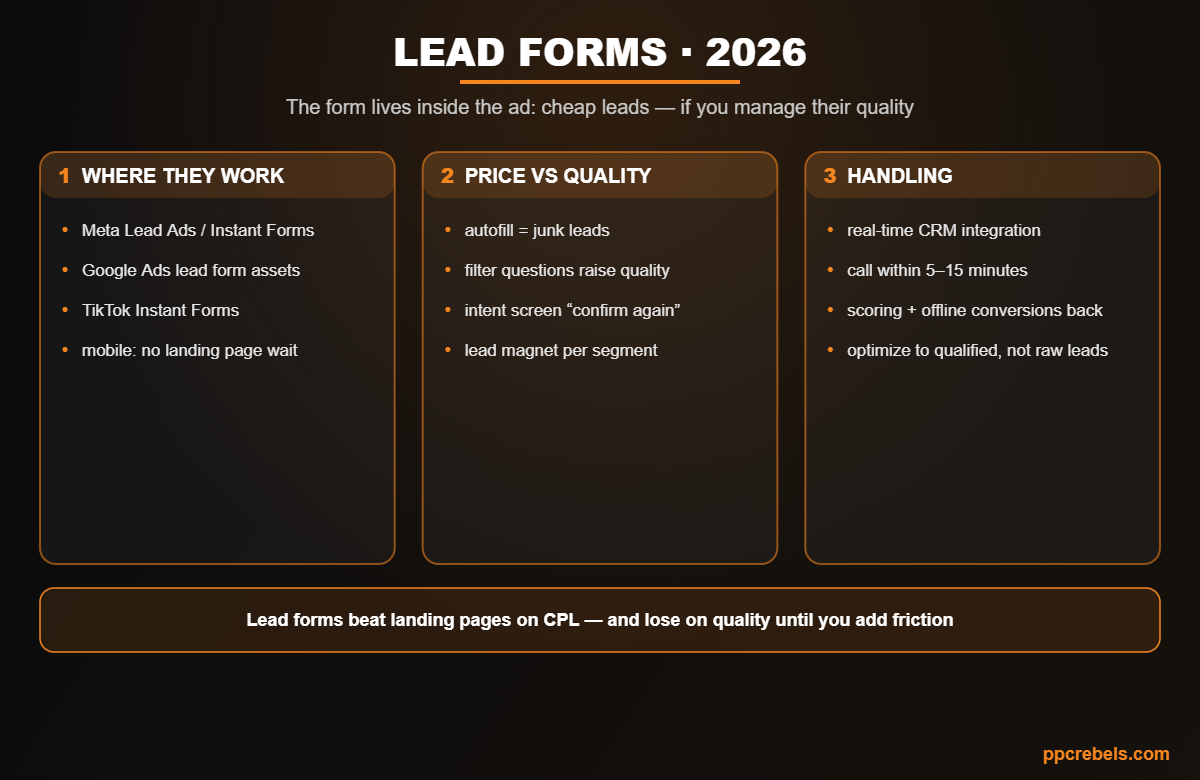
- Meta Lead Ads / Instant Forms — the most mature format: the form in the feed, profile autofill, CRM integrations. It lives by the signal rules from the Meta Ads tracking guide.
- Google Ads lead form assets — attached to Search, PMax and video campaigns: a submission straight from the results page or the video.
- TikTok Instant Forms — the same mechanics in the vertical feed.
- When the form beats the page: mobile traffic, simple offers (consultation, quote, booking), a slow or weak site. When the page wins: a complex product, an expensive deal, content warm-up needed — that’s the job of a converting landing page.
Price vs quality: the core trade-off
- Autofill causes both the cheapness and the junk: people submit without fully waking up. A dirt-cheap lead who never answers the phone is not a lead.
- Add deliberate friction: 1–2 filter questions (budget, timeline, city), one custom free-text question, an intent screen (“review before sending”). CPL rises — CPQL (cost per qualified lead) falls.
- A lead magnet per segment: a quote, an audit, a catalog — not an abstract “leave a request.”
- Do the math on qualified leads: compare forms vs landing pages by cost per deal, not CPL — the arithmetic is in our unit economics breakdown.
Handling: a lead form without speed is a leak
- Real-time CRM integration: leads flow in via webhook/connector instantly; a daily manual CSV export kills lead-to-sale conversion.
- Speed to call decides: contact within the first 5–15 minutes converts multiples better than “we’ll call tomorrow” — a native lead cools faster than a landing page one.
- Scoring and feedback into the platform: mark qualification and upload offline conversions — optimize campaigns to qualified leads/deals, not raw submissions; paired with Advantage+ this literally changes who the algorithm finds.
- The quality loop: junk sources (placements, creatives, audiences) show up through scoring — cut them weekly.
Common mistakes
- A form made only of autofilled fields — record CPL and silence in sales.
- Leads pulled manually once a day — and going cold.
- Optimizing campaigns to “lead” instead of qualified lead.
- One questionnaire for every segment and offer.
- Comparing forms vs landing pages by CPL instead of cost per deal.
FAQ
Mobile, a simple offer, fast response — forms. A complex product, an expensive deal, warm-up needed — the landing page. Often the best answer is testing both, judged by cost per deal.
Autofill removes intent: the submission happens on impulse. The cure is filter questions, an intent screen, and instant handling.
Contacts plus 1–3 qualifying questions. Fewer — junk; many more — you lose the format’s advantage over a landing page.
Benchmark: the first 5–15 minutes. Set up instant CRM delivery and sales notifications; every hour of waiting cuts contact rates.
Score leads in the CRM and send qualification back as offline conversions. Bid goals then work on qualified leads/deals — and the algorithm starts finding the right people.
Bottom line
Lead forms in 2026 are a trade: two taps instead of a landing page buy a cheap lead, and discipline gives it value back — filter questions, instant CRM delivery, a call within 5–15 minutes, and optimization to qualified leads via offline conversions. Judge by cost per deal, not CPL — and native forms become a conveyor, not a junk pile.