App Campaigns in 2026: Driving Profitable Installs When the Algorithm Took All the Knobs
Google’s app campaigns have almost none of the familiar knobs: no keywords, no audiences, no placements — the algorithm decides who sees your ad across Search, YouTube, the networks and Google Play. From the outside it looks like an “install faucet” button. Inside, it’s a system where two things decide everything: the quality of your creative assets and how close your conversion signal sits to money. App campaigns forgive missing settings — they never forgive a junk signal.
How app campaigns work
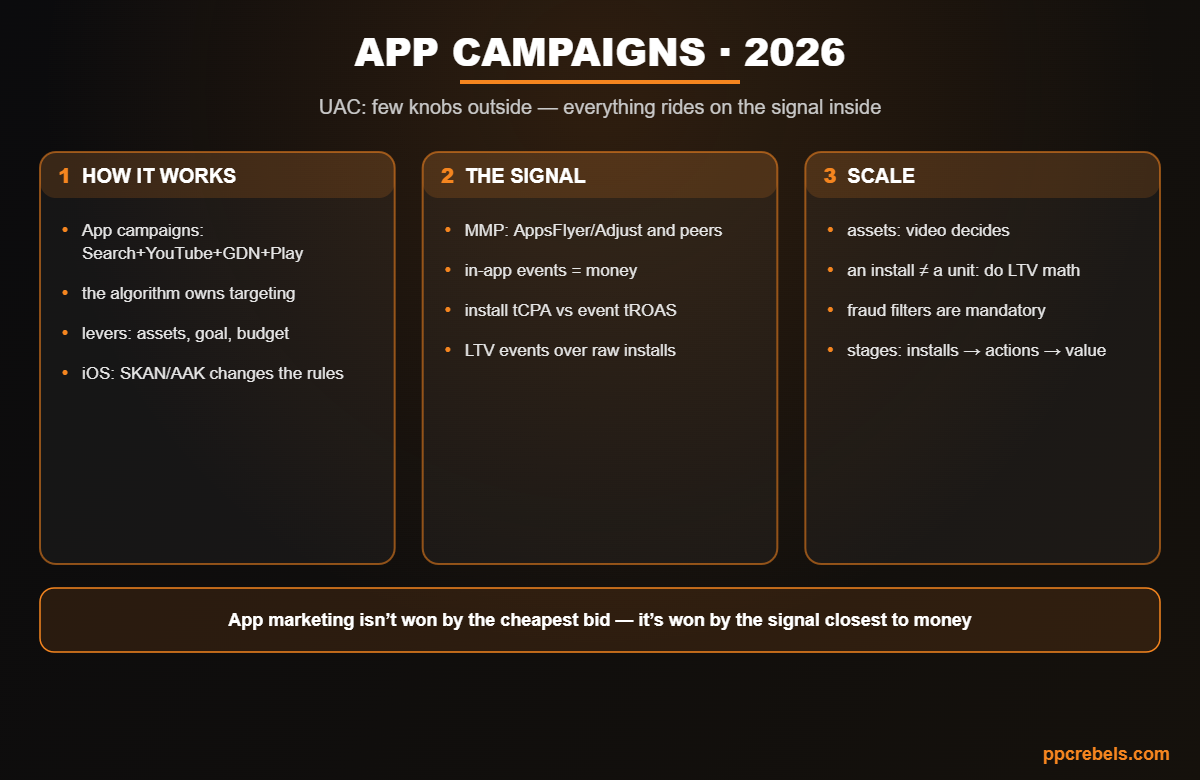
- One format, every Google surface: Search, YouTube, Display, Discover and Google Play from a single campaign. You supply texts, images, video and a goal — the algorithm combines and targets.
- The levers that remain: the asset set, the goal type (installs / in-app actions / value), tCPA/tROAS and budget. Each weighs more than ten old knobs did.
- iOS is its own reality: ATT and SKAdNetwork/AdAttributionKit cut granularity and delay data; iOS campaigns are planned with aggregated attribution and extra patience — a continuation of the privacy theme from our Consent Mode v2 breakdown.
The signal: MMPs and the events that get paid for
- An MMP (AppsFlyer, Adjust and peers) is the foundation: unified install and event attribution across sources, deduplication, postbacks to the platforms.
- In-app events = money: a registration is a weak signal; a purchase, subscription, or progression to the key action is strong. The algorithm hunts people similar to those who fired the goal event.
- The goal ladder: start on installs (volume), move to actions (event tCPA), finish on value (revenue tROAS). Each rung needs its own data density — the same rules as in bidding strategies.
- LTV over installs: an install is worth nothing by itself; your max CPI derives from cohort LTV — the math from unit economics multiplied by retention.
Scale: assets, fraud and staging
- Video decides: vertical and horizontal, gameplay/product from the first seconds, several durations — the hook rules from our video ads article. Without your own video, Google builds a screenshot slideshow.
- A full asset set with rotation: headlines, descriptions, images in all formats; report-flagged weak assets replaced every 2–4 weeks.
- Fraud filters are mandatory: install fraud and incentivized traffic in the networks are real; MMP anti-fraud plus CTIT and retention anomalies stay under constant watch.
- Geos and platforms split: iOS and Android, tier-1 and tier-3 economics never share one goal.
Common mistakes
- Optimizing to installs forever — an ocean of installs, zero money.
- Launching without an MMP: sources can’t be compared, fraud can’t be caught.
- One campaign for iOS+Android and every geo at once.
- Three screenshots instead of video assets.
- Changing the goal and tCPA every three days — permanent learning mode.
FAQ
Minimal manual targeting: the algorithm distributes delivery across Google’s surfaces itself. You steer through assets, the goal type, tCPA/tROAS and budget.
For a single channel Firebase suffices; with multiple sources an MMP becomes necessary — independent attribution, deduplication and anti-fraud in one place.
When the goal event reaches stable volume (benchmark: dozens per week). Earlier — nothing to learn from; later — you’re burning budget on empty installs.
None in isolation from LTV: max CPI = cohort LTV × your target margin share. Cheap installs with zero retention cost more than “expensive” payers.
ATT cut identifiers; SKAdNetwork/AdAttributionKit provide aggregated, delayed data. Plan iOS campaigns with longer evaluation windows and cohort-based judgment instead of instant reports.
Bottom line
App campaigns in 2026 are steered through signal and creative: an MMP as the foundation, money events over installs, the “installs → actions → value” goal ladder, rotating video assets and fraud filters. Do the math on cohort LTV, split platforms and geos, give learning its time — and the “install faucet” becomes a profitable scaling machine.
Read also
- Traffic arbitrage & CPA marketing 2025–2026: the complete guide
- PPC Rebels and Coronium.io: mobile proxies for arbitrage and SEO in 2026
- Google Ads agency accounts 2026: the complete media buyer’s guide
Related reading: Deep Links and Web to App Connect in 2026: Where Conversions Leak Between Site and App