Customer Match & First-Party Data in Google Ads 2026: Targeting in the Privacy Era
Third-party cookies are fading, and the winner is whoever knows how to work with their own data. Customer Match and first-party data let you target real customers by email and phone — legally, precisely and fully within Google’s policy. This is the foundation of targeting in the 2026 privacy era.
What Customer Match and first-party data are
First-party data is the contact information customers gave you directly: buyers, subscribers, CRM leads. Customer Match is the Google Ads tool that turns those lists into targetable audiences. The data is hashed before upload, so Google can match users without ever exposing personal details.
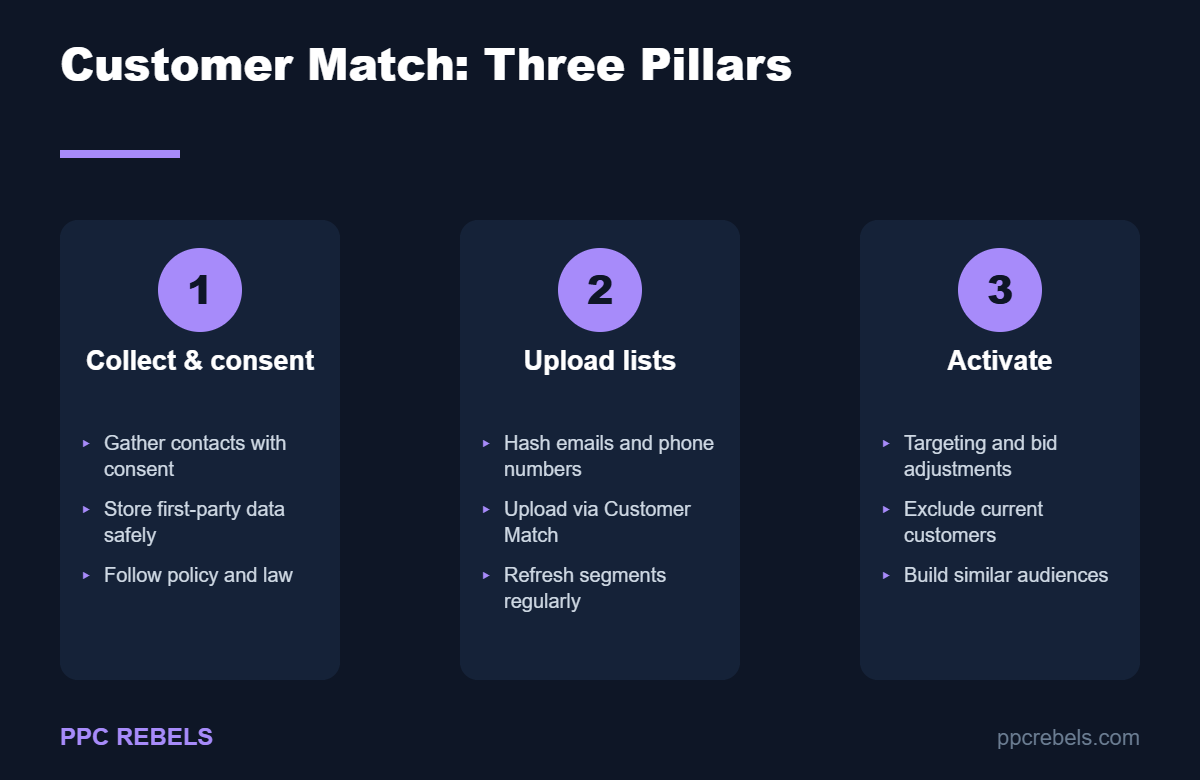
Three pillars of Customer Match
Pillar 1. Collect data and consent
Collect contacts honestly and with explicit marketing consent — that is required by both Google and the law. Store the data securely and keep the consent source documented. A quality landing page with a transparent form is the best way to grow your list legally.
Pillar 2. Prepare and upload lists
Normalize and hash emails and phone numbers (SHA-256) before upload, or let Google’s interface hash them for you. Upload segments through Customer Match and refresh them regularly — stale lists lose reach. A clear account structure keeps your audiences organized.
Pillar 3. Activate audiences
Use lists for targeting, bid adjustments and exclusions. Exclude current customers from acquisition campaigns, build similar audiences to expand, and feed signals into your bid strategies so the algorithm hunts for people who look like your best buyers.
Launch checklist
- Build a consented list and remove duplicates.
- Normalize email and phone formats.
- Create a Customer Match segment and upload the data.
- Wait for the list to populate (usually up to 48 hours).
- Set up targeting, exclusions and result tracking.
Common mistakes
- Uploading a list without consent — risk of suspension and fines.
- Never refreshing lists, losing reach and relevance.
- Not excluding current customers and overpaying for existing buyers.
- A list too small for Google to activate the audience.
FAQ
Yes, with consent. Data is hashed and Google uses it only for matching. The key condition is lawful collection and explicit user consent.
An audience must reach enough matches to serve (usually a few thousand). Google simply will not activate lists that are too small.
First-party data is more accurate, resistant to browser restrictions and entirely yours. In the privacy era it is the most reliable targeting source.