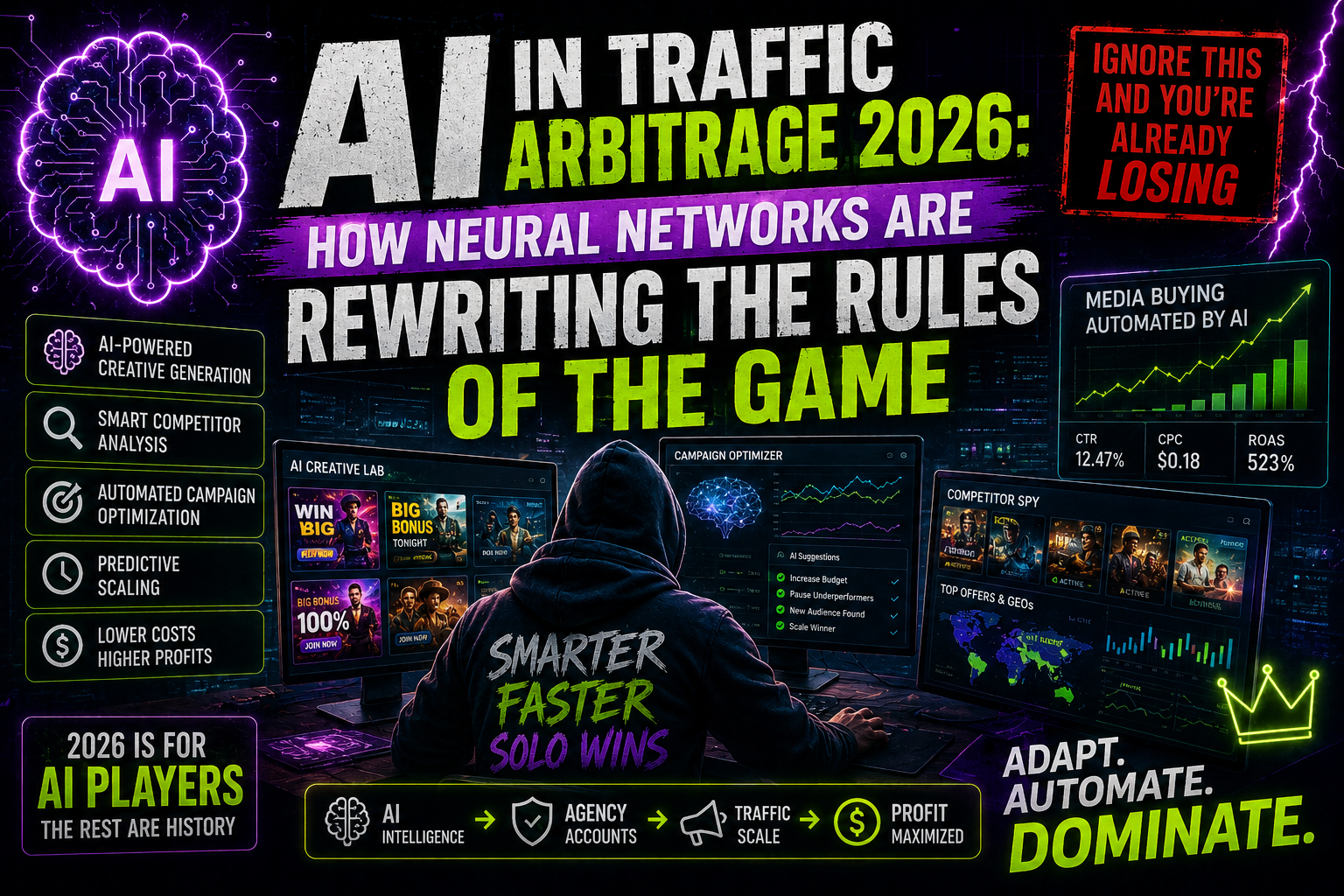
AI in Traffic Arbitrage 2026: How Neural Networks Are Rewriting the Rules of the Game — and Why Media Buyers Who Ignore This Are Already Losing
Spoiler: This is not an article about “ChatGPT wrote me an ad text.” This is about a systemic shift. It’s about how AI paired with agency Google Ads accounts turns a solo arbitrageur into a full-fledged media buying team with minimal operating costs.
Why this matters more now than ever
If you’re reading this in 2026 and still doing everything manually, you’re paying an invisible tax. Not in money — in time, scale, and lost profits.
Look at the numbers: the cost of a lead in the gambling niche has risen by 38–65% over the past two years, competition in gray verticals has tripled, while the entry barrier for those who know how to work with AI tools has, on the contrary, dropped. Because one arbitrageur with the right tool stack today does the work of a five-person team from 2022.
This is exactly where the story of real competitive advantage in 2026 begins.
Chapter 1. Where AI Actually Works in the Arbitrage Funnel — No Marketing Bullshit
Let’s be honest. Most articles about “AI in marketing” are just vague buzzwords. We’ll do it differently: we’ll break down the specific points in the funnel where neural networks deliver measurable results.
🔵 1.1 Creative Generation and Testing
Before, an A/B test of a single ad required: 3–5 days for a copywriter to write the text → design → upload → launch → analysis. Total: one week and $300–500 per test.
Today, the combo Claude/GPT-4o + Midjourney/FLUX/Ideogram lets you generate 20–30 creative variants with different headlines, triggers, and visuals in just 2–3 hours. You launch them all at once on small budgets ($10–20 per creative), check CTR after 48 hours, and scale the winners.
Real case (nutra, Tier-2):
- Without AI: 4 creatives per week, 1 survives, ROI 90–110%
- With AI generation: 28 creatives in the same week, 4–5 survive, best ROI — 210%
- Difference in creative costs: $1200 → $180
Tools: Text — Claude 3.5 Sonnet, GPT-4o. Visuals — Midjourney v7, FLUX Pro, Ideogram 3. Video creatives — Kling AI, Runway Gen-4, Hailuo.
🔵 1.2 Writing Prompts for Specific Verticals
This is the main mistake 90% of arbitrageurs who “tried AI and got disappointed” make.
A neural network is not a magic button. It’s a tool that works exactly as well as your prompt is good.
Here’s what a working prompt for gambling creatives looks like (adapted for legal advertising rules):
text
You are an experienced copywriter for casinos in Latin America. Audience: men 28–45 years old, average income, football fans. Write 5 headline variants for Google Ads (max 30 characters) and 5 descriptions (max 90 characters). Trigger — registration bonus. Tone: bold, confident, no emoji overload. Avoid prohibited words: [list]. Provide variants with different emotional hooks: FOMO, exclusivity, social proof.The difference between “write text for a casino” and this prompt is the difference between garbage and a working creative.
🔵 1.3 Automatic Campaign Optimization via Scripts + AI
Google Ads Scripts + LLM is a combo that only a few people use — and they’re missing out.
The workflow:
- Google Ads Script exports campaign data (CTR, CPC, conversions, search queries) to Google Sheets every 6 hours.
- A Python script with API access to Claude/GPT analyzes the data and generates recommendations: which keywords to negative, where to raise bids, which ads to pause.
- Recommendations are either applied automatically (for routine decisions) or sent to a Telegram bot for manual approval (for big changes).
This isn’t fantasy. It works right now and requires a one-time setup of about 6–8 hours of developer time.
Time saved on manual optimization of one account: 3–4 hours a day → 20–30 minutes.
🔵 1.4 Competitor Analysis via AI + Spy Data
You use Spy services? Great. But most arbitrageurs just look at creatives with their eyes and copy them intuitively — even though proper analysis through spy tools already changes the outcome dramatically. AI makes this analysis much deeper and faster.
The 2026 approach:
- Export the TOP-50 competitor ads in your vertical from AdSpy/SpyFu/SimilarWeb.
- Upload everything to Claude with the task: “Analyze patterns: which triggers repeat most often? What headline structures dominate? What do the longest-living ads have in common?”
- You get a structured analysis with insights that would have taken an analyst 2–3 days.
It’s legal, ethical, and it works.
Chapter 2. Where AI Will NOT Replace an Experienced Arbitrageur (and Why That’s Good for You)
Honesty is our policy, so let’s be direct.
AI still cannot: ❌ Intuitively read the market. When a vertical is “on fire,” an experienced buyer feels it from indirect signals: CPC changes, colleagues getting bans, affiliate programs altering terms. AI works with data after the fact. ❌ Build relationships. Your personal contact at the affiliate program who sends you exclusive offers — a neural network can’t replicate that. ❌ Make non-standard ethical decisions. Where exactly the “gray” line is for a specific geo and platform — that’s experience, intuition, and market knowledge. ❌ Take responsibility. An AI tool can make mistakes. The final decision always stays with the human.
Conclusion: AI does not replace a media buyer. It amplifies him 5–10 times. That’s why a person with an AI stack is already beating teams that still work the old way.
Chapter 3. Full AI Stack for an Arbitrageur in 2026 — What to Actually Use
Here’s an honest list of tools with no affiliate links or paid placements:
| Task | Tool | Price/month | What it delivers |
|---|---|---|---|
| Copywriting creatives | Claude 3.5 Sonnet / GPT-4o | $20–$100 | Texts, headlines, landing page copy |
| Visual creatives | Midjourney v7 | $30–$120 | Banners, static creatives |
| Video creatives | Kling AI / Runway | $60–$150 | Videos for YouTube, TikTok |
| Campaign analysis | Claude API + scripts | $50–$200 | Auto-optimization of accounts |
| Competitor analysis | SpyFu + GPT | $90–$200 | Patterns of successful creatives |
| Translations & localization | DeepL Pro + GPT | $30 | Adaptation for Tier-2/3 geos |
| Automation | Make.com / n8n | $20–$100 | Connecting all tools |
| Voice creatives | ElevenLabs | $22–$99 | Voiceovers for videos |
Total minimum stack: ~$300–500/month
What it replaces: copywriter ($1500+) + designer ($1200+) + analyst ($1500+)
Chapter 4. Case Study: How AI Automation Works with an Agency Google Ads Account
Now for the most interesting part. Because AI tools are only half the equation.
The second half is stability of the advertising infrastructure.
Here’s the real pain point: you spend 8 hours creating the perfect AI creative, set up smart optimization, launch the campaign — and 36 hours later you get an account ban. Game over. ROI = -100%.
That’s why AI automation without reliable agency Google Ads accounts is a house without a foundation.
This is what the correct 2026 stack looks like:
text
AI stack (generation + optimization)
         ↓
Agency Google Ads account (trust + stability)
         ↓
Cloaking (protection from unwanted audience)
         ↓
Pre-landing + Landing (conversion)
         ↓
Offer (affiliate program)
Every link in this chain is critical. Remove one and the whole thing breaks. It’s especially painful with cloaking: without it, even a trusted account burns quickly on gray offers (we covered how to build proper protection here).
Agency accounts give you what a self-registered account never can:
- Inherited trust — Google sees an account history of 3 to 10 years
- Priority moderation — your ads are reviewed faster and more leniently
- Higher limits — run $5000–$20,000/day without stops
- Real support on bans — not “account blocked, create a new one,” but case review and fast recovery
When AI optimizes campaigns 24/7 and the agency account provides stability — that’s when the system truly scales.
Chapter 5. Practical 30-Day Plan: How to Implement AI into Your Arbitrage
No fluff. A concrete plan.
Week 1: Foundation
- Sign up for Claude Pro and GPT-4o (test both for different tasks)
- Build a library of prompts for your verticals (minimum 10–15 prompts)
- Set up Midjourney or Ideogram for visual creatives
- Make sure you have a reliable agency Google Ads account — without it, AI automation is pointless
Week 2: Creative Testing
- Create your first 20 AI creatives for one campaign
- Launch them with $10–15 budget each
- Log results in a table (CTR, CPC, conversions)
- Analyze patterns of the winners
Week 3: Automation
- Set up campaign data export to Google Sheets via Ads Script
- Create a simple analysis prompt: “What needs to be optimized in this data?”
- Set up a Telegram bot for daily recommendations
- Run your first automated optimization
Week 4: Scaling
- Pick 3–5 best creatives and scale the budget
- Launch a second account with a new geo or vertical
- Connect Make.com or n8n for routine automation
- Calculate ROI before and after AI implementation
Chapter 6. The Biggest Mistakes When Implementing AI in Arbitrage
Learn from other people’s failures.
❌ Mistake 1: “AI wrote it — launch it immediately” The neural network doesn’t know which words trigger bans in Google. Every AI text must be checked against the platform’s internal guidelines and adapted. Auto-publishing without review = burned account.
❌ Mistake 2: Using one universal prompt A prompt for gambling is not the same as one for nutra or crypto. Each vertical needs its own prompt library that accounts for audience, geo, triggers, and platform restrictions.
❌ Mistake 3: Forgetting the foundation The coolest AI stack won’t save you if your account burns every 3 days. First build reliable infrastructure (agency account, proxies, antidetect), then add automation.
❌ Mistake 4: Not training the AI on yourself Feed the neural network context: your best creatives, audience analysis, successful cases. The better the context, the more accurate the output. AI without your expertise is a blind tool.
❌ Mistake 5: Expecting magic on day one AI is a muscle. The more you train it, the better your prompts become and the more precise the results. The first 2–3 weeks are training. Don’t expect 500% ROI from the first launch.
Chapter 7. Where the Industry Is Heading — Forecast for the Second Half of 2026
This is our insider view based on trends we’re seeing right now.
🔮 Trend 1: AI agents will replace manual campaign management The first “autonomous agents” are already appearing — systems that don’t just recommend but actually make changes, test hypotheses, and optimize in real time. By the end of 2026 this will be standard for top teams.
🔮 Trend 2: User-level creative personalization AI already generates different ad versions for different audience segments. The next step is real-time dynamic personalization: a user from Brazil at 10 PM Friday sees a different creative than a user from Argentina at 10 AM Monday.
🔮 Trend 3: AI detection vs AI bypass Platforms are rolling out AI to detect violations. Arbitrageurs are responding with AI that creates more “human-like” creatives. This arms race will accelerate. The winners will be those with better infrastructure and more trusted accounts.
🔮 Trend 4: The end of “manual” media buying for solo players A person without an AI stack in 2027 will be like an arbitrageur without internet in 2010. Not because AI is “smarter,” but because competitors with AI work faster, cheaper, and more accurately.
The winning formula in arbitrage 2026
text
(Agency account with trust) × (AI automation) × (Right offer) = Sustainable ROIRemove any multiplier and the formula breaks.
An agency account without AI is a reliable machine without a navigator. It moves, but slowly. AI without a reliable account is a Ferrari on flat tires. Looks cool, but won’t get you far. Together — it’s a system that scales.
What to do right now
- Audit your stack: Which tasks are you still doing manually? Write them down — that’s your automation list.
- Start with creatives: This gives the fastest ROI from AI. Today you can create 10 ad variants in an hour instead of a week.
- Secure the foundation: If you’re still on farm or self-registered accounts, that’s your bottleneck. Solve the agency Google Ads account issue first.
- Measure everything: Track time and budget spent on creatives, analysis, and optimization. Compare the numbers in a month.
The PPC Rebels team has been working with arbitrageurs for 7+ years. We’ve watched the industry evolve — from manual account farming to complex AI infrastructures. Our job is to give you a rock-solid foundation in the form of agency Google Ads accounts so your AI stack runs without interruptions. Discuss your situation: @ppc_rebels_alex
Frequently Asked Questions
Can AI be used to create creatives for gray verticals in Google Ads? Yes, but with mandatory manual review and adaptation to platform policies. AI creates the base — the arbitrageur edits it to fit geo and vertical requirements.
Which AI tool is best for a beginner arbitrageur? Start with Claude Pro or GPT-4o for text and Ideogram for visuals. It’s the most accessible combo with the fastest payback.
Will AI replace media buyers by 2027? No. AI enhances the media buyer but does not replace strategic thinking, intuition, or industry connections. It will only replace those who refuse to use it.
How much does a basic AI stack cost for an arbitrageur? A minimum working stack costs $300–500 per month. It replaces the manual work of a copywriter, designer, and analyst — worth $4000–5000/month combined.
Is an agency Google Ads account mandatory when using AI automation? Critically important. AI automation creates heavy load on the account (frequent changes, tests, scaling). A regular account won’t survive. An agency account handles it.