Consent Mode v2 and Privacy in 2026: Collecting Signal When Half Your Users Are “Invisible”
Every year media buyers bury tracking: “cookies are dying, it’s all over.” The 2026 reality is more prosaic: third-party cookies in Chrome survived (Google reversed the deprecation back in April 2025), but the privacy pressure never left — Safari ITP, iOS ATT, ad blockers and, above all, mandatory consent. Consent Mode v2 is Google’s way of living in this world: collect signal from those who consent and model the picture for the rest.
Let’s cover it without panic: what actually changed in privacy, how Consent Mode v2 and its signals work, and which measurement stack (CMP, Enhanced Conversions, server-side tagging) keeps campaigns sighted.
What’s actually happening with privacy
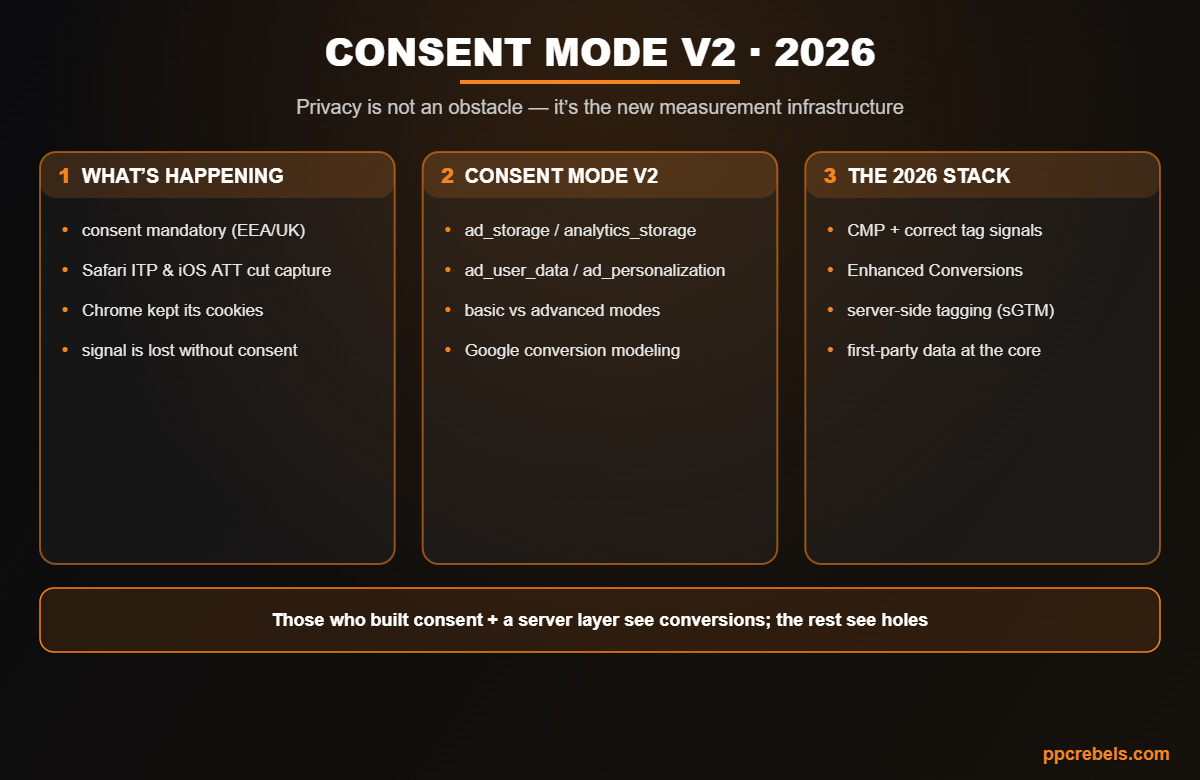
- The cookie apocalypse was cancelled; the pressure wasn’t. Chrome kept third-party cookies, but Safari/Firefox have long cut them, iOS ATT restricts identifiers, and blockers multiply.
- Consent became mandatory: in the EEA/UK, without valid consent Google won’t accept personal data for advertising — without Consent Mode v2, remarketing lists and personalization break.
- The consequence for buyers: a share of users will always be directly “invisible.” The question isn’t “how to bypass it” but how to honestly collect the maximum and model the rest properly.
How Consent Mode v2 works
- Four signals: ad_storage and analytics_storage (storage for ads/analytics) plus the v2 additions — ad_user_data (sending data to Google) and ad_personalization (personalization/remarketing). The CMP passes them to tags automatically.
- Basic vs Advanced: in basic, tags don’t load until consent (max privacy, min data); in advanced they send cookieless anonymous pings — on which Google builds conversion modeling, closing part of the gap.
- Modeling is an estimate: trends are visible, microscopic channel differences aren’t. How to read such data is covered in GA4 attribution.
- Without v2 signals in the EEA/UK, audiences and remarketing don’t work — a direct hit to retargeting.
The 2026 measurement stack everyone needs
- A CMP integrated with Consent Mode v2 — a certified platform, all four signals passed correctly, no dark patterns.
- Enhanced Conversions: hashed first-party data (email/phone) from the conversion improves matching where the cookie didn’t survive.
- Server-side tagging (sGTM): resilience to blockers and ITP, control over what leaves for the platforms — the foundation from our tracking in arbitrage guide; on Meta the same role is played by CAPI from the Meta Ads tracking guide.
- First-party data at the core: your own lists and events survive any browser storm.
Common mistakes
- A checkbox-theater consent banner that doesn’t pass signals to tags — data silently lost.
- Missing ad_user_data/ad_personalization — and “suddenly” empty audiences in the EEA.
- “Tracking is dead” panic instead of completing the stack (EC + sGTM recover most losses).
- Comparing numbers before/after consent without adjusting for modeling.
- Dark patterns in the CMP — the domain and account risk costs more than any consent uplift.
FAQ
For EEA/UK traffic — effectively yes: without v2 signals Google won’t accept data for personalization and remarketing. Elsewhere it’s best practice and future-proofing.
Advanced gives conversion modeling and fewer blind spots; basic is maximum conservatism. The choice depends on your legal position — align with counsel.
Chrome isn’t the whole internet: Safari, iOS, blockers and consent requirements have long been cutting capture. The CMP + EC + server-layer stack recovers losses regardless of what happens to cookies.
In the EEA/UK audiences stop filling and personalization switches off. If your lists suddenly emptied — check the consent signals first.
Good enough for trends and optimization, but it’s an estimate: don’t act on microscopic differences, and always reconcile against money in the CRM.
Bottom line
Privacy in 2026 isn’t the end of measurement — it’s its new infrastructure: a CMP with correct Consent Mode v2 signals, Enhanced Conversions on first-party data, server-side tagging, and a sober attitude to modeling. Build this stack once — and your campaigns stay sighted where competitors read tea leaves from what’s left of the pixel.