Google Ads Account Suspended? How Smart Affiliates Stay Running in 2026
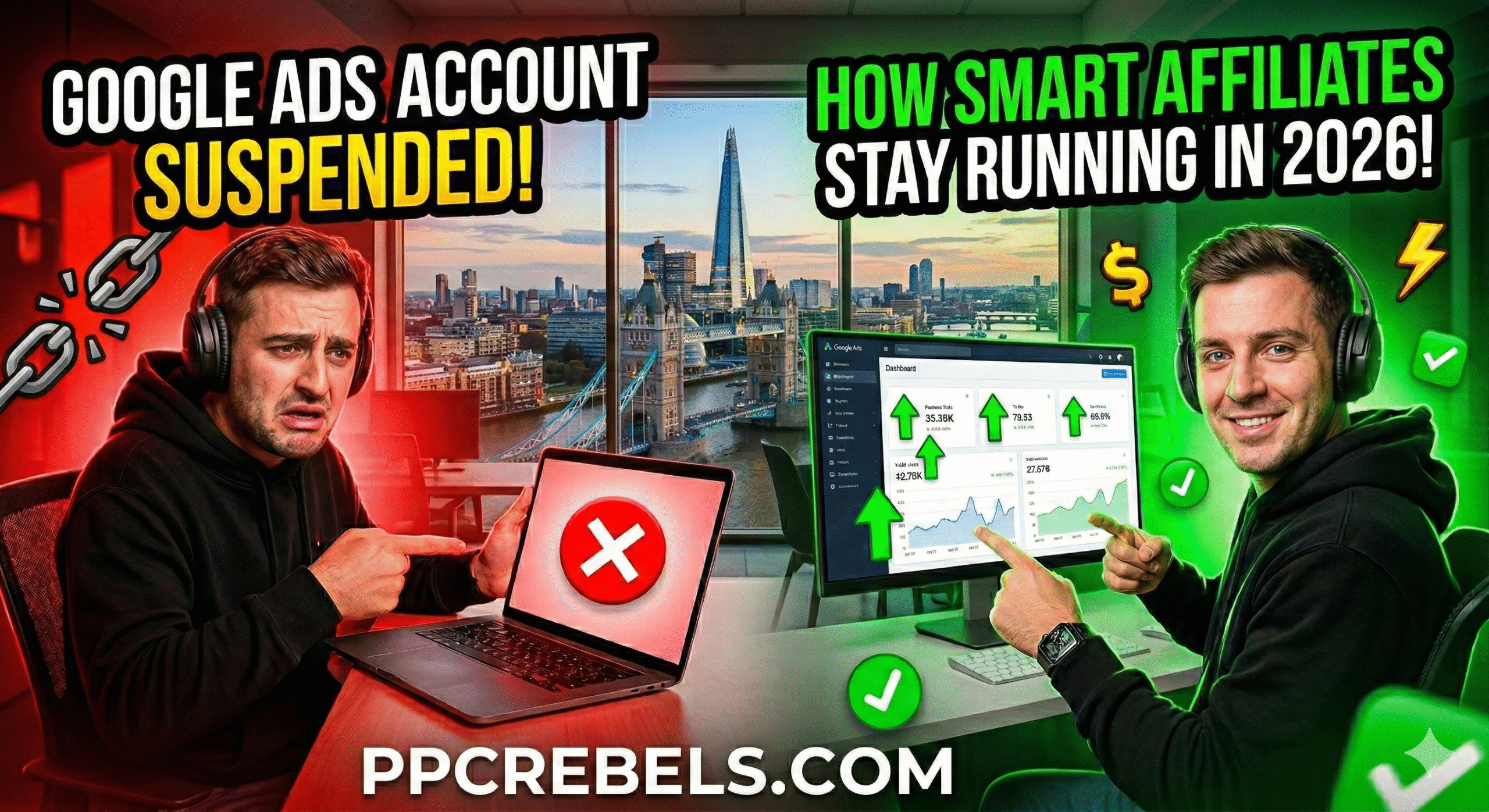
You wake up on a Monday morning, coffee in hand, ready to check your overnight campaign results — and instead you see it: a red banner across your Google Ads dashboard. Account suspended. All campaigns paused. Zero impressions.
Sound familiar? If you’ve been running paid traffic for any length of time — especially in competitive or grey verticals — you already know this feeling. Google’s automated enforcement systems have become dramatically more aggressive in recent years. What once took months of policy violations to trigger now happens overnight, sometimes within hours of launching a new account.
But here’s what separates hobbyist affiliates from seasoned media buyers: it’s not whether your account gets suspended. It’s what you do the moment it happens — and, more importantly, how you set up your infrastructure so that one suspension never kills your entire operation.
This guide breaks down everything you need to know about Google Ads suspensions in 2026: why they happen, how to recover, and the professional strategy that top media buyers use to stay running no matter what Google throws at them.
1. Why Google Ads Accounts Get Suspended in 2026
Before you can fix a problem, you need to understand what’s causing it. Google issues account suspensions for a range of reasons, and the platform has gotten significantly better at detecting violations that would have slipped through a few years ago.
Policy Violations — The Obvious Ones
The most straightforward causes are direct policy breaches: promoting prohibited products, using misleading ad copy, or running landing pages that violate Google’s advertising policies. In grey verticals — gambling, nutra, dating, crypto, adult — the margin for error is essentially zero. A single campaign that crosses the line can trigger a review that ends with a permanent ban.
Circumventing Systems
One of the most brutal suspension triggers in Google’s arsenal is the “Circumventing systems” policy violation. This catch-all category covers cloaking, keyword stuffing, using bridge pages, and any tactic that tries to show different content to Google’s crawlers than to actual users. The system is now sophisticated enough to detect many cloaking setups automatically, and the penalty is almost always a permanent account-level ban.
Billing Anomalies and Payment Issues
New accounts with unusual payment activity are flagged by Google’s risk systems almost immediately. Using virtual cards that fail on the first charge, switching between multiple payment methods in a short window, or having billing information that doesn’t match your account identity are all red flags. Even perfectly legitimate advertisers get caught by these automated triggers.
Account Trust Score — The Hidden Factor
This is the one that catches even experienced media buyers off guard. Google maintains an internal trust score for every advertiser. A fresh account that immediately launches campaigns with high budgets, aggressive bidding, and grey-area creative has a trust score of essentially zero. The algorithm treats it as high-risk and applies extra scrutiny — sometimes before you’ve even spent a dollar.
By contrast, an established agency account with years of compliant spending history, verified business information, and a positive payment record carries a trust score that gives it dramatically more room to operate.
Key insight: Most suspensions aren’t about individual ad violations. They’re about Google’s overall risk assessment of your account, your infrastructure, and your behavioral patterns inside the platform.
2. The Three Phases of a Suspension — and What to Do at Each Stage
Phase 1: Account Under Review
This is the preliminary stage — often triggered by an automated system rather than a human reviewer. Your ads may stop serving, but the account status shows “Under review” rather than “Suspended”. At this point:
- Do not make any changes to campaigns, ad groups, or settings. Additional activity during a review can escalate the case.
- Do not submit an appeal immediately. Wait 24–48 hours to understand the exact suspension reason Google provides.
- Review your landing pages, billing information, and ad copy against Google’s policies to identify anything that might have triggered the review.
Phase 2: Official Suspension Notice
If the review results in a suspension, you’ll receive an email specifying which policy was violated. This is where your response strategy matters enormously:
- Read the policy violation notice carefully. “Circumventing systems” and “Egregious violations” are effectively permanent — appeals rarely succeed for these categories.
- For standard policy violations (billing issues, misleading ads, unacceptable content), a well-structured appeal that demonstrates understanding of the policy and concrete corrective actions has a reasonable success rate.
- Address every point in the suspension notice. Vague appeals that simply say “I comply with all policies” are automatically dismissed.
Phase 3: Post-Suspension Decision
Here’s the brutal truth that Google won’t tell you: for many grey-vertical operators and high-volume media buyers, the appeal process is a dead end. Google’s automated systems are calibrated to protect the platform, not to give advertisers the benefit of the doubt. Once a permanent ban is in place, the practical recovery path is not through appeals — it’s through infrastructure.
Professional media buyers treat account suspensions as an operational risk to be managed — not an emergency to be panicked about. The solution is infrastructure, not appeals.
3. The Professional Solution: Google Ads Agency Accounts
If you’ve been in the affiliate marketing space for more than a few months, you’ve heard about agency accounts. But there’s a lot of confusion — and frankly, a lot of misinformation — about what they are, how they work, and why they’re the preferred solution for serious media buyers.
What Is a Google Ads Agency Account?
An agency account (also called a manager account or MCC — My Client Center) is an account type issued directly to verified Google Ads partners. These are companies and agencies that have a formal relationship with Google, years of account history, substantial verified ad spend, and established trust with the platform.
When you access Google Ads through an agency account, you’re essentially operating under the umbrella of that trust relationship. Your campaigns inherit a dramatically higher starting trust score than any fresh account you could create yourself.
Why Agency Accounts Change the Game in Grey Verticals
The difference between running campaigns from a fresh personal account and running through a verified agency account is not incremental — it’s categorical. Here’s what changes:
- Higher trust score from day one: Your campaigns start with significantly more policy leeway because the account history signals compliance and reliability to Google’s systems.
- Faster campaign approval: Ads that might spend days in review on a fresh account often get approved within hours on an established agency account.
- Reduced suspension risk: The automated systems that aggressively flag new accounts apply much lighter scrutiny to established agency accounts with verified business histories.
- Better billing stability: Agency accounts typically have dedicated billing relationships with Google, eliminating the payment friction that triggers so many automated suspensions.
- Access to higher spending limits: Fresh accounts are often throttled at relatively low daily budgets. Agency accounts can scale to substantial spend levels much faster.
Renting vs. Buying an Agency Account
When sourcing agency accounts, you’ll generally encounter two models: renting and buying. Each has different implications for your operation.
Renting means you pay a fee (usually a percentage of ad spend) to run your campaigns inside an account that remains owned and managed by the agency. This is the lower-upfront-cost option and includes ongoing support, but you don’t control the account assets directly.
Buying means you acquire an account that’s transferred under your management. This gives you more direct control but requires a higher upfront investment and more technical sophistication to manage correctly.
For most media buyers — especially those just scaling up their operations — renting is the more practical starting point. You get the trust-score benefits without the overhead of managing the account infrastructure yourself.
The best providers offer escrow-protected transactions for agency accounts — meaning your funds are held by a verified third party until the account is confirmed working. This protection is non-negotiable when buying at scale.
4. Infrastructure Best Practices for Running Google Ads at Scale in 2026
Whether you’re working with a personal account, an agency account, or a mix of both, the following infrastructure principles apply to any serious paid traffic operation in 2026.
Separate Your Campaigns by Risk Level
Not all campaigns carry the same risk. Whitehat campaigns for compliant products should run in dedicated accounts separate from grey-vertical campaigns. Mixing high-risk and low-risk traffic in the same account is one of the fastest ways to get your entire operation suspended.
Use Dedicated Payment Infrastructure
Virtual cards, shared payment methods, and recycled billing information are major red flags. Serious media buyers use dedicated billing entities — either corporate cards or purpose-built payment solutions — for each account. The additional cost is negligible compared to the revenue loss from a suspended account.
Build a Warm-Up Protocol for New Accounts
Even with an agency account, launching immediately at maximum budget with aggressive creatives is a risk. A proper warm-up protocol involves starting with modest budgets, compliant creatives, and a gradual spend ramp over the first several days. This signals responsible advertiser behavior and builds trust history organically.
Maintain Backup Accounts in Rotation
Professional arbitrage operations never depend on a single account. Maintaining 3–5 accounts in different states of readiness — some actively running campaigns, some in warm-up, some on standby — means that a single suspension never stops the traffic flow. It just requires shifting spend from one account to another.
Document Your Compliance Posture
Keep records of your landing pages, ad creatives, and policy compliance documentation. When an account goes through review, being able to quickly demonstrate that your campaigns have always followed the relevant policies makes appeals significantly more credible.
5. How to Choose a Reliable Agency Account Provider
The market for Google Ads agency accounts includes legitimate, professional providers — and a substantial number of scammers and low-quality operators. Knowing the difference before you commit funds is critical.
What to Look For
- Verified escrow support: Any provider offering accounts worth thousands of dollars should offer a verified third-party escrow option (like Partnerkin.com) to protect your payment until the account is confirmed working.
- Transparent track record: Legitimate providers can show evidence of their accounts’ spending history, age, and compliance record. If a provider is vague about these details, walk away.
- Ongoing support: Account questions and operational issues arise constantly. A provider that disappears after the transaction is useless. Look for providers with accessible, responsive support.
- Clear terms on replacement: Even with agency accounts, issues can arise. A reputable provider should have clear policies on what happens if an account develops problems after transfer.
Red Flags to Avoid
- Suspiciously low prices: A verified, high-trust agency account with real history has real value. Prices dramatically below market usually signal stolen accounts, low-quality accounts, or outright scams.
- No verifiable identity or business presence: Legitimate providers operate as actual businesses, not anonymous Telegram handles with no verifiable history.
- Pressure to pay without escrow: Any provider who insists on direct payment without escrow protection is either naive about risk or actively looking to take advantage of you.
- Accounts with no disclosed history: Know what you’re buying. Age, spend history, and policy compliance record should all be disclosed upfront.
6. The Real Cost of Getting Suspended — and the Math Behind Agency Accounts
Media buyers sometimes hesitate at the cost of agency accounts. Let’s run the actual numbers to understand what the calculus looks like.
Consider a media buyer running $5,000/day in Google Ads spend across grey-vertical campaigns. A single account suspension during a peak traffic period could mean:
- 48–72 hours of zero campaign activity while rebuilding on a fresh account
- Loss of campaign optimization data and quality score history
- $10,000–$15,000 in missed revenue at conservative conversion estimates
- Additional time and resources spent on fresh account warm-up
Now compare that against the typical cost of operating through a quality agency account: a service fee of 5–10% of ad spend. On $5,000/day of spend, that’s $250–$500/day — a fraction of what a single suspension event costs.
This isn’t a feature cost. It’s operational insurance for your traffic business.
The math is simple: the premium for operating through a verified agency account is almost always lower than the expected cost of the suspensions it prevents. For grey-vertical affiliates, this isn’t optional — it’s table stakes.
7. Frequently Asked Questions About Google Ads Suspensions and Agency Accounts
Can I recover a permanently suspended Google Ads account?
In most cases involving ‘Circumventing systems’ or ‘Egregious violations’, permanent bans are exactly that — permanent. While appeals are worth submitting for less severe violations, experienced media buyers don’t rely on recovery as their primary contingency. Infrastructure is the answer.
Is using an agency account against Google’s policies?
No. Google Ads agency accounts are a legitimate, official product that Google offers to verified advertising partners. Running campaigns through an agency’s MCC is entirely within Google’s terms of service. The key distinction is that the agency itself must maintain compliance — which is why choosing a reputable provider matters.
How long does a Google Ads account suspension appeal take?
Standard appeals are typically reviewed within 3–5 business days, though complex cases can take 2–3 weeks. For permanent bans, appeals rarely result in reinstatement regardless of timeline.
Can I run gambling or nutra campaigns on Google Ads in 2026?
Yes — but the requirements vary significantly by geography and product category. Gambling advertising is permitted in markets where it’s legally regulated, but requires Google certification. Nutra products are allowed with restrictions on claims. In all cases, these verticals carry elevated scrutiny, which is exactly why agency accounts with established trust history are so valuable for operators in these niches.
What happens to my ad spend if my account gets suspended mid-campaign?
Any unspent budget is typically returned to your billing account. However, committed spend that has already been charged for served impressions is not refunded. More significantly, any conversion data, quality scores, and campaign optimization history accumulated in that account is lost.
Conclusion: Suspension-Proofing Your Traffic Business
Google Ads account suspensions are a structural reality of modern paid traffic — not an edge case. In 2026, with Google’s enforcement systems more sophisticated than ever, the question isn’t whether you might face a suspension. It’s whether your operation is built to absorb one without missing a beat.
The professionals who consistently profit from Google Ads in competitive verticals aren’t doing anything magical. They’ve built infrastructure: multiple accounts at different stages of readiness, dedicated billing entities, proper warm-up protocols, and critically — access to verified agency accounts that give their campaigns a fighting chance from day one.
If you’re currently running on fresh personal accounts with shared payment methods and no backup infrastructure, you’re not managing a traffic business. You’re gambling. And Google’s systems are very, very good at finding that kind of operation.
The best time to set up your agency account infrastructure was six months ago. The second best time is today.