PPC Competitor Analysis in 2026: Reading Rivals’ Bids, Creatives and Offers — and Finding the Gaps
You pay for every click in an auction where specific companies stand across from you with their bids, offers and creatives. Not knowing them means playing poker without looking at the table. Competitor analysis in PPC isn’t industrial espionage — it’s the systematic reading of open data: who bids against you, which angles they take, and where they’ve left gaps your offer can fill cheaper and sharper.
The sources: it’s all in the open
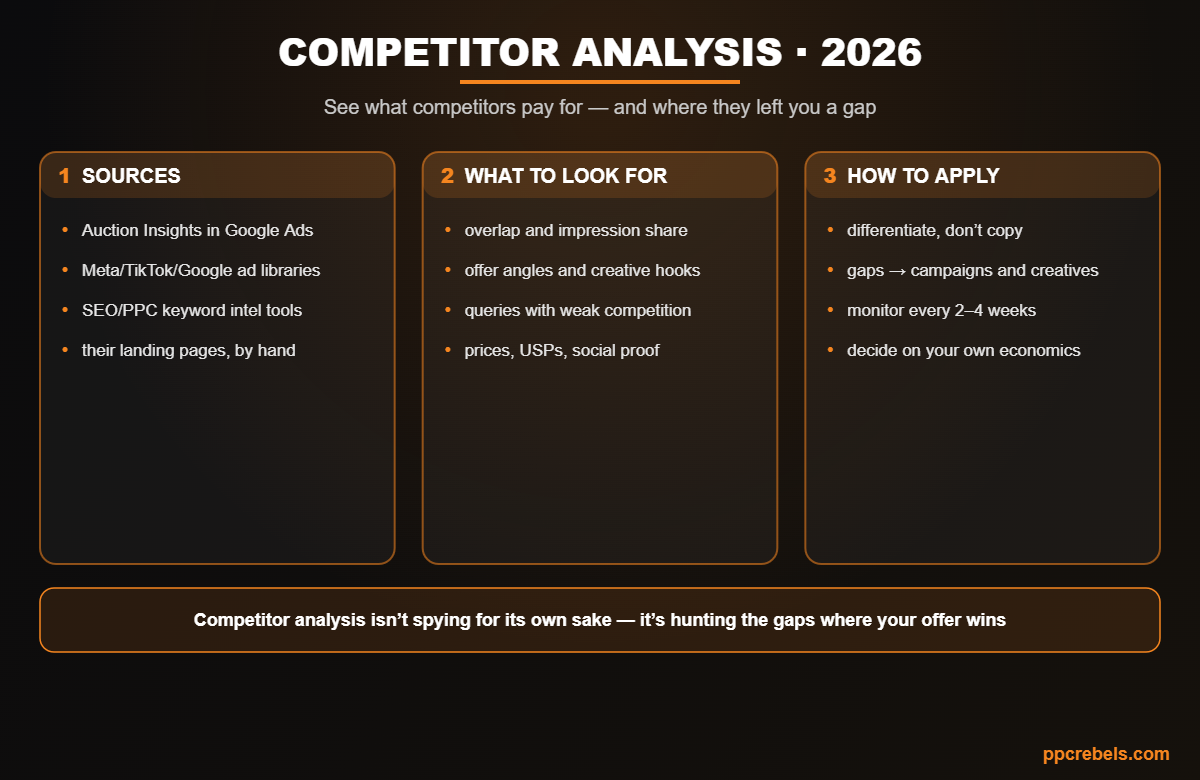
- Auction Insights in Google Ads: who you actually overlap with, whose share is growing, who sits above you. Your primary radar — per campaign and over time.
- Ad libraries: Meta Ad Library, Google’s transparency center, TikTok’s library — every active competitor creative: formats, hooks, landing pages. A long-running creative is almost certainly working.
- Keyword intel tools (Semrush, SimilarWeb and peers): which queries a competitor is visible on, rough budgets and trends. The numbers are estimates — direction matters more than precision.
- Hands and eyes: walk the competitor’s funnel as a customer — landing page, form, emails, callback speed. This yields more insight than any tool.
What to look for: questions beat data
- Overlap and momentum: who presses with impression share, on which campaigns, growing or fading.
- Offer angles: what do competitors hook with — price, speed, guarantee, status? Which angle is empty? An empty angle is your next creative.
- Keyword gaps: query clusters with real intent but weak competition — campaign candidates per the logic from match types.
- Landing pages: USPs, prices, social proof, speed — against the criteria from our landing page conversion guide. Where their page is weaker than yours, you win on Quality Score and CR.
How to apply it: differentiate, don’t copy
- Copying a creative is betting on someone else’s economics: their LTV, margin and goals differ. Copy the question (“why does this angle work for them?”), not the answer.
- Turn gaps into tests: an empty offer angle → a creative variant; a weak query cluster → a campaign; a weak competitor page → strengthen yours.
- Don’t enter bid wars blind: answering someone’s bid hike makes sense only inside your own unit economics. Sometimes the right move is shifting segments, not overpaying.
- The rhythm: monitor every 2–4 weeks — Auction Insights, fresh creatives, landing page changes. A one-off “competitor audit” goes stale in a month.
Common mistakes
- Blindly copying creatives and bids because “it works for them.”
- Bid wars on brand and generic queries with no regard for margin.
- Trusting tools’ exact numbers — they’re estimates, not the competitor’s books.
- A one-off analysis instead of ongoing monitoring.
- Watching only the ads and never walking the funnel by hand.
FAQ
With Auction Insights: the real list of who you overlap with in the auction. Then their creatives in the ad libraries, and a hands-on funnel walk.
Yes: ad libraries and auction statistics are official open tools the platforms built for transparency.
They’re models with wide error bars. Use them for direction and trends; make decisions on your own data and economics.
Do the math first: can your economics sustain a response? Often the smarter move is shifting focus — other query clusters, offer angles, channels — rather than paying for pride.
A light check every 2–4 weeks (Auction Insights + fresh creatives); a deep review quarterly or whenever impression share shifts noticeably.
Bottom line
PPC competitor analysis is the regular reading of open sources with the right questions: Auction Insights shows the “who,” ad libraries the “what,” keyword tools the “where,” and a hands-on funnel walk the “why.” Hunt gaps and differentiate instead of copying, answer bid moves only within your own economics — and competitors turn from a threat into a free idea source.