B2B PPC in 2026: Advertising When Five People and Three Months Decide the Deal
Carry the e-commerce playbook into B2B and you’ll drown: leads are scarce, a click on “manufacturing CRM” costs like dinner, and the “conversion” happens three months after the first touch, once five people sign off. B2B PPC runs on different physics: a long cycle, a buying committee, narrow demand. The rules are different too — and whoever knows them takes the leads competitors dismiss as “too expensive.”
The physics: why the e-commerce playbook breaks here
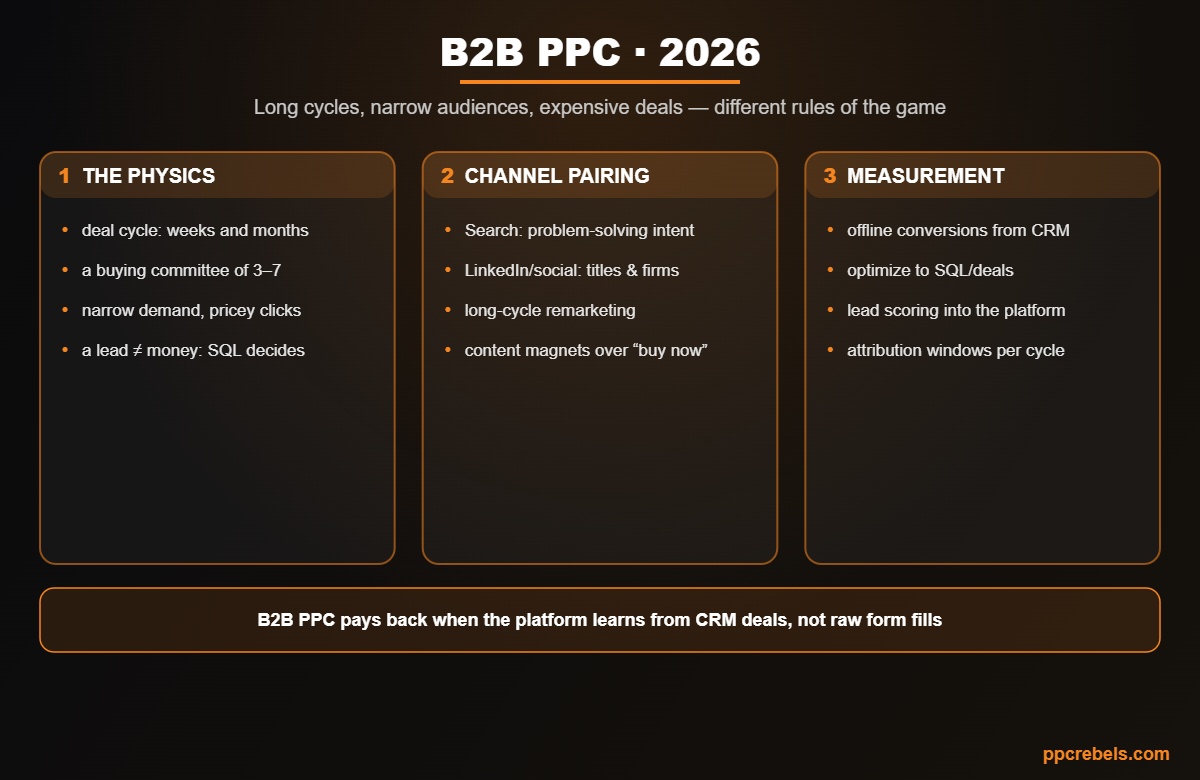
- Deal cycles run weeks to months: optimizing on “yesterday’s conversions” is blind; attribution windows and expectations stretch to match the cycle.
- A buying committee of 3–7: the champion, the user, finance, security. One click isn’t one person; content must serve different roles.
- Narrow demand: few queries and pricey clicks — but concentrated intent: behind “compare X vs Y for enterprise” sit real budgets.
- A lead ≠ money: a student and a director fill the same form. The economics only close at the SQL and deal level — do the math via unit economics with contract LTV.
Channel pairing: intent + role targeting
- Search catches the problem moment: “how to automate X,” “Y comparison,” “Z alternative.” Category and comparison queries often beat direct “buy” ones in value.
- LinkedIn and social target titles, industries and company size: expensive per click but precise on the committee; this is where content magnets live, not cold “book a demo.”
- Content magnets per stage: a benchmark/calculator, a guide, a webinar, a case study — value traded for contact; the form mechanics come from lead forms, with qualifying questions as a mandatory layer.
- Long-cycle remarketing: touches mapped to committee stages (case study → ROI calculator → demo) with 30–90 day windows and strict frequency — the rules from retargeting.
Measurement: the platform must learn from deals
- Offline conversions from the CRM are the heart of the B2B loop: qualification (MQL→SQL) and deals flow back into the platforms, and smart bidding optimizes on money instead of form fills.
- Lead scoring with values: an SQL is worth multiples of an MQL — pass weighted values and value-based bidding starts hunting directors, not students.
- Attribution for the long cycle: paths of dozens of touches are read in GA4 and the CRM; last-click is more meaningless in B2B than anywhere.
- Patience as a setting: judge campaigns by lead cohorts and their deal progression, not by a week of spend.
Common mistakes
- Optimizing to “lead” — and a funnel full of students and bots.
- “Book a demo” as the only offer for cold audiences.
- Killing campaigns after two weeks “because no sales” on a quarter-long cycle.
- No CRM → platform loop: the algorithm never learns what money looked like.
- One landing page and one message for the engineer, the CFO and the CEO.
FAQ
Yes — with optimization to SQL/deals via offline conversions, stage-mapped content magnets and windows stretched to the cycle. Only the “conversion today” e-commerce playbook breaks.
Search: formed intent and the shortest road to SQL. Add LinkedIn to expand onto the committee and segments that aren’t searching yet.
On intermediate money-like events: SQL, meeting booked, pilot — with values from scoring. Full deals upload later as offline conversions when they close.
None in isolation: B2B CPLs compare through SQL rates and cost per deal against contract LTV. An expensive lead with high deal progression usually beats cheap junk.
Yes: the engineer gets tech details and integrations, finance gets ROI and TCO, the executive gets risks and case studies. One message for everyone is the main cause of “expensive” B2B campaigns.
Bottom line
B2B PPC in 2026 plays by long-cycle rules: Search catches the problem moment, social reaches the committee, content magnets trade value for contact, and offline conversions from the CRM teach the platform to tell a deal from a form fill. Build that loop — and the “too expensive” B2B clicks become the account’s most profitable contracts.