GA4 Attribution for Media Buyers in 2026: Why Ad Platforms Lie and How to See Which Channel Actually Sells
Google Ads says “I brought 50 sales.” Meta says “so did I.” Your CRM shows 60 orders total. Familiar math? Every ad platform grades its own homework: it counts by its own rules and claims everything it touched. The only place where channels can be compared under one set of rules is independent analytics — and in 2026 its base layer is GA4 attribution.
Let’s break down how a media buyer squeezes the truth out of GA4: which attribution model runs there and why the numbers never match the ad platforms, what to configure so the data can be trusted, and how to read the reports so budget decisions follow the money — not each platform’s self-promotion.
How GA4 attribution works: data-driven by default
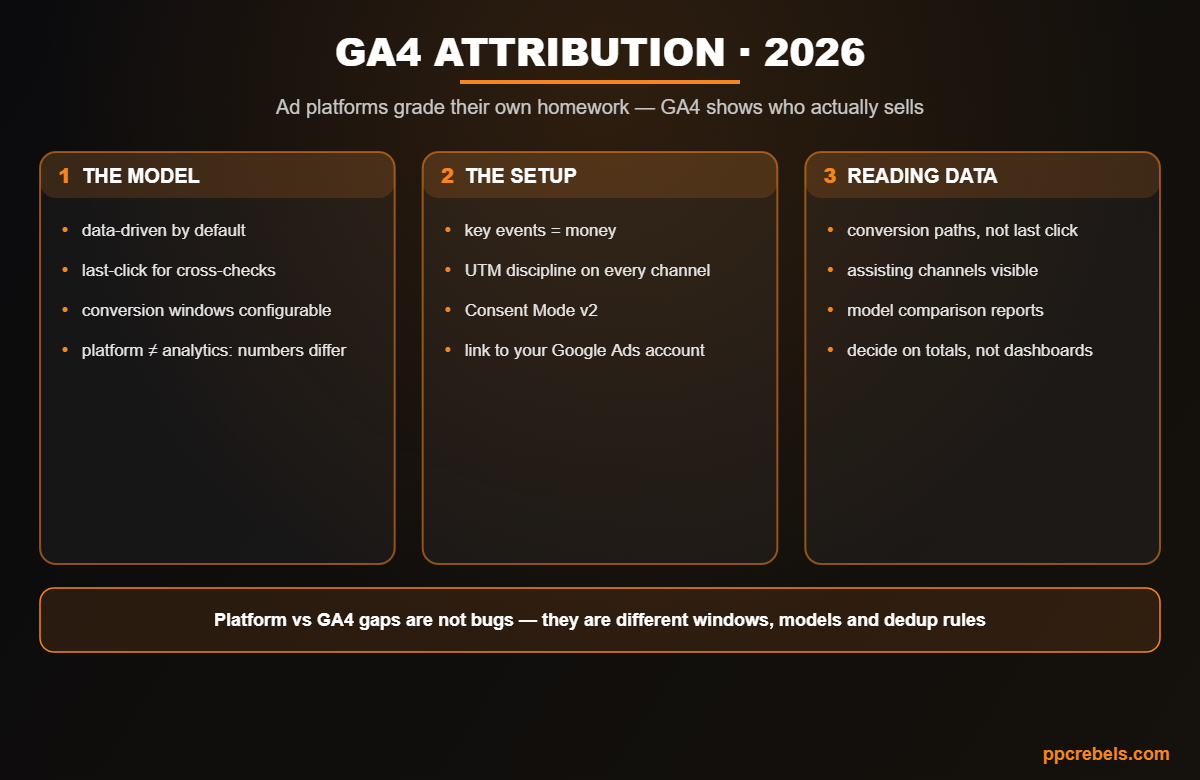
GA4’s primary model is data-driven attribution (DDA): credit for a conversion is distributed across the touchpoints of the path by a machine-learned model, instead of handing everything to the last click. Last-click remains as a reference model for cross-checks. The practical meaning: a channel that “warms up” demand (social, video) gets part of the credit in DDA — and stops looking useless the way it does in last-click.
The second key point is conversion windows: they’re configurable, and it’s precisely the window differences (plus platform view-through and different dedup rules) that explain why Google Ads, Meta, and GA4 show three different numbers for the same sale. That’s not “GA4 is broken” — those are different coordinate systems. The media buyer’s rule: platforms are for in-channel optimization, GA4 is for comparing channels against each other.
The setup without which GA4 attribution lies
- Key events = money. Mark purchases and paid leads as key events, not scrolls and button clicks. Junk key events turn every report into noise.
- UTM discipline. One tagging template across all channels (source/medium/campaign on a single scheme). Half of the “(direct)” and “unassigned” in your reports is just leaky UTMs. Google Ads autotagging (gclid) stays on and doesn’t conflict with manual tags.
- Consent Mode v2 and server-side capture. With consent requirements and restricted browser collection, GA4 models the gaps; a server-side layer makes the data more complete — we covered how in the tracking and analytics in arbitrage guide and the Meta Ads tracking breakdown.
- The Google Ads link. Conversion and audience import only works with linked accounts — and remember Google Ads applies its own attribution to those same events after import.
Reading the reports: paths, not the last click
- Conversion paths reveal channel roles: who opens the path (prospecting), who assists, who closes. A channel with an “ugly” last-click ROAS may be your main supplier of new paths.
- Model comparison (DDA vs last-click) is the fastest way to spot undervalued channels: if a channel earns noticeably more credit in DDA than in last-click, you’re underbuying it.
- Look at the total. The “where does budget go” decision is made on total account sales and acquisition cost per GA4/CRM — not on whichever dashboard painted the prettiest ROAS. Same incrementality principle as in retargeting.
- Feed it back into structure. GA4 conclusions should return to campaign architecture — what to scale and how, see the Google Ads account structure guide.
Common mistakes
- Comparing platform and GA4 numbers head-on and declaring one of them broken.
- Key events on micro-actions — reports about scrolls instead of money.
- Ragged UTMs and a mountain of “(direct)/(none)” nobody can act on.
- Cutting “warming” channels based on last-click — then wondering a month later why the “closers” got expensive.
- Ignoring modeling: under strict consent, part of the data is an estimate, and microscopic channel differences aren’t significant.
FAQ
Data-driven attribution: credit is distributed across path touchpoints by a machine-learned model. Last-click is available for reference and model comparison.
Different conversion windows, different models, platform view-through, and different dedup rules. That’s normal: platforms for in-channel optimization, GA4 for honest cross-channel comparison.
Actions with money attached: purchases, paid orders, qualified leads. Keep micro-actions (scrolls, button clicks) as regular events — otherwise attribution measures noise.
Yes: gclid covers Google Ads, while every other channel (Meta, TikTok, email, seeding) gets UTMs on one template. Without it, conversion paths crumble into “(direct)”.
GA4 is the shared coordinate system, but do the final check against CRM/real money and incrementality (what happens to total sales when budget shifts), not one report.
Bottom line
GA4 attribution isn’t “one more report” — it’s the coordinate system where channels can be compared honestly. The formula: key events = money, iron UTM discipline, Consent Mode and server-side capture, the data-driven model verified through model comparison — and decisions made on total sales rather than platform self-promotion. That’s when budget flows to where it actually works.