International Campaign Launch in 2026: Entering New Geos Without a Geography of Losses
“Let’s add five more countries to targeting” — that’s the most expensive way to go international. An international launch isn’t extra checkboxes; it’s opening a new business: different demand, a different auction, a different price of trust and different laws. Whoever pilots one geo and does the unit math scales; whoever “turns on the world” pays for the algorithm’s education across ten markets at once.
Picking the geo: data over intuition
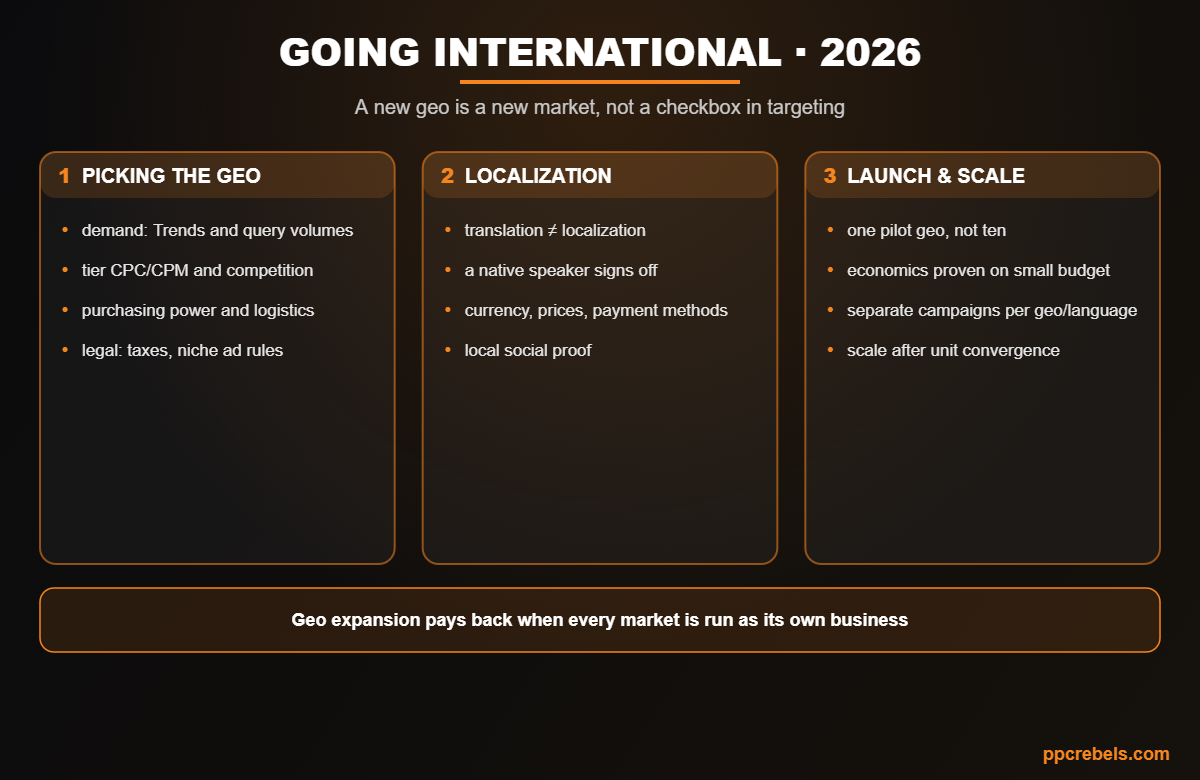
- Demand: Google Trends and the keyword planner on local search terms — does the market exist at all, and what’s its season.
- Tier economics: tier-1 CPC/CPMs run multiples above tier-2/3, but so do AOV and purchasing power. Run the “CPC × CR × AOV” estimate per candidate before the first budget dollar, per the unit economics math.
- Operations: delivery/logistics or the service’s local applicability, native-language support, time zones.
- Niche law: ad rules for your vertical differ by country (finance, health, subscriptions), plus privacy requirements — in the EU remarketing won’t fly without Consent Mode v2.
Localization: deeper than translation
- Translation ≠ localization: a native speaker spots machine copy in an ad from the first word — and trust dies with the CR. Final review of hooks and offers belongs to a native.
- Keywords rebuilt, not translated: local query phrasing often differs from the calque — harvest keywords from the local planner and suggestions.
- Money and payments: prices in local currency, familiar payment methods, local address and phone formats — every detail converts.
- Trust is local: reviews, cases and trust marks of that market; creatives with “foreign” faces and props lose to local ones even with the same offer. For offline, the local advertising layer applies inside the country.
Launch and scale: pilot → convergence → rollout
- One pilot market, chosen on data — not ten at once: budget and attention concentrate, conclusions become readable.
- Separate campaigns per geo/language: their own budget, a target from the local economics, their own creatives — blended “multi-geo” campaigns hide losing markets inside averages.
- Unit convergence on a small budget is the gate to scale: CPA/ROAS against the local target, not against your home market.
- Rollout by playbook: a successful pilot becomes a checklist (keywords → localization → launch → control) that opens each next market faster and cheaper.
Common mistakes
- “Turning on 20 countries” in one campaign with home-market creative.
- Machine-translated ads and landing pages with no native review.
- Prices in a foreign currency and unfamiliar payment methods.
- Judging a new geo by home-market metrics.
- Ignoring local niche rules — until the first account ban.
FAQ
The market where “demand × economics × operations” converges: often neighboring countries with a close language/culture, or a tier-2 with growing demand and moderate CPCs — not “straight to the US.”
Enough for decision-grade statistics: dozens of conversions per market. Less is fortune-telling; much more is overpaying for a conclusion visible earlier.
Sometimes, for narrow B2B/tech audiences. For mass demand the local language almost always beats English on CR and cost per conversion.
Separate per geo/language: own target, budget and creative. Blending is acceptable only for very similar markets with identical economics.
When the market’s unit economics converge on a small budget and hold for 2–4 weeks. Then budget growth replicates profit, not loss.
Bottom line
An international launch in 2026 is discipline: the geo chosen on demand and economics, localization deeper than translation (keywords, payments, trust — signed off by a native), a single-market pilot proving unit convergence, and only then a playbook rollout to the next countries. Every market is its own business; run it that way — and expansion becomes growth instead of a geography of losses.