
Profitable Campaign? How to Scale It Without Killing ROI
The campaign turned profitable – and your hand itches to double the budget right now. This is the exact moment more profitable campaigns die than from bans and fatigue combined. Scaling is not pour more; it is a controlled process with economics checks at every step. Here is how to grow without crashing ROI.
Why scale breaks the economics
When the budget jumps sharply, the algorithm leaves the cheap core of the audience: it has to buy pricier impressions, CPM rises, conversion quality dilutes. Add the learning-phase reset: a sharp budget change restarts optimization, and the campaign spends days learning again – on your money. Hence the core principle: scaling is a series of small steps, not one big leap.
Vertical scaling: the +20-30% rule
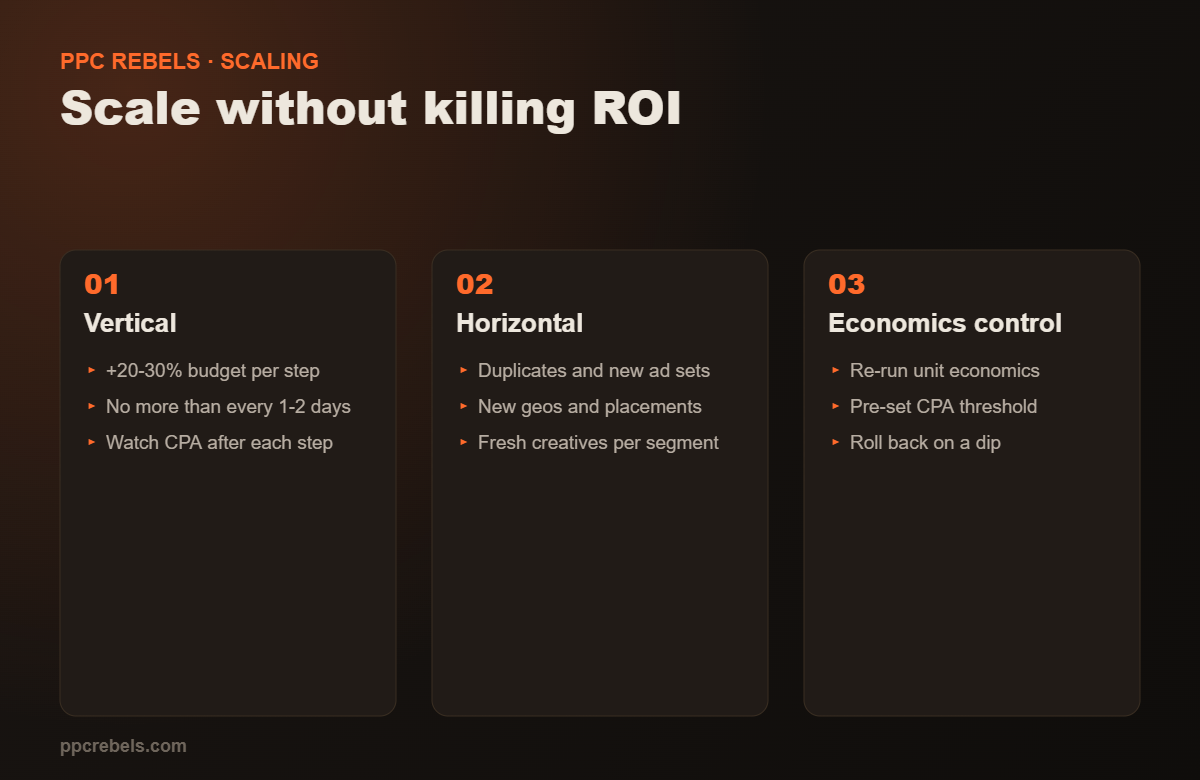
Raise the budget by 20-30% per step and no more often than every 1-2 days. That increment usually keeps the campaign inside its stable optimization phase. After each step, watch CPA and frequency for a day: economics holding – take the next step; drifting – roll back to the previous level and pause.
Horizontal scaling: duplicates, geos, placements
The second vector is not growing one ad set but multiplying the funnel: duplicates with different audiences, new geos, extra placements, fresh creative batches per segment. Horizontal scaling is slower but sturdier: one ad set dipping does not sink the whole system. Combine both vectors – vertical until the first saturation signs, then horizontal.
Economics control at every step
Before scaling, lock the CPA threshold at which the campaign stops being profitable – from unit economics and LTV, not from gut feel. Check every step against it. Two days below the threshold means roll back and diagnose: it is usually audience saturation or a pricier auction, both covered in the ROI crash triage.
When to stop
Every funnel has a ceiling: audience size, offer capacity, season. Ceiling signs – CPM growing faster than conversions, frequency creeping up, new duplicates failing to take off. That is not bad news: lock in the profit, prep the next funnel, and factor seasonality into budget planning.
FAQ
The benchmark is 20-30% per step, no more often than every 1-2 days. Sharp jumps restart the learning phase and break stable optimization.
Both, in sequence: vertical growth first until the early saturation signs, then horizontal duplicates onto new audiences and geos.
The algorithm left the cheap audience core, and a sharp budget change may have reset the learning phase. Step back one level and let the campaign stabilize.