Ad Creatives for Feeds in 2026: Stop the Scroll in 1.5 Seconds — Formats, Hooks and the Testing Conveyor
Targeting has become the same for everyone: Meta’s and TikTok’s algorithms find the buyer themselves. One variable remains where you actually compete — ad creatives. They decide 70% of feed results: whether your banner stops the thumb, lands the offer in a second and a half, and gives a reason to believe. Everything else — bids, audiences, placements — the algorithm levels out for you.
Let’s dissect the anatomy of a feed creative: what stops the scroll, which format fits which job (statics, carousel, UGC, short video), and how to put testing on a conveyor so winning combinations are found systematically, not by luck.
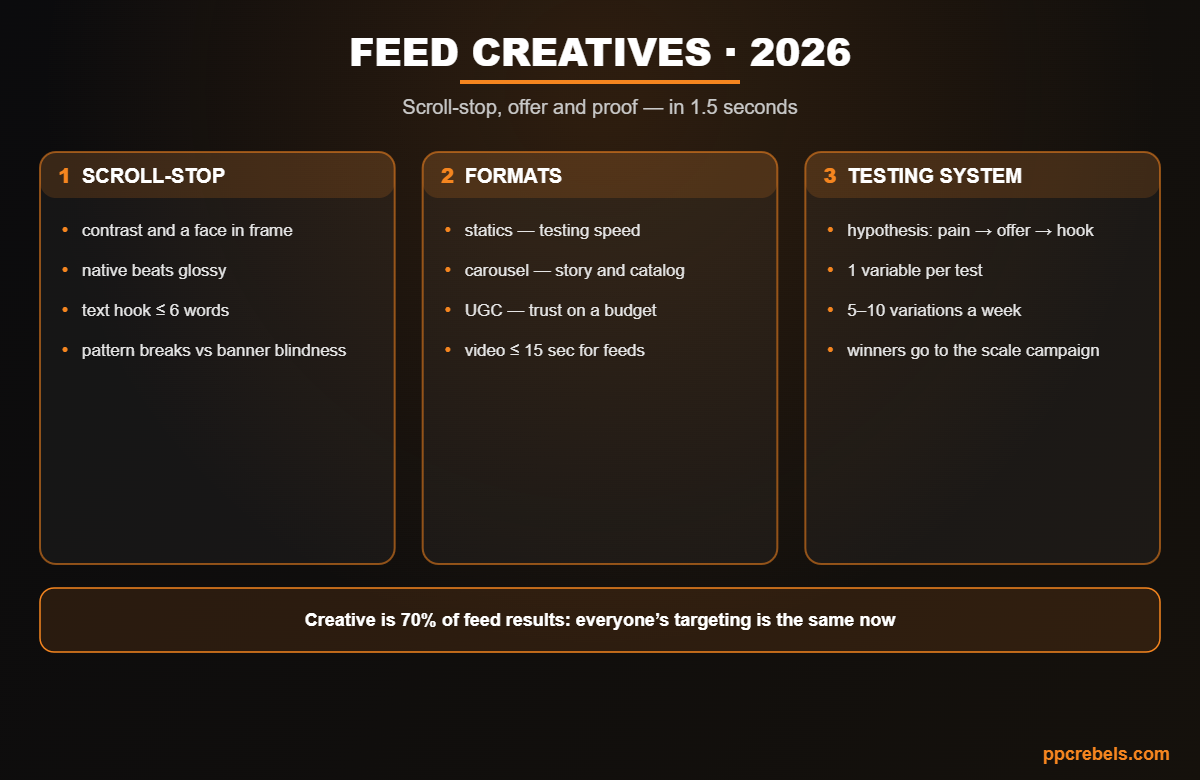
Scroll-stop: a second and a half for everything
- Contrast and a face. Eyes latch onto people, emotion, and color contrast against the feed. Glossy stock misses: a native “like a friend posted it” image consistently beats studio polish.
- A text hook of up to 6 words on the image itself: a pain, a number, a bold claim. Nobody reads walls of text on a banner.
- Pattern breaks: an odd angle, a “chat screenshot,” a handwritten style — anything that breaks the ad expectation cures banner blindness.
- The offer is visible without a click: what it is, who it’s for and why now — in the creative, not only on the landing page. The page then converts — per the rules in our landing page conversion guide.
Formats: which one for which job
- Statics — the king of testing speed: cheap, fast, easy to spin hook variations. Almost every offer test starts here.
- Carousel — a frame-by-frame story (“problem → solution → proof”) and the catalog format for e-commerce.
- UGC — a “person like you” with a phone in hand: maximum trust for minimal production. Works on Meta and TikTok alike — the vertical-feed mechanics are in our TikTok advertising guide.
- Short video ≤ 15 sec — motion in the feed is a stop factor by itself; the full performance loop for video is in the video ads article.
- Format combinatorics is then scaled by automation — how to feed assets to the algorithm is in the Meta Advantage+ guide.
The testing system: a conveyor instead of luck
- A hypothesis behind every creative: which pain, which offer, which hook. “Just a pretty banner” is not a hypothesis.
- One variable per test: the hook, the visual or the CTA — otherwise you won’t know what worked.
- The rhythm: 5–10 new variations a week per active combination; tired ones (rising CPA, CTR down two days straight) get replaced.
- Winners go to scale: a separate campaign/ad set with budget; the test zone lives apart and doesn’t disturb learning.
- A knowledge base: log which hooks and angles work per vertical — a winners library speeds up every next test.
Common mistakes
- One “perfect” banner per month instead of a variation conveyor.
- Glossy stock where the feed expects native.
- Testing five variables at once — and learning nothing.
- A hook in tiny type in the corner nobody sees.
- Judging creative by CTR without CPA: clickbait without money is still a leak.
FAQ
A working rhythm is 5–10 new variations a week per active combination. Sounds like a lot, but statics and UGC make variations fast: you change the hook and the first frame, not the whole production.
The hook and the offer angle — they produce the biggest deltas. Then the visual style (native/UGC/static), then the CTA and details.
Not mandatory, but it’s usually the best trust-for-budget trade. In many verticals an honest “person with a phone” beats studio production on CPA by multiples.
CPA rising versus your baseline plus CTR falling two days straight at the same reach. The fix is a fresh variation into the same combination, not rebuilding the campaign.
CPA/ROAS. CTR is an early scroll-stop indicator, but money has the final word: clickbait with expensive conversions is a pretty leak.
Bottom line
Ad creatives in 2026 are the main competitive field of the feeds: a scroll-stop in a second and a half, the offer right in the image, a format per job, and a conveyor of 5–10 weekly variations with one variable per test. Put that cycle on rails — and winning combinations show up on schedule, not on holidays.