Promo Peak Preparation in 2026: The 4-Week Black Friday Playbook — Offer, Warm-Up and Day X
On Black Friday the auction inflates by multiples, sites crash, warehouses empty — and half the advertisers launch a “−20% off” on Thursday evening and wonder about the results. A promo peak isn’t a sale day; it’s a four-week operation: the offer, a creative wave, audience warm-up, a site stress test and a plan for “after.” The peak’s money is allocated in advance — on the day itself you only execute the script.
T-minus 4 weeks: the foundation
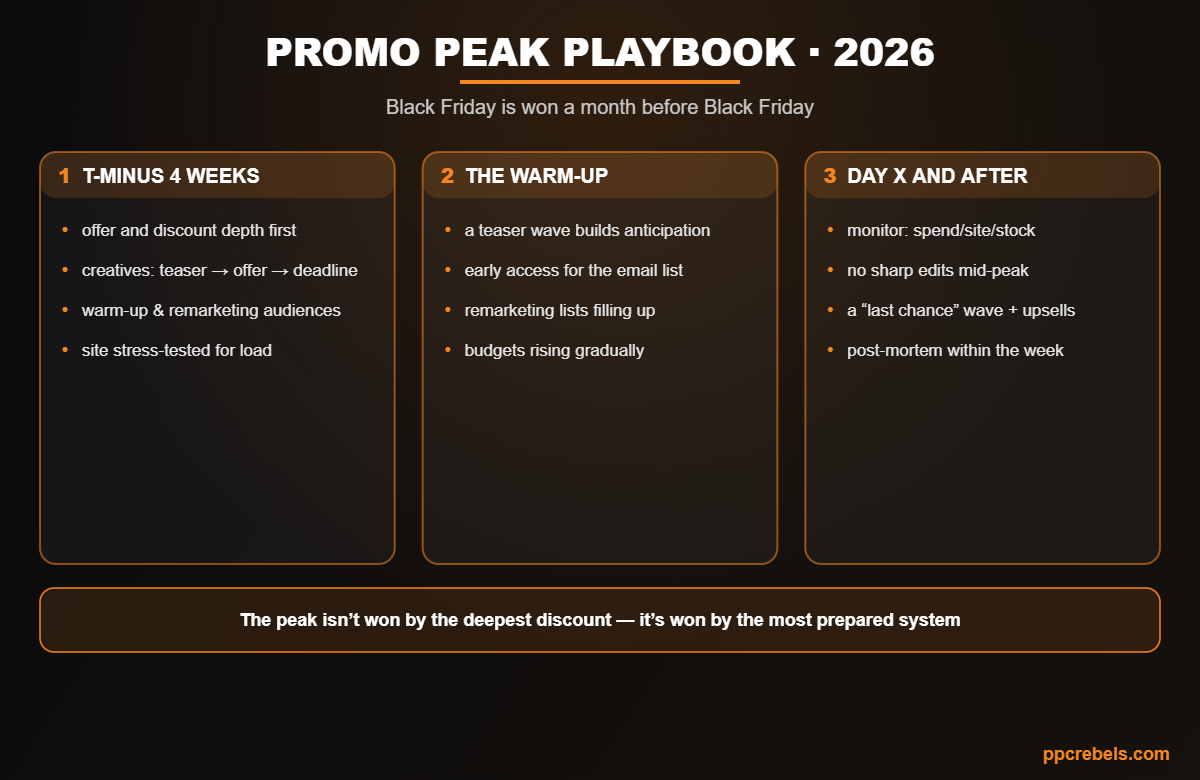
- The offer comes first: discount depth from margin (not “like everyone”), bundles and thresholds (“−X% over amount Y”) instead of blanket markdowns, flagship traffic drivers handled separately. No budget saves a weak offer.
- A staged creative wave: teaser (“coming”), offer (“it’s live”), deadline (“last day”) — three creative packs built in advance, not drawn overnight.
- The site under load: speed, a stress test, simplified checkout; a landing page down at the peak is the year’s most expensive minutes.
- Money on the calendar: budgets and the peak reserve are already mapped per the seasonal planning logic — here you just execute them.
The warm-up: 2 weeks out
- A teaser wave builds anticipation: reach formats fill the remarketing lists that will become the peak’s cheapest converting segment.
- Early access for the list: email subscribers get the offer a day early: auction-free sales and load off the peak day.
- Wishlists and carts: “save it for the sale” mechanics turn warm-up traffic into a queue of buyers.
- Budgets and targets rise gradually over 10–14 days; entering the peak with cold campaigns in learning is the classic way to overpay.
Day X and after: execution and the second harvest
- A day-of monitoring board: spend pace, CPA, site availability, stock on the drivers — checks every 1–2 hours, alerts armed.
- No sharp edits mid-peak: breaking campaign learning on the peak day means losing the day; touch only clear emergencies (stock-outs, site down, off-target leaks).
- The “after” wave: “last chance” for the hesitant, upsells to buyers, the peak’s abandoned carts — a third of the event’s revenue hides here.
- A post-mortem within the week: what worked across offers, creatives and segments — into the knowledge base for the next peak while the numbers are hot.
Common mistakes
- A “−20% on everything” offer invented three days out.
- One creative for the whole cycle instead of the teaser→offer→deadline wave.
- Empty remarketing lists at peak start.
- Sharp bid and budget edits in the middle of day X.
- Silence after the peak — and the upsell wave lost.
FAQ
At least 4 weeks out: offer and creatives in week one, warm-up in weeks three and four. A “three days before” launch leaves you nothing but auction overpayment.
From margin, not from competitors: the depth your economics sustains, plus mechanics (bundles, thresholds, gifts) that raise AOV instead of blanket markdowns.
That’s expected: the peak is carried by pre-warmed segments (remarketing, the list) whose CR offsets pricey reach. Cold traffic at the very peak is the most expensive kind.
Yes: auction-free sales, load off the peak day and list loyalty. It’s the event’s cheapest segment — wasting it is a sin.
By the whole event’s margin (including the “after” wave) against plan — not by day-X revenue. Plus list and remarketing-audience growth: that’s the next peak’s asset.
Bottom line
A promo peak is won before it starts: a margin-based offer and a creative wave a month out, list warm-up and early access two weeks out, execution discipline on day X and an upsell wave after. Turn Black Friday from a fire drill into a script — and the peak’s expensive auction works for you, not for your panicking competitors.