Keyword Match Types in 2026: Why Broad Match Stopped Being Evil (and Under Which Conditions)
Not long ago the rule was simple: “broad is evil, build exact lists.” In 2026 that rule is obsolete: Google matches queries by meaning, not letters, and keyword match types have swapped roles. Broad match paired with smart bidding became the reach workhorse, exact became the control tool, and thousand-keyword lists turned into museum pieces.
Let’s break down how match types work today, under which conditions broad match makes money (and under which it burns it), and what query discipline turns a “wide” campaign into a manageable one.
How keyword match types work in 2026
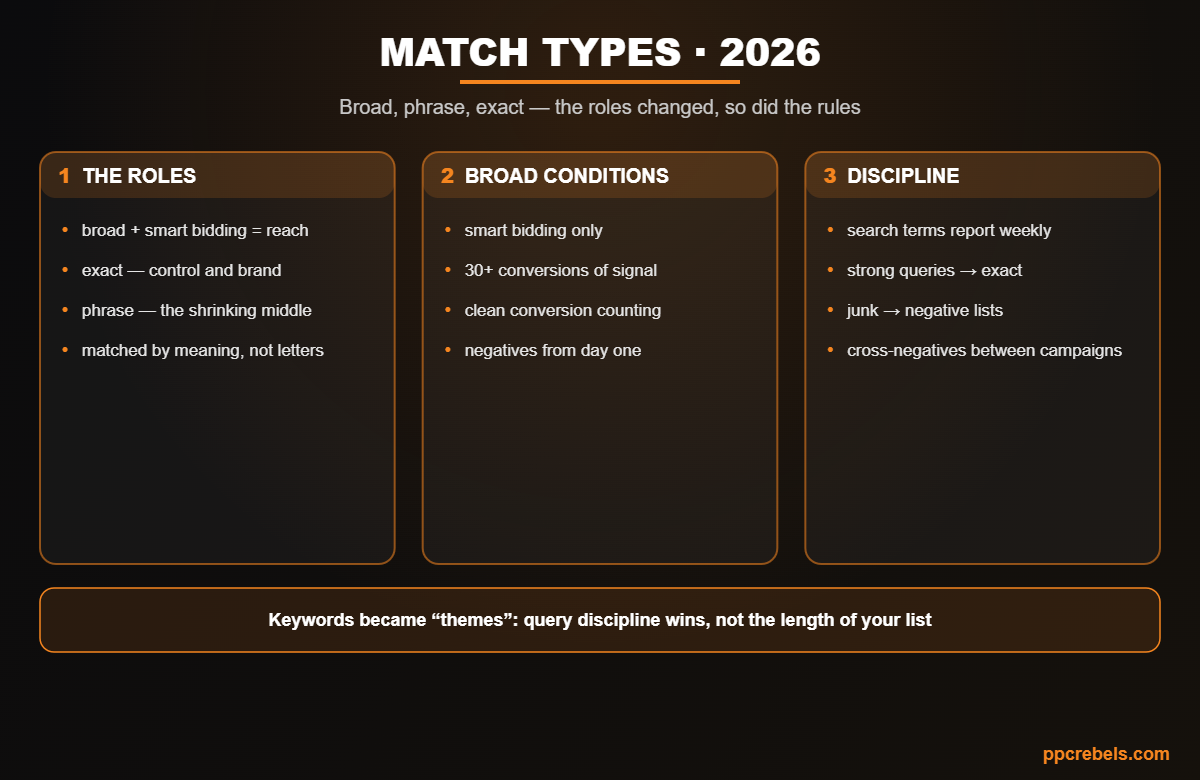
- Broad match — matching by query meaning with user signals factored in. With smart bidding it finds conversions where exact keywords can’t reach. Without smart bidding it’s just spend on irrelevant impressions.
- Exact match — maximum control: brand, your most expensive queries, cannibalization protection. “Exact” also became semantic (close variants), but stays the most predictable.
- Phrase match — the middle, squeezed ever tighter between broad and exact: useful as a transition format and for “meaning + word order matters” slices.
- Keyword walls are dead: the algorithm merges thousands of variations of one keyword by itself; what wins is “a few strong keywords + strong ads + data,” as covered in account structure at scale.
Broad match: the conditions under which it earns
- Smart bidding only (tCPA/tROAS): broad hands query selection to the algorithm, and a goal-driven bidder must steer it — which goal to give it is in the bidding strategies guide.
- Signal: 30+ conversions a month and clean counting (no duplicates or micro-goals) — otherwise semantic matching learns from noise.
- Negatives from day one: obviously junk themes, competitor brands (where not needed), informational no-intent queries.
- Brand separate on exact, and negated in broad campaigns and Performance Max — otherwise “wide” campaigns paint their ROAS on your own brand.
Query discipline: the weekly ritual
- Search terms report — weekly: junk to the negative list, strong converting queries promoted to exact with their own bid.
- Cross-negatives: exact campaigns protected from broad interception (and vice versa) so campaigns don’t bid against each other.
- Account-level negative lists: one shared “blacklist” of themes attached to all campaigns.
- A quarterly review as part of the account audit: query hygiene is the fastest money return there is.
Common mistakes
- Broad match on manual bids “as a test” — the test becomes a leak.
- Launching broad without a negatives foundation and brand exclusions.
- Thousands of duplicate exact keywords instead of consolidation.
- The search terms report “quarterly, if I remember.”
- Judging broad by the first three days — semantic matching needs data and time.
FAQ
No — under three conditions: smart bidding with a correct goal, 30+ conversions of clean signal, and negatives discipline. Remove any of them and broad reverts to its 2015 reputation.
Brand, your highest-value transactional queries, cannibalization protection, and anywhere you need predictable bid and copy control for a specific intent.
As a transition format — yes: when broad feels scary and exact is too narrow. But its zone keeps shrinking, and most 2026 setups live on the broad + exact pair.
Few: several strong keywords of one theme. Semantic matching covers the variations itself — data density and relevant ads matter more than list length.
Weekly on active campaigns: junk to negatives, converters to exact. It’s the cheapest efficiency gain in the account.
Bottom line
Keyword match types in 2026 are a division of roles: broad with smart bidding mines reach and new queries, exact holds control and brand, and a weekly discipline of search terms and negatives turns the “wide” campaign from roulette into a system. Fewer keywords, more data, stricter hygiene — and keywords work for you again.