Google Ads Bidding Strategies in 2026: tCPA, tROAS or Max Conversions — What to Pick and How Not to Break Learning
“What bid should I set?” is a 2018 question. In 2026 almost nobody sets bids by hand: smart bidding runs the auction, and the real question is different — which goal to give it, what data to feed it, and how not to break the learning. Google Ads bidding strategies are today’s main profitability lever: pick the wrong goal and the algorithm will optimize you into the red with perfect precision.
Let’s break down how tCPA differs from tROAS and when each strategy fits, how much data smart bidding needs, how to set the target from unit economics, and which edits break learning without you noticing.
Which Google Ads bidding strategies to pick in 2026
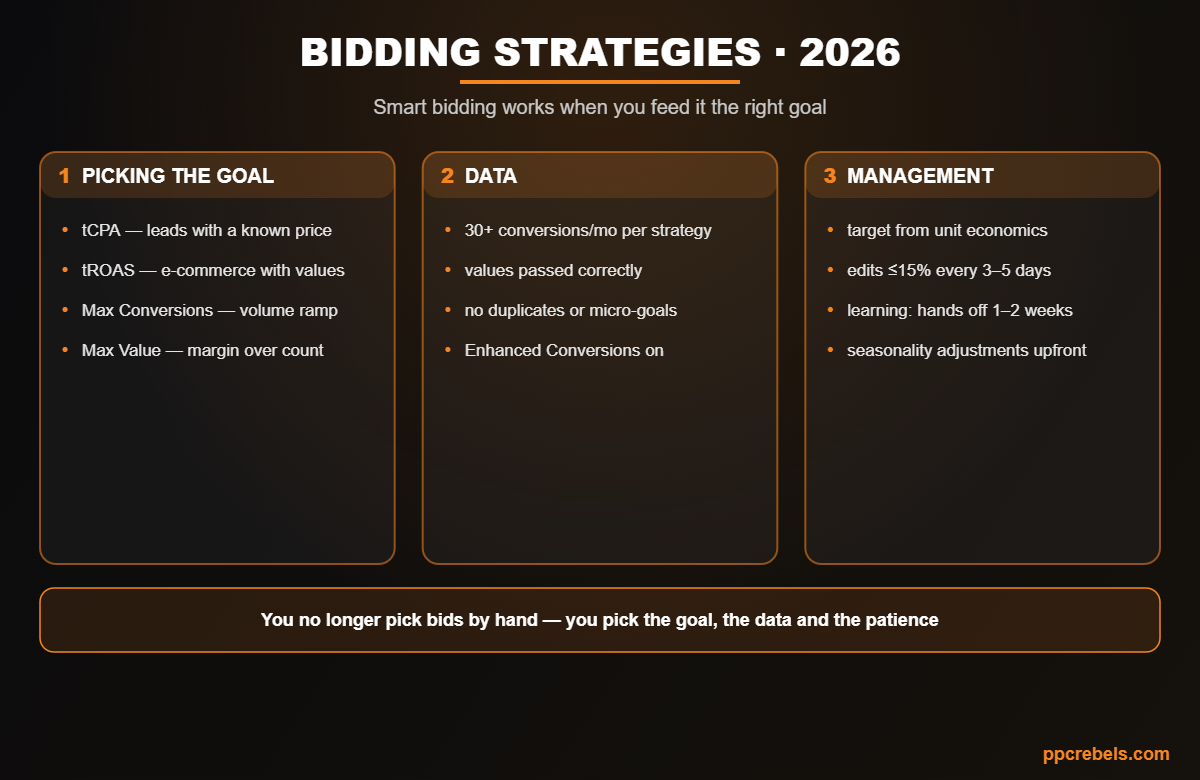
- Target CPA (tCPA) — lead gen with a known acceptable cost per lead. The algorithm holds average conversion cost near the target. The classic mistake is setting a wishful tCPA at half your historical CPA: the campaign simply loses impressions.
- Target ROAS (tROAS) — e-commerce and anything where conversions carry different values. Requires value passing; without it tROAS is blind. Works from historical ROAS, not from dreams.
- Maximize Conversions — volume ramp when cost targets are secondary: new campaigns, signal building, sales events. Keep a hand on the budget — it will spend whatever you give it.
- Maximize Conversion Value — maximum value within budget; the transition step toward tROAS while value data is thin.
- Manual bidding and eCPC — legacy in practice: still useful for micro-budgets and edge cases, but against a smart auction you’re playing blind by hand.
Data: without it, smart bidding is a random number generator
- Benchmark: 30+ conversions per month per strategy (50+ preferred for tROAS). Less means the algorithm learns from noise; the cure is consolidation — see account structure at scale.
- Conversions = money, no duplicates. Micro-goals in primary and double counting break any strategy — that’s layer one of the account audit.
- Enhanced Conversions and server-side tagging are mandatory basics: the fuller the signal, the sharper the bids. How to build it — in tracking and analytics in arbitrage.
- Conversion values for tROAS/Max Value: real margin, or at least weighted estimates by lead type.
Management: how not to break the learning
- Target from unit economics: tCPA = acceptable lead cost from margin and lead-to-sale rate; tROAS = the inverse of your acceptable ad-spend share.
- Smooth edits: change the target by no more than 10–15% every 3–5 days. A sharp jump = a new learning phase and a rollercoaster.
- Hands off for 1–2 weeks after launch or a strategy change. Judge by full weeks, not by yesterday.
- Seasonality adjustments are for short spikes (sales events), not a daily steering wheel.
- Portfolio strategies — when several campaigns share one economy: one target, one data pool. The same signal-density logic applies in Performance Max.
Common mistakes
- Wishful tCPA/tROAS instead of history — the campaign loses auctions and dies quietly.
- Switching strategies every three days “because it’s not working.”
- tROAS without passed values.
- Splitting budget across a dozen campaigns where none gets enough conversions.
- Judging by a single day instead of full weeks: smart bidding is wavy by weekday.
FAQ
tCPA when conversions are roughly equal in value (fixed-price lead gen). tROAS when values differ (e-commerce, tiered plans) and values are passed into the account.
A working benchmark: 30+ per month per strategy, 50+ for tROAS. With less, consolidate campaigns or start on Maximize Conversions to build signal.
In 10–15% steps every 3–5 days, anchored to your actual 30-day CPA/ROAS. Sharp edits restart learning.
That’s the learning phase: for 1–2 weeks the algorithm recalibrates, and swings are normal. Evaluate on full weeks after learning ends, not the first days.
In spots: micro-budgets, narrow special campaigns, hard control of individual queries. Otherwise smart bidding with a correct goal and data beats hands over the long run.
Bottom line
Google Ads bidding strategies in 2026 are not about picking a number — they’re about picking a goal: tCPA for equal-value leads, tROAS for varied value, Max Conversions/Value for ramps. Give the strategy 30+ conversions of clean signal, a target from unit economics, smooth edits and two quiet weeks — and the auction starts working for you, not for Google’s budget.