
Media Buying Unit Economics in 2026: Calculate Your Max CPA from LTV — and Stop Praying to ROAS
“Is a 300% ROAS good?” Nobody knows. At a 20% margin it’s a loss; at 60% it’s a gold mine. Until you’ve done the unit economics, every dashboard number is just a number: you don’t know your bid ceiling, how far you can scale, or which channel actually feeds the business. A media buyer who knows their max CPA bids with open eyes; everyone else prays to ROAS.
Let’s cover the base: how to compute margin, CAC and LTV without illusions, which thresholds make the economics healthy — and how to move those numbers into the dashboard via tCPA/tROAS and value-based bidding.
The base: margin, CAC, LTV — no self-deception
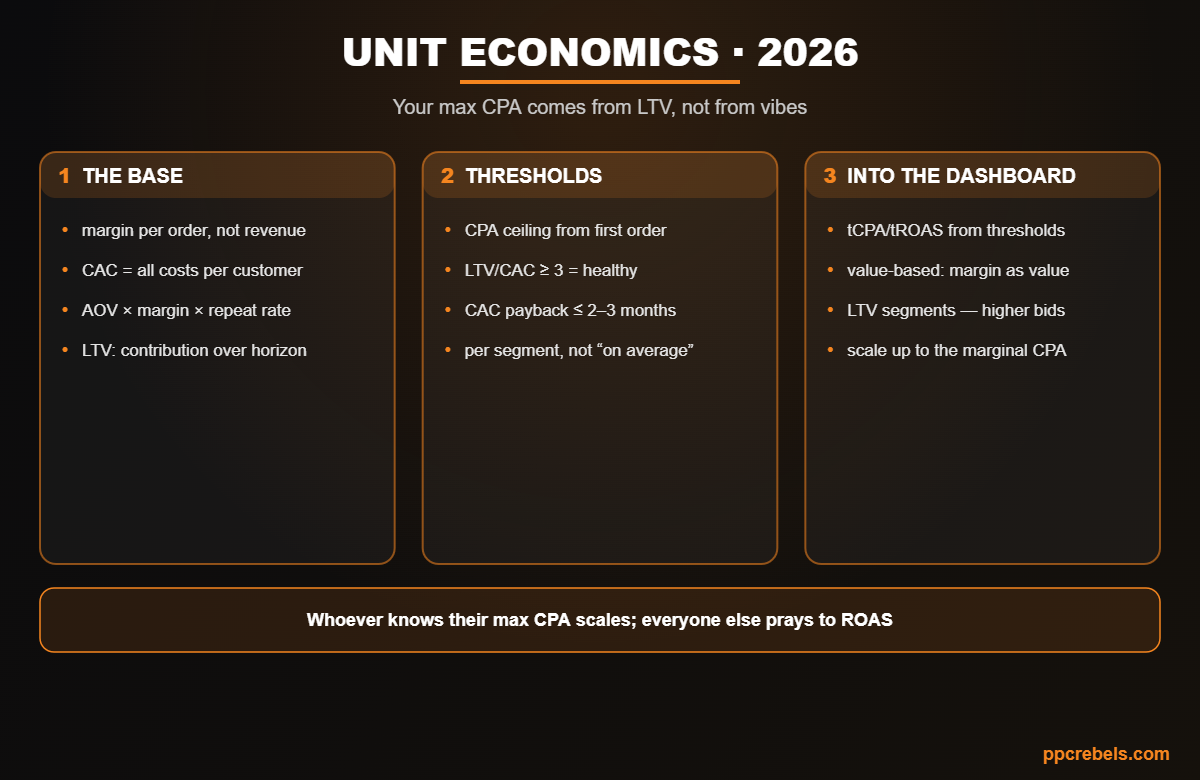
- Count margin, not revenue: from AOV subtract COGS, shipping, payment fees, returns. Ads live on margin — revenue ROAS masks losses.
- An honest CAC: all ad spend plus adjacent costs (tools, creative production, fees) divided by new customers — not by all orders.
- LTV by cohorts: a customer’s margin contribution over a horizon (3/6/12 months) including repeat purchases. A working formula: AOV × margin × average purchases per period.
- Per segment, not “on average”: channels and offers differ in AOV, repeat rate and returns — averaging hides both your best and your worst.
Thresholds: where the ceiling is and what “healthy” means
- The first-order CPA ceiling: first-order margin minus target profit. Anything above pays back only through repeat purchases — that’s an LTV bet, and it must be a conscious one.
- LTV/CAC ≥ 3 — the classic health benchmark: a customer brings three times what they cost.
- CAC payback ≤ 2–3 months for cash-cycle businesses: longer, and the cash gap eats your growth even with a pretty LTV.
- Repeat rate decides: retention and retargeting lift LTV — and with it, the bid you can afford on cold traffic.
Into the dashboard: economics → targets
- tCPA = your max CPA from the math above; tROAS = 1 / your acceptable ad-spend share of margin. Managing those targets is covered in the bidding strategies guide.
- Value-based bidding: pass margin (or a weighted value) instead of revenue — the algorithm starts hunting profitable customers, not cheap ones.
- LTV segments: audiences with high predicted repeat rates get a higher target and bid.
- Reconcile on money: plan/actual against CRM and cohorts, not the ad platform’s report — the coordinate system is in GA4 attribution. And remember: lifting landing page conversion cuts CAC without a single extra dollar.
Common mistakes
- Revenue ROAS on thin margins — a dashboard “plus,” a cash-register minus.
- CAC over all orders instead of new customers.
- LTV “from the gut” without cohorts or a horizon.
- An LTV bet without payback control — growth eaten by the cash gap.
- One target across segments with different margins and repeat rates.
Before you read on, run your own numbers in the interactive calculator: set CPM, CTR, conversion, approval and payout, and it instantly shows CPA, ROI, EPC and the break-even point.
FAQ
First-order margin minus target profit per order. If you’re willing to pay back through repeats, add the discounted LTV contribution — but watch the payback window.
Benchmark ≥ 3. Below 2 the economics are on the edge; far above 4–5 you may be underbuying traffic and growing slower than you could.
By cohorts over 3/6/12 months depending on the repurchase cycle. “Lifetime” LTV with no horizon is a pretty number with no operational meaning.
Raise AOV (bundles, upsells), landing page conversion and repeat rate — all three directly widen your max CPA. Or change the offer/vertical: you can’t out-bid broken economics.
Through conversion values (margin or a weighted per-segment estimate) and offline conversion / lead-quality uploads. Then value-based strategies optimize for profit, not volume.
Bottom line
Unit economics is media buying’s coordinate system: margin instead of revenue, an honest CAC, cohort LTV, thresholds of LTV/CAC ≥ 3 and payback ≤ 2–3 months — and those numbers moved into the dashboard via tCPA/tROAS and value-based bidding. Do the math once — and every decision about bids, scale and channels becomes arithmetic instead of guessing.